. 2010 Aug 19;466(7309):992-5.
doi: 10.1038/nature09295.

A mechanically stabilized receptor-ligand flex-bond important in the vasculature

Affiliations

A mechanically stabilized receptor-ligand flex-bond important in the vasculature

Jongseong Kim et al. Nature. .

Abstract

Haemostasis in the arteriolar circulation mediated by von Willebrand factor (VWF) binding to platelets is an example of an adhesive interaction that must withstand strong hydrodynamic forces acting on cells. VWF is a concatenated, multifunctional protein that has binding sites for platelets as well as subendothelial collagen. Binding of the A1 domain in VWF to the glycoprotein Ib alpha subunit (GPIbalpha) on the surface of platelets mediates crosslinking of platelets to one another and the formation of a platelet plug for arterioles. The importance of VWF is illustrated by its mutation in von Willebrand disease, a bleeding diathesis. Here, we describe a novel mechanochemical specialization of the A1-GPIbalpha bond for force-resistance. We have developed a method that enables, for the first time, repeated measurements of the binding and unbinding of a receptor and ligand in a single molecule (ReaLiSM). We demonstrate two states of the receptor-ligand bond, that is, a flex-bond. One state is seen at low force; a second state begins to engage at 10 pN with a approximately 20-fold longer lifetime and greater force resistance. The lifetimes of the two states, how force exponentiates lifetime, and the kinetics of switching between the two states are all measured. For the first time, single-molecule measurements on this system are in agreement with bulk phase measurements. The results have important implications not only for how platelets bound to VWF are able to resist force to plug arterioles, but also how increased flow activates platelet plug formation.


Figures
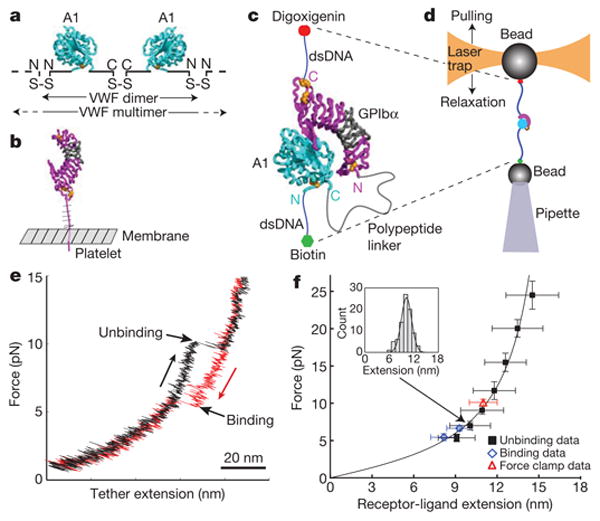
Figure 1
Figure 1. The A1 and GP1bα single-molecule construct and change in extension on unbinding and rebinding
a–d, Schematic diagrams of VWF (a), GPIbα (b), the ReaLiSM (c), and the laser tweezers setup (d). Ribbon diagrams based on the A1 domain-GP1bα LRR domain complex show disulphide side chains as gold spheres. The LRR domain of GP1bα is magenta except LRR repeats 2–4 are grey. The mucin-like region between the LRR domain and membrane in GP1bα, and the non-A1 portion of the VWF monomer which comprises 90% of its mass, are shown schematically. e, Representative force-extension trace for one cycle of force increase (black) and decrease (red) in force-ramp experiments. f, Fit of receptor–ligand extension (unbinding) data to the WLC model. Data were binned by force; one representative bin is shown in the inset. Error bars show 1 s.d. for force and extension in each bin (n per bin = 10 to 85 for unbinding, 26 to 30 for rebinding, and 428 for force clamp). Fit to the WLC equation was by occurrence-weighted least squares. Data from receptor–ligand binding and force-clamp experiments were not included in fitting, but fall on the same line.
Figure 2
Figure 2. Force spectroscopy and bond lifetime
a–f, Unbinding force distributions at different pulling rates in absence (ad) or presence of 0.5 mg ml−1 ristocetin (e) or 0.1 μg ml−1 botrocetin (f). Error bars show Poisson noise. Loading rate averages and s.d. are over rupture events at each pulling rate. Curves show the predicted rupture force distributions using the constants from panels g and h. g, h, Bond lifetimes at constant force, estimated from each bin in af, using the Dudko–Hummer–Szabo equation. g, Lifetimes from pulling at 5 nm s−1 (open circles), 10 nm s−1 (open squares), 20 nm s−1 (open triangles) and 40 nm s−1 (open diamonds), and 40 nm s−1 with a 26-residue linker (filled diamonds, Supplementary Fig. 4). The grey filled circle shows the lifetime in bulk phase measurements. The inset shows additional bond lifetime measurements (filled circles) at constant force (Fig. 3). h, Lifetimes in presence of ristocetin and botrocetin. Errors are Poisson noise. For panels c–e, equation (1) was evaluated separately for bins 1–4 (pathway 1) and bins 4–7/8 (pathway 2). Events in bin 4 were apportioned between pathway 1 and 2 according to the fits. Fits to the Bell equation, shown in panels g and h, were by occurrence-weighted least squares (dashed and solid lines).
Figure 3
Figure 3. Force-clamp experiments
a–d, Extension over representative 60 s periods at the indicated clamped forces (average ± s.d., n > 105). ΔX is the average extension between the bound (B) and unbound (U) states. eh, Survival fraction of the bound state as a function of force and time in a–d over periods of 200 to 400s (n = 55 to 172).
Figure 4
Figure 4. The flex-bond
Schematic model of different states of the A1–GP1bα flex-bond, showing direction of tensile force (horizontal arrows) and estimated constants.

References

    1. Sadler JE. New concepts in von Willebrand disease. Annu Rev Med. 2005;56:173–191. - PubMed
    1. Ruggeri ZM, Mendolicchio GL. Adhesion mechanisms in platelet function. Circ Res. 2007;100:1673–1685. - PubMed
    1. Ruggeri ZM, Orje JN, Habermann R, Federici AB, Reininger AJ. Activation-independent platelet adhesion and aggregation under elevated shear stress. Blood. 2006;108:1903–1910. - PMC - PubMed
    1. Nesbitt WS, et al. A shear gradient-dependent platelet aggregation mechanism drives thrombus formation. Nature Med. 2009;15:665–673. - PubMed
    1. Huizinga EG, et al. Structures of glycoprotein Iba and its complex with von Willebrand factor A1 domain. Science. 2002;297:1176–1179. - PubMed

Publication types

MeSH terms
