


Validity of activity-based devices to estimate sleep
- PMID: 20726281
- PMCID: PMC2919663
Validity of activity-based devices to estimate sleep
Abstract
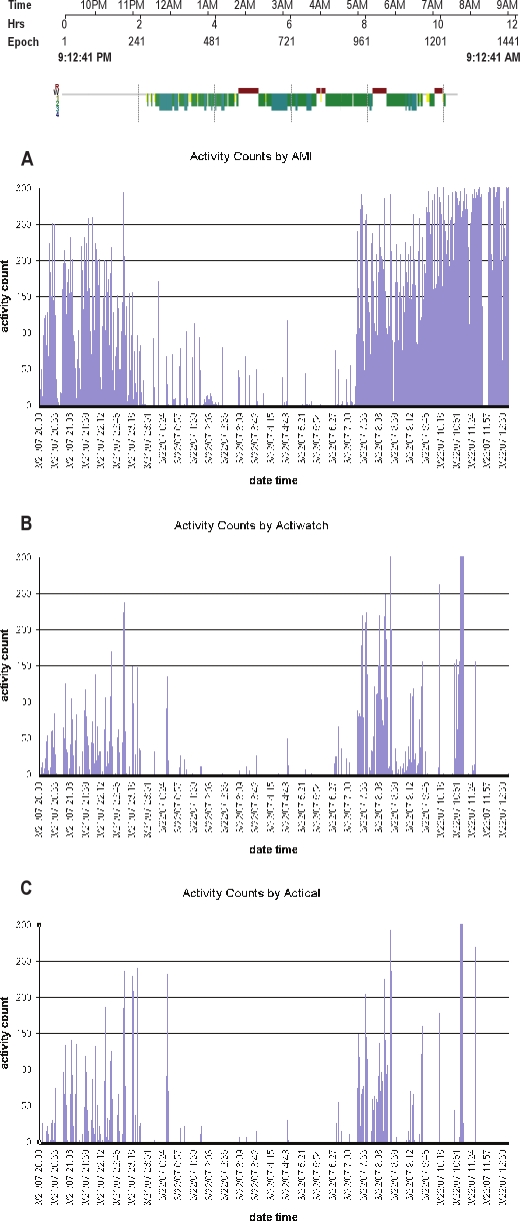
Study objectives: The aim of this study was to examine the feasibility of sleep estimation using a device designed and marketed to measure core physical activity.
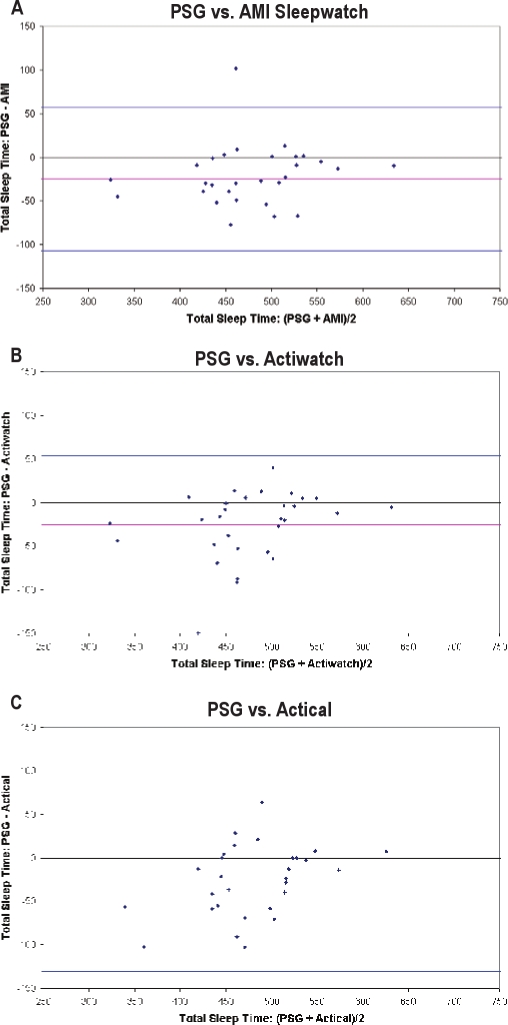
Methods: Thirty adolescent participants in an epidemiological research study wore 3 actigraphy devices on the wrist over a single night concurrent with polysomnography (PSG). Devices used include Actical actigraph, designed and marketed for placement around the trunk to measure physical activity, in addition to 2 standard actigraphy devices used to assess sleep-wake states: Sleepwatch actigraph and Actiwatch actigraph. Sleep-wake behaviors, including total sleep time (TST) and sleep efficiency (SE), were estimated from each wrist-device and PSG. Agreements between each device were calculated using Pearson product movement correlation and Bland-Altman plots.
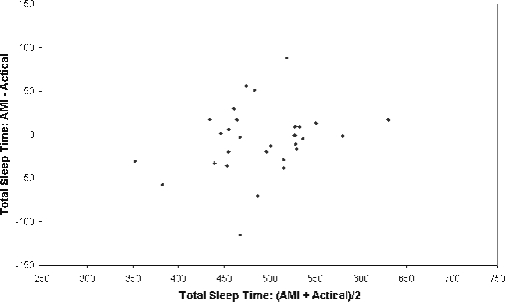
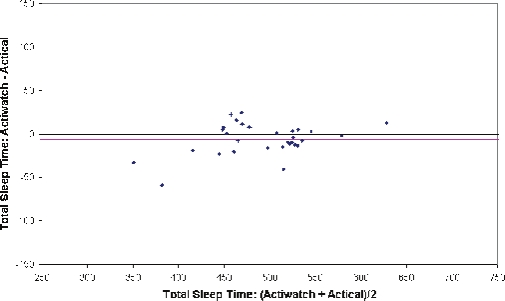
Results: Statistical analyses of TST revealed strong correlations between each wrist device and PSG (r = 0.822, 0.836, and 0.722 for Sleepwatch, Actiwatch, and Actical, respectively). TST measured using the Actical correlated strongly with Sleepwatch (r = 0.796), and even stronger still with Actiwatch (r = 0.955). In analyses of SE, Actical correlated strongly with Actiwatch (r = 0.820; p < 0.0001), but not with Sleepwatch (0.405; p = 0.0266). SE determined by PSG correlated somewhat strongly with SE estimated from the Sleepwatch and Actiwatch (r = 0.619 and 0.651, respectively), but only weakly with SE estimated from the Actical (r = 0.348; p = 0.0598).
Conclusions: The results from this study suggest that a device designed for assessment of physical activity and truncal placement can be used to measure sleep duration as reliably as devices designed for wrist use and sleep wake inference.
Figures
References
-
- Erlichman J, Kerbey AL, James PT. Physical activity and its impact on health outcomes; Paper 2:Prevention of unhealthy weight gain and obesity by physical activity: an analysis of the evidence. Obes Rev. 2002;3:273–87. - PubMed
-
- Wareham NJ, Wong MY, Day NE. Glucose intolerance and physical inactivity: the relative importance of low habitual energy expenditure and cardiorespiratory fitness. Am J Epidemiol. 2000;152:132–9. - PubMed
-
- Marschollek M, Goevercin M, Wolf KH, et al. A performance comparison of accelerometry-based step detection algorithms on a large, non-laboratory sample of healthy and mobility-impaired persons. Conf Proc IEEE Eng Med Biol Soc. 2008:1319–22. - PubMed
-
- Bassett DR, Ainsworth BE, Swartz AM, Strath SJ, O'Brian WL, King GA. Validity of four motion sensors in measuring moderate intensity physical activity. Med Sci Sports Exerc. 2000;32:S471–80. - PubMed
-
- Bassett DR. Validity and reliability issues in objective monitoring of physical activity. Res Q Exerc Sport. 2000;71:30–6. - PubMed
Publication types
MeSH terms
Grants and funding
- AG05407/AG/NIA NIH HHS/United States
- AR35582/AR/NIAMS NIH HHS/United States
- AG05394/AG/NIA NIH HHS/United States
- UL1-RR024989/RR/NCRR NIH HHS/United States
- U54 CA116867/CA/NCI NIH HHS/United States
- AR35583/AR/NIAMS NIH HHS/United States
- R01 AR035582/AR/NIAMS NIH HHS/United States
- R01 AG008415/AG/NIA NIH HHS/United States
- UL1 RR024989/RR/NCRR NIH HHS/United States
- 1U54CA116867/CA/NCI NIH HHS/United States
- R01 AR035583/AR/NIAMS NIH HHS/United States
- HL60957/HL/NHLBI NIH HHS/United States
- R01 AR035584/AR/NIAMS NIH HHS/United States
- HL07567/HL/NHLBI NIH HHS/United States
- R01 AG005407/AG/NIA NIH HHS/United States
- T32 HL007567/HL/NHLBI NIH HHS/United States
- AG08415/AG/NIA NIH HHS/United States
- R01 AG005394/AG/NIA NIH HHS/United States
- AR35584/AR/NIAMS NIH HHS/United States
- U54CA116867/CA/NCI NIH HHS/United States
LinkOut - more resources
Full Text Sources
Other Literature Sources
Medical