


Biology and augmentation of tendon-bone insertion repair
- PMID: 20727196
- PMCID: PMC2931497
- DOI: 10.1186/1749-799X-5-59
Biology and augmentation of tendon-bone insertion repair
Abstract
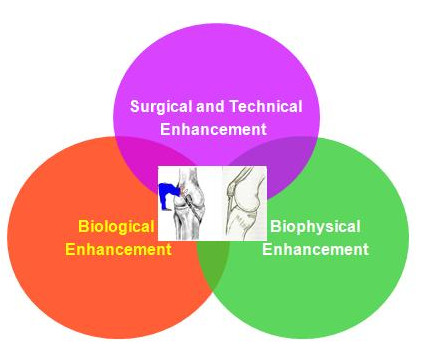
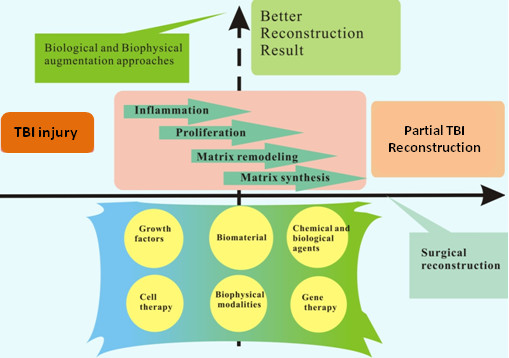
Surgical reattachment of tendon and bone such as in rotator cuff repair, patellar-patella tendon repair and anterior cruciate ligament (ACL) reconstruction often fails due to the failure of regeneration of the specialized tissue ("enthesis") which connects tendon to bone. Tendon-to-bone healing taking place between inhomogenous tissues is a slow process compared to healing within homogenous tissue, such as tendon to tendon or bone to bone healing. Therefore special attention must be paid to augment tendon to bone insertion (TBI) healing. Apart from surgical fixation, biological and biophysical interventions have been studied aiming at regeneration of TBI healing complex, especially the regeneration of interpositioned fibrocartilage and new bone at the healing junction. This paper described the biology and the factors influencing TBI healing using patella-patellar tendon (PPT) healing and tendon graft to bone tunnel healing in ACL reconstruction as examples. Recent development in the improvement of TBI healing and directions for future studies were also reviewed and discussed.
Figures
References
-
- Jones RM. Mechanics of composite materials. 2. Philadelphia: Taylor & Francis, Inc; 1999.
-
- Williams ML. Stress singularities resulting from various boundary conditions in angular corners of plates in extension. J Applied Mechanics. 1952;19:526–528.
-
- Moffat KL, Sun WH, Pena PE, Chahine NO, Doty SB, Ateshian GA, Hung CT, Lu HH. Characterization of the structure-function relationship at the ligament-to-bone interface. Proceedings of the National Academy of Sciences of the United States of America. 2008;105:7947–7952. doi: 10.1073/pnas.0712150105. - DOI - PMC - PubMed
LinkOut - more resources
Full Text Sources
Other Literature Sources
