


Regional differences in estradiol effects on numbers of HSD2-containing neurons in the nucleus of the solitary tract of rats
- PMID: 20728435
- PMCID: PMC2949458
- DOI: 10.1016/j.brainres.2010.08.037
Regional differences in estradiol effects on numbers of HSD2-containing neurons in the nucleus of the solitary tract of rats
Abstract
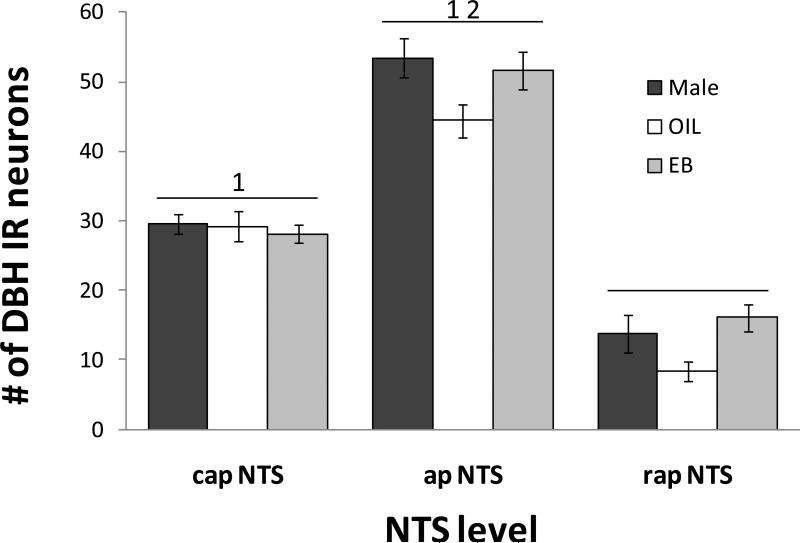
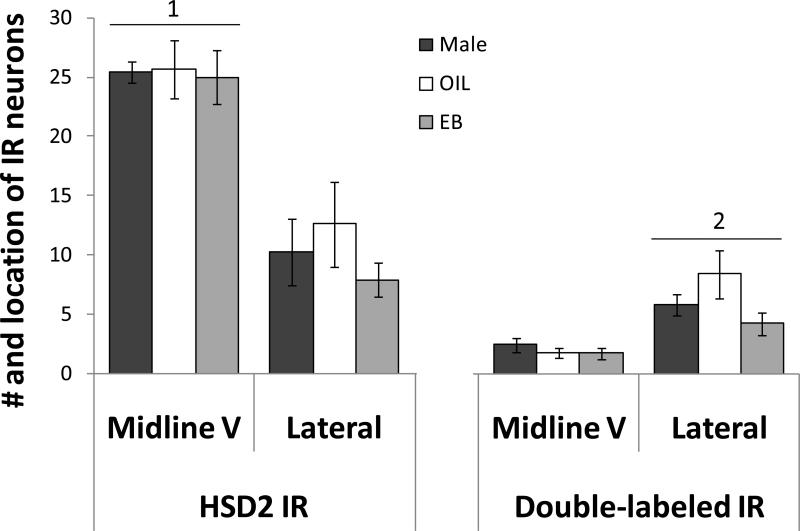
Estrogens affect body fluid balance, including sodium ingestion. Recent findings of a population of neurons in the hindbrain nucleus of the solitary tract (NTS) of rats that are activated during sodium need suggest a possible central substrate for this effect of estrogens. We used immunohistochemistry to label neurons in the NTS that express 11-β-hydroxysteroid dehydrogenase type 2 (HSD2), an enzyme that promotes aldosterone binding, in male rats, and in ovariectomized (OVX) rats given estradiol benzoate (EB) or oil vehicle (OIL). During baseline conditions, the number of HSD2 immunoreactive neurons in the NTS immediately rostral to the area postrema was greater in EB-treated OVX rats compared to those in OIL-treated OVX and male rats. A small number of HSD2 immunoreactive neurons was also labeled for dopamine-β-hydroxylase (DBH), an enzyme involved in norepinephrine biosynthesis. Double-labeled neurons in the NTS were located primarily in the more lateral portion of the HSD2 population, at the level of the area postrema in all three groups, with no sex or estrogen-mediated differences in the number of double-labeled neurons. These results suggest that two subpopulations of HSD2 neurons are present in the NTS. One subpopulation, which does not colocalize with DBH and is increased during conditions of elevated estradiol, may contribute to the effects of estrogens on sodium ingestion. The role of the other, smaller subpopulation, which colocalizes with DBH and is not affected by estradiol, remains to be determined, but one possibility is that these latter neurons are part of a larger network of catecholaminergic input to neuroendocrine neurons in the hypothalamus.
Copyright © 2010 Elsevier B.V. All rights reserved.
Figures



References
-
- Blackburn RE, Samson WK, Fulton RJ, Stricker EM, Verbalis JG. Central oxytocin and ANP receptors mediate osmotic inhibition of salt appetite in rats. Am. J. Physiol. 1995;269:R245–251. - PubMed
-
- Bossmar T, Forsling M, Akerlund M. Circulating oxytocin and vasopressin is influenced by ovarian steroid replacement in women. Acta Obstet. Gynecol. Scand. 1995;74:544–548. - PubMed
-
- Buller KM, Khanna S, Sibbald JR, Day TA. Central noradrenergic neurons signal via ATP to elicit vasopressin responses to haemorrhage. Neuroscience. 1996;73:637–642. - PubMed
-
- Chow SY, Sakai RR, Witcher JA, Adler NT, Epstein AN. Sex and sodium intake in the rat. Behav. Neurosci. 1992;106:172–180. - PubMed
Publication types
MeSH terms
Substances
Grants and funding
LinkOut - more resources
Full Text Sources
Miscellaneous
