. 2011 Jan 15;54(2):1735-42.
doi: 10.1016/j.neuroimage.2010.08.026. Epub 2010 Aug 20.

Impairment of prosocial sentiments is associated with frontopolar and septal damage in frontotemporal dementia

Affiliations

Impairment of prosocial sentiments is associated with frontopolar and septal damage in frontotemporal dementia

Jorge Moll et al. Neuroimage. .

Abstract

Poets and philosophers have long acknowledged moral sentiments as key motivators of human social behavior. Prosocial sentiments, which include guilt, pity and embarrassment, enable us to care about others and to be concerned about our mistakes. Functional imaging studies have implicated frontopolar, ventromedial frontal and basal forebrain regions in the experience of prosocial sentiments. Patients with lesions of the frontopolar and ventromedial frontal areas were observed to behave inappropriately and less prosocially, which could be attributed to a generalized emotional blunting. Direct experimental evidence for brain regions distinctively associated with moral sentiment impairments is lacking, however. We investigated this issue in patients with the behavioral variant of frontotemporal dementia, a disorder in which early and selective impairments of social conduct are consistently observed. Using a novel moral sentiment task, we show that the degree of impairment of prosocial sentiments is associated with the degree of damage to frontopolar cortex and septal area, as assessed with 18-Fluoro-Deoxy-Glucose-Positron Emission Tomography, an established measure of neurodegenerative damage. This effect was dissociable from impairment of other-critical feelings (anger and disgust), which was in turn associated with dorsomedial prefrontal and amygdala dysfunction. Our findings suggest a critical role of the frontopolar cortex and septal region in enabling prosocial sentiments, a fundamental component of moral conscience.


Figures

Figure 1
Figure 1
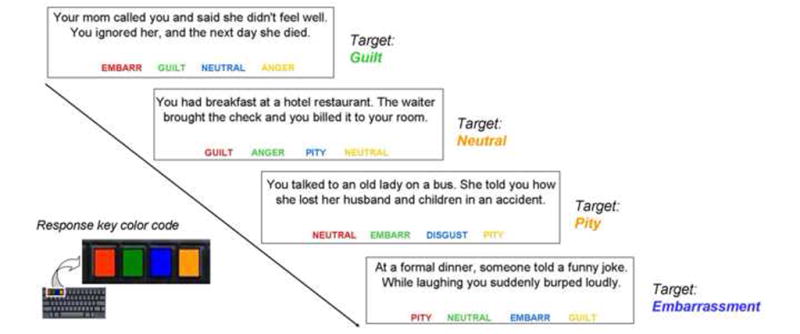
Moral sentiment task design. Participants viewed 98 social scenarios on the screen, together with response options: the target (correct choice, based on normative data) and three non-targets (“distracters”). They were told to report what they would feel in each given situation. A fixed color coding of keyboard keys and response options helped to minimize task-related visuomotor load. The position of the target word option was randomized across trials. The neutral option (with equal frequency as the other options) was present in all trials. Any given word could be the target on each trial with equal probability. The scenario examples do not include samples from all experimental conditions.
Figure 2
Figure 2
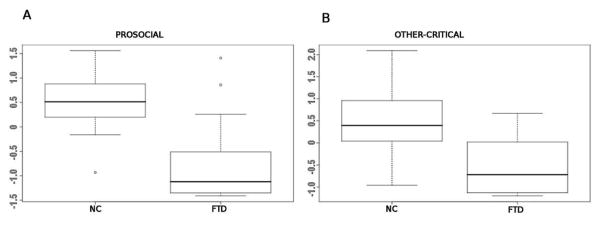
(a) Box plots showing normalized scores for prosocial sentiments, compared between bvFTD patients and controls. Patients with bvFTD were significantly impaired in prosocial sentiments. (b) Box plots showing normalized scores for other -critical sentiments, compared between bvFTD and controls. Patients with bvFTD were also significantly impaired in other-critical sentiments.
Figure 3
Figure 3
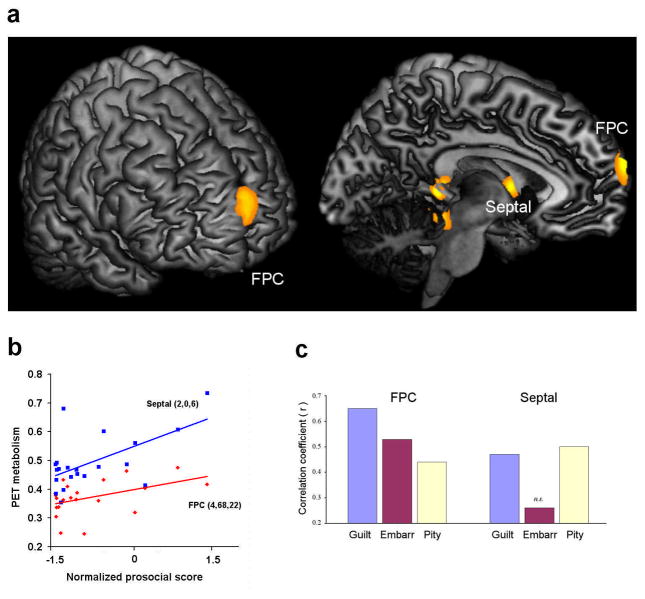
(a) Areas of PET hypometabolism associated with reduced prosocial sentiments in bvFTD patients (adjusted for dementia severity and other -critical feelings). The FPC and the septal area were the only regions surviving FWE - correction over the whole-brain or a priori ROIs. Statistical maps are overlaid onto an anatomical template, with display threshold of uncorrected p < 0.05, k ≥ 20 voxels for visualization purposes. (b) Linear regression plots (not adjusted for dementia severity and other -critical sentiments) of regional PET metabolism and prosocial scores for the FPC ( r = 0.45, p = 0.041) and septal area (r = 0.60, p = 0.004). These scatter plots are for the purpose of display only, and were not the basis of any inferences in this study. (c) Correlations between FPC and septal metabolism with guilt, pity and embarrassment scores. FPC metabolism was significantly correlated with guilt (r = 0.65, p = 0.002), pity (r = 0.44, p = 0.052) and embarrassment (r = 0.53, p = .016). Septal metabolism was significantly correlated with guilt (r = 0.46, p = 0.039) and pity (r = 0.50, p = 0.025), but not with embarrassment (r = 0.26, p = 0.26).
Figure 4
Figure 4
(a) Areas of PET hypometabolism associated with reduced other -critical sentiments (adjusted for dementia severity and prosocial sentiments). The right amygdala and the dmPFC were the only regions surviving FWE -corrected p = 0.05 over the whole-brain or a priori ROIs. Statistical maps are overlaid onto an anatomical template, with display threshold of uncorrected p < 0.05, k ≥ 20 voxels for visualization purposes. (b) Linear regression plots (not adjusted for dementia severity and prosocial sentiments) of regional PET metabolism and other-critical scores for the dmPFC (r = 0.54, p = 0.011) and right amygdala (r = 0.50, p = 0.022). These scatter plots are for the purpose of display only, and were not the basis of any inferences in this study.

References

    1. Amodio DM, Frith CD. Meeting of minds: the medial frontal cortex and social cognition. Nat Rev Neurosci. 2006;7:268–277. - PubMed
    1. Andy OJ, Stephan H. The septum in the human brain. J Comp Neurol. 1968;133:383 –410. - PubMed
    1. Bartels A, Zeki S. The neural correlates of maternal and romantic love. Neuroimage. 2004;21:1155–1166. - PubMed
    1. Bechara A, Damasio H, Damasio AR. Emotion, decision making and the orbitofrontal cortex. Cereb Cortex. 2000;10:295–307. - PubMed
    1. Berthoz S, Armony JL, Blair RJR, Dolan RJ. An fMRI study of intentional and unintentional (embarrassing) violations of social norms. Brain. 2002;125:1696 –1708. - PubMed

Publication types

LinkOut - more resources