Review
. 2010 Oct 15;19(R2):R152-61.
doi: 10.1093/hmg/ddq353. Epub 2010 Aug 20.

Large non-coding RNAs: missing links in cancer?

Affiliations
Review

Large non-coding RNAs: missing links in cancer?

Maite Huarte et al. Hum Mol Genet. .

Abstract

Cellular homeostasis is achieved by the proper balance of regulatory networks that if disrupted can lead to cellular transformation. These cell circuits are fine-tuned and maintained by the coordinated function of proteins and non-coding RNAs (ncRNAs). In addition to the well-characterized protein coding and microRNAs constituents, large ncRNAs are also emerging as important regulatory molecules in tumor-suppressor and oncogenic pathways. Recent studies have revealed mechanistic insight of large ncRNAs regulating key cancer pathways at a transcriptional, post-transcriptional and epigenetic level. Here we synthesize these latest advances within the context of their mechanistic roles in regulating and maintaining cellular equilibrium. We posit that similar to protein-coding genes, large ncRNAs are a newly emerging class of oncogenic and tumor-suppressor genes. Our growing knowledge of the role of large ncRNAs in cellular transformation is pointing towards their potential use as biomarkers and targets for novel therapeutic approaches in the future.


Figures
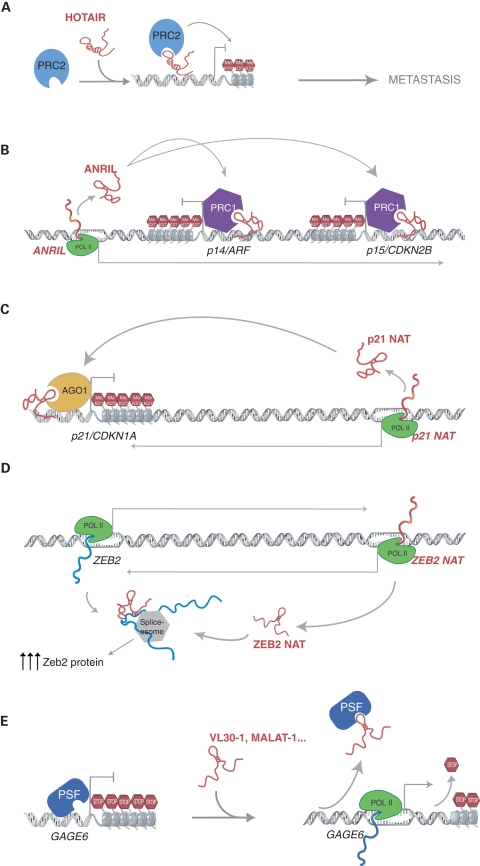
Figure 1.
Figure 1.
Mechanisms of gene regulation by oncogenic large ncRNAs. (A) lincRNA HOTAIR recruits PRC2 to specific gene promoters for methylation of lysine 27 of histone 3 (H3K27me), inducing gene repression that leads to breast tumor metastasis. (B) Large ncRNA ANRIL is transcribed antisense of the p14/ARF and p15/CDKN2B genes. ANRIL mediates gene silencing of the locus by interaction and recruitment of CBX7, a component of PRC1 histone 3 lysine 27-methyltransferase complex. (C) p21 NAT ncRNA is transcribed antisense of the p21/CDKN1A gene. This RNA requires Ago1 protein to mediate epigenetic silencing of p21/CDKN1A promoter involving H3K27me. (D) The ncRNA expressed antisense of the Zeb2 gene (Zeb2 NAT) overlaps with the 5′ splice site of one of Zeb2 introns. Zeb2 NAT inhibits the splicing of the intron, which contains an IRES sequence. In this way, Zeb2 protein translation is upregulated. (E) Rab23 proto-oncogene (mouse) and GAGE6 proto-oncogene (human) are repressed by PSF protein. This repression is relieved when VL30-1 ncRNA (mouse) or MALAT-1 and others (human) interact with PSF, displacing it from the promoter.
Figure 2.
Figure 2.
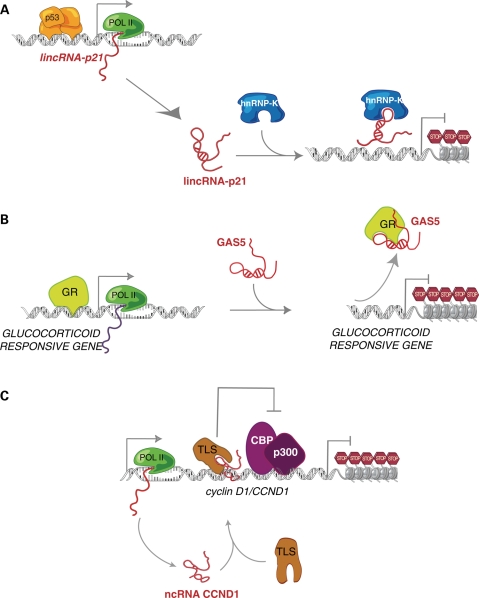
Mechanisms of gene regulation by tumor-suppressor large ncRNAs. (A) lincRNA-p21 expression is directly induced by p53. Then, lincRNA-p21 specifically interacts with hnRNP-K for localization to gene promoters for repression. (B) GAS5 mimics the conformation of DNA GREs, binding to GR. In this manner, GR loses the ability to activate transcription of target genes. (C) DNA damage induces the expression of ncRNA CCND1 from the 5′ of cyclin D1/CCND1 gene. ncRNA CCND1 interacts with the TLS protein, inducing a conformational change in TLS that allows its binding to the cyclin D1 promoter. This causes inhibition of cyclin D1 gene expression by blocking of CBP and p300 HAT activity.

References

    1. Cowin P.A., Anglesio M., Etemadmoghadam D., Bowtell D.D. Profiling the cancer genome. Annu. Rev. Genomics Hum. Genet. 2010 Epub ahead of print 2 July 2010. - PubMed
    1. Calin G.A., Pekarsky Y., Croce C.M. The role of microRNA and other non-coding RNA in the pathogenesis of chronic lymphocytic leukemia. Best Pract. Res. Clin. Haematol. 2007;20:425–437. - PubMed
    1. Ma L., Teruya-Feldstein J., Weinberg R.A. Tumour invasion and metastasis initiated by microRNA-10b in breast cancer. Nature. 2007;449:682–688. - PubMed
    1. Ruan K., Fang X., Ouyang G. MicroRNAs: novel regulators in the hallmarks of human cancer. Cancer Lett. 2009;285:116–126. - PubMed

    1. Calin G.A., Croce C.M. Chronic lymphocytic leukemia: interplay between noncoding RNAs and protein-coding genes. Blood. 2009;114:4761–4770. - PMC - PubMed

Publication types

Substances