


Upregulation of eNOS and unchanged energy metabolism in increased susceptibility of the aging type 2 diabetic GK rat heart to ischemic injury
- PMID: 20729402
- PMCID: PMC2993220
- DOI: 10.1152/ajpheart.00998.2009
Upregulation of eNOS and unchanged energy metabolism in increased susceptibility of the aging type 2 diabetic GK rat heart to ischemic injury
Abstract
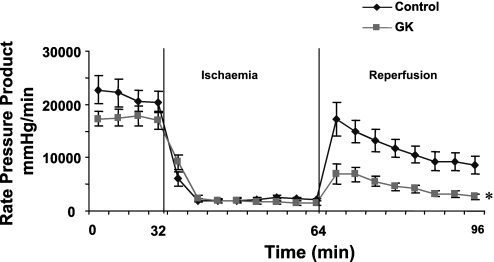
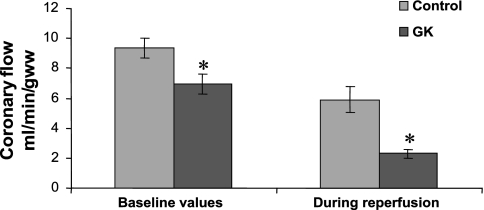
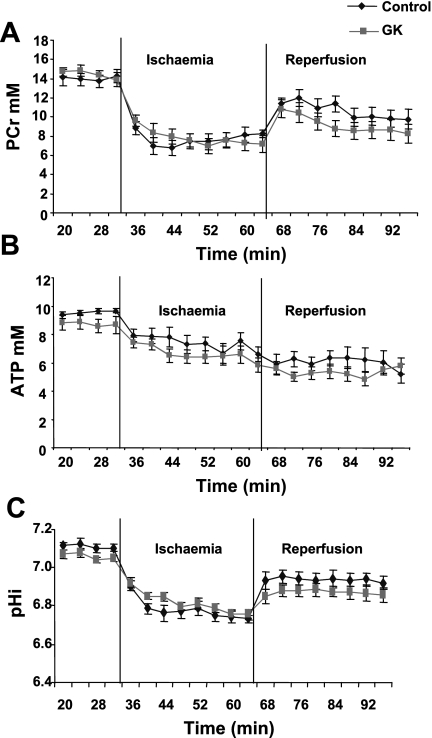
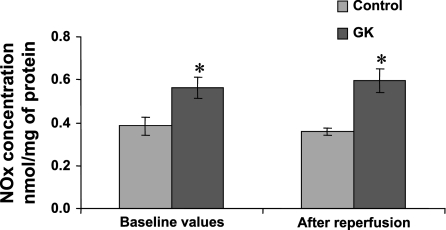
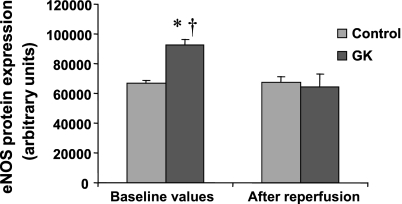
We investigated the tolerance of the insulin-resistant diabetic heart to ischemic injury in the male Goto-Kakizaki (GK) rat, a model of type 2 diabetes. Changes in energy metabolism, nitric oxide (NO) pathway, and cardiac function were assessed in the presence of physiological substrates. Age-matched control Wistar (n = 19) and GK (n = 18) isolated rat hearts were perfused with 0.4 mM palmitate, 3% albumin, 11 mM glucose, 3 U/l insulin, 0.2 mM pyruvate, and 0.8 mM lactate for 24 min before switching to 1.2 mM palmitate (11 rats/group) during 32 min low-flow (0.5 ml·min(-1)·g wet wt(-1)) ischemia. Next, flow was restored with 0.4 mM palmitate buffer for 32 min. A subset of hearts from each group (n = 8 for control and n = 7 for GK groups) were freeze-clamped for determining baseline values after the initial perfusion of 24 min. ATP, phosphocreatine (PCr), and intracellular pH (pH(i)) were followed using (31)P magnetic resonance spectroscopy with simultaneous measurement of contractile function. The NO pathway was determined by nitric oxide synthase (NOS) isoform expression and total nitrate concentration (NOx) in hearts. We found that coronary flow was 26% lower (P < 0.05) during baseline conditions and 61% lower (P < 0.05) during reperfusion in GK vs. control rat hearts. Rate pressure product was lower during reperfusion in GK vs. control rat hearts (P < 0.05). ATP, PCr, and pH(i) during ischemia-reperfusion were similar in both groups. Endothelial NOS expression was increased in GK rat hearts during baseline conditions (P < 0.05). NOx was increased during baseline conditions (P < 0.05) and after reperfusion (P < 0.05) in GK rat hearts. We report increased susceptibility of type 2 diabetic GK rat heart to ischemic injury that is not associated with impaired energy metabolism. Reduced coronary flow, upregulation of eNOS expression, and increased total NOx levels confirm NO pathway modifications in this model, presumably related to increased oxidative stress. Modifications in the NO pathway may play a major role in ischemia-reperfusion injury of the type 2 diabetic GK rat heart.
Figures

References
-
- Aasum E, Hafstad AD, Severson DL, Larsen TS. Age-dependent changes in metabolism, contractile function, and ischemic sensitivity in hearts from db/db mice. Diabetes 52: 434–441, 2003 - PubMed
-
- Abdul-Ghani MA, DeFronzo RA. Mitochondrial dysfunction, insulin resistance, type 2 diabetes mellitus. Curr Diab Rep 8: 173–178, 2008 - PubMed
-
- Abdul-Ghani MA, Muller FL, Liu Y, Chavez AO, Balas B, Zuo P, Chang Z, Tripathy D, Jani R, Molina-Carrion M, Monroy A, Folli F, Van Remmen H, DeFronzo RA. Deleterious action of FA metabolites on ATP synthesis: possible link between lipotoxicity, mitochondrial dysfunction, and insulin resistance. Am J Physiol Endocrinol Metab 295: E678–E685, 2008 - PubMed
-
- Almind K, Dorio A, Kahn CR. Putting the genes for type II diabetes on the map. Nat Med 7: 277–279, 2001 - PubMed
-
- Bernard M, Caus T, Sciaky M, Lan C, Cozzone PJ. Optimized cardiac graft preservation: a comparative experimental study using P-31 magnetic resonance spectroscopy and biochemical analyses. J Heart Lung Transplant 18: 572–581, 1999 - PubMed
Publication types
MeSH terms
Substances
Grants and funding
LinkOut - more resources
Full Text Sources
Medical
Miscellaneous
