


Increased levels of kynurenine and kynurenic acid in the CSF of patients with schizophrenia
- PMID: 20729465
- PMCID: PMC3329991
- DOI: 10.1093/schbul/sbq086
Increased levels of kynurenine and kynurenic acid in the CSF of patients with schizophrenia
Abstract
Background: The kynurenic acid (KYNA) hypothesis for schizophrenia is partly based on studies showing increased brain levels of KYNA in patients. KYNA is an endogenous metabolite of tryptophan (TRP) produced in astrocytes and antagonizes N-methyl-D-aspartate and α7* nicotinic receptors.
Methods: The formation of KYNA is determined by the availability of substrate, and hence, we analyzed KYNA and its precursors, kynurenine (KYN) and TRP, in the cerebrospinal fluid (CSF) of patients with schizophrenia. CSF from male patients with schizophrenia on olanzapine treatment (n = 16) was compared with healthy male volunteers (n = 29).
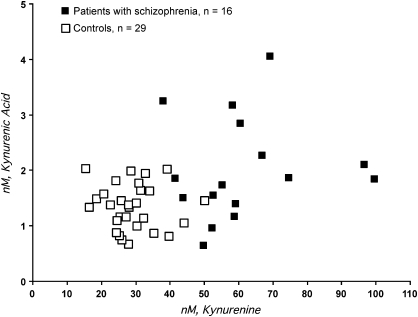
Results: KYN and KYNA concentrations were higher in patients with schizophrenia (60.7 ± 4.37 nM and 2.03 ± 0.23 nM, respectively) compared with healthy volunteers (28.6 ± 1.44 nM and 1.36 ± 0.08 nM, respectively), whereas TRP did not differ between the groups. In all subjects, KYN positively correlated to KYNA.
Conclusion: Our results demonstrate increased levels of CSF KYN and KYNA in patients with schizophrenia and further support the hypothesis that KYNA is involved in the pathophysiology of schizophrenia.
Figures

References
-
- Erhardt S, Blennow K, Nordin C, Skogh E, Lindstrom LH, Engberg G. Kynurenic acid levels are elevated in the cerebrospinal fluid of patients with schizophrenia. Neurosci Lett. 2001;313:96–98. - PubMed
-
- Nilsson LK, Linderholm KR, Engberg G, et al. Elevated levels of kynurenic acid in the cerebrospinal fluid of male patients with schizophrenia. Schizophr Res. 2005;80:315–322. - PubMed
-
- Schwarcz R, Rassoulpour A, Wu HQ, Medoff D, Tamminga CA, Roberts RC. Increased cortical kynurenate content in schizophrenia. Biol Psychiatry. 2001;50:521–530. - PubMed
-
- Parsons CG, Danysz W, Quack G, et al. Novel systemically active antagonists of the glycine site of the N-methyl-D-aspartate receptor: electrophysiological, biochemical and behavioral characterization. J Pharmacol Exp Ther. 1997;283:1264–1275. - PubMed
Publication types
MeSH terms
Substances
LinkOut - more resources
Full Text Sources
Other Literature Sources
Medical
