


Alcohol use disorders affect antimicrobial proteins and anti-pneumococcal activity in epithelial lining fluid obtained via bronchoalveolar lavage
- PMID: 20729531
- PMCID: PMC2930253
- DOI: 10.1093/alcalc/agq045
Alcohol use disorders affect antimicrobial proteins and anti-pneumococcal activity in epithelial lining fluid obtained via bronchoalveolar lavage
Abstract
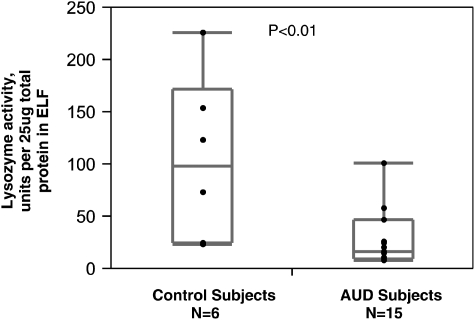
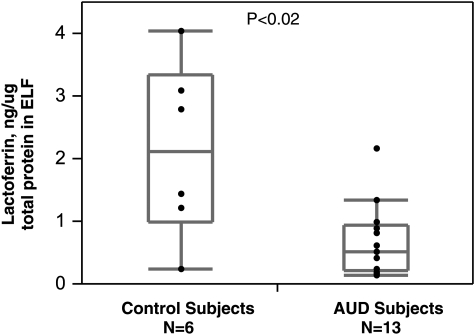
Aims: Our overall objective was to examine whether characteristics of epithelial lining fluid (ELF) from subjects with alcohol use disorders (AUDs) obtained via bronchoalveolar lavage (BAL) contribute to their predisposition to pneumococcal pneumonia. We sought to compare the anti-pneumococcal activity of acellular human BAL from subjects with AUDs to matched controls. Further, differences in BAL lysozyme activity and lactoferrin concentrations between these two groups were examined to determine the effect of AUDs on these antimicrobial proteins.
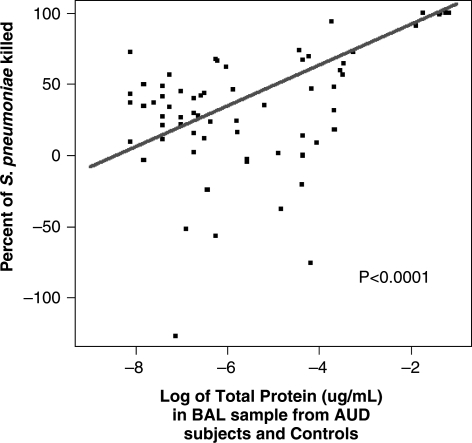
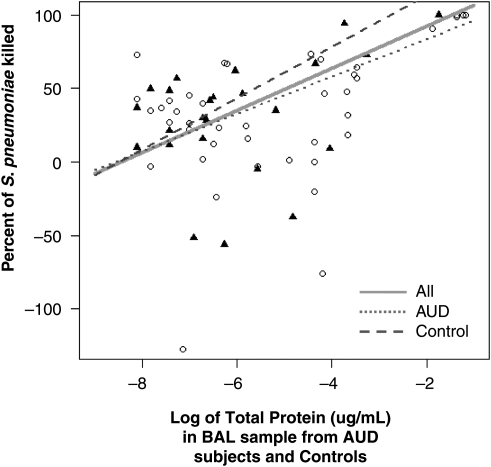
Methods: BAL was performed in subjects with AUDs and matched controls. Acellular BAL was used at varying concentrations in an in vitro killing assay of Streptococcus pneumoniae, type 2, and the percent kill of organisms per microgram per milliliter total BAL protein was ascertained. Lysozyme activity and lactoferrin concentrations were measured in BAL from subjects and controls at measured concentrations of BAL protein.
Results: AUD subjects (n = 15) and controls (n = 10) were enrolled in these investigations who were balanced in terms of smoking history. Using a mixed effect model, across the range of BAL protein concentrations, killing of pneumococcus tended to be less potent with BAL fluid from AUD subjects. Additionally, lysozyme activity and lactoferrin concentrations were significantly lower in the AUD group.
Conclusions: The predisposition for pneumococcal pneumonia among those with AUDs may be in part mediated through effects of alcohol on substances within ELF that include antimicrobial proteins. Clarifying the composition and activity of ELF antimicrobial proteins in the setting of AUDs via investigations with human BAL fluid can help establish their contribution to the susceptibility for pulmonary infections in these individuals.
Figures
References
-
- Anonymous. Reduction in alcohol-related traffic fatalities—United States, 1990–1992. MMWR Morb Mortal Wkly Rep. 1993;42:905–9. - PubMed
-
- Akinbi HT, Epaud R, Bhatt H, et al. Bacterial killing is enhanced by expression of lysozyme in the lungs of transgenic mice. J Immunol. 2000;165:5760–6. - PubMed
-
- Alkawash M, Head M, Alshami I, et al. The effect of human lactoferrin on the MICs of doxycycline and rifampicin for Burkholderia cepacia and Pseudomonas aeruginosa strains. J Antimicrob Chemother. 1999;44:385–387. - PubMed
-
- Antony VB, Godbey SW, Hott JW, et al. Alcohol-induced inhibition of alveolar macrophage oxidant release in vivo and in vitro. Alcohol Clin Exp Res. 1993;17:389–93. - PubMed
-
- Baker HM, Baker EN. Lactoferrin and iron: structural and dynamic aspects of binding and release. Biometals. 2004;17:209–216. - PubMed
Publication types
MeSH terms
Substances
Grants and funding
LinkOut - more resources
Full Text Sources
Medical
