Review
doi: 10.18632/aging.100189.
p53, ROS and senescence in the control of aging
Affiliations
- PMID: 20729567
- PMCID: PMC2954038
- DOI: 10.18632/aging.100189
Item in Clipboard
Review
p53, ROS and senescence in the control of aging
Aging (Albany NY).
2010 Aug.
Abstract
In addition to its function as a tumour suppressor, p53 is also involved in an increasing number of pathology associated with aging. Several activities of p53 appear contribute to its role in aging; one function that might be particularly relevant in this context is the regulation of senescence. The control of ROS and senescence by p53 may help to explain how p53 can function to both restrain and promote aging.
Figures
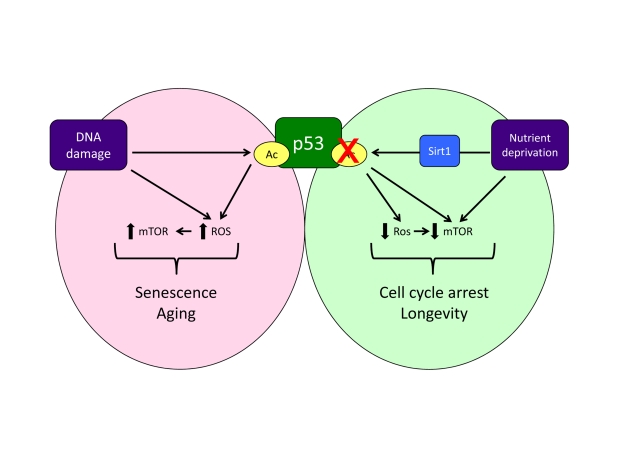
Note that this model does not account
for all published observations (e.g. reduction of the initial burst of mTOR
activity during oncogene induced senescence [17]) and represents
an oversimplification of these signalling pathways.
References
-
- Tyner SD, Venkatachalam S, Choi J, Ghebranious N, Igelmann H. p53 mutant mice that display early ageing-associated phenotypes. Nature. 2002;415:45–53. - PubMed
-
- Matheu A, Maraver A, Klatt P, Flores I, Garcia-Cao I. Delayed ageing through damage protection by the Arf/p53 pathway. Nature. 2007;448:375–379. - PubMed
-
- Zhao T, Xu Y. p53 and stem cells: new developments and new concerns. Trends Cell Biol. 2010;20:170–175. - PubMed
Publication types
MeSH terms
Substances
LinkOut - more resources
Full Text Sources
Medical
Research Materials
Miscellaneous