. 2010 Sep;2(9):772-9.
doi: 10.1038/nchem.733. Epub 2010 Jul 18.

A polyhedron made of tRNAs

Affiliations

A polyhedron made of tRNAs

Isil Severcan et al. Nat Chem. 2010 Sep.

Abstract

Supramolecular assembly is a powerful strategy used by nature to build nanoscale architectures with predefined sizes and shapes. With synthetic systems, however, numerous challenges remain to be solved before precise control over the synthesis, folding and assembly of rationally designed three-dimensional nano-objects made of RNA can be achieved. Here, using the transfer RNA molecule as a structural building block, we report the design, efficient synthesis and structural characterization of stable, modular three-dimensional particles adopting the polyhedral geometry of a non-uniform square antiprism. The spatial control within the final architecture allows the precise positioning and encapsulation of proteins. This work demonstrates that a remarkable degree of structural control can be achieved with RNA structural motifs for the construction of thermostable three-dimensional nano-architectures that do not rely on helix bundles or tensegrity. RNA three-dimensional particles could potentially be used as carriers or scaffolds in nanomedicine and synthetic biology.


Figures

Figure 1
Figure 1
Structure and design principles of tRNA-based architectures. (a) 3D model of the tRNA unit: the variable arm points out of the plane defined by the anticodon (ac) and amino-acid (aa) arms that are perpendicular to each other. Angle values between arms are indicated. (b) Generic secondary structure diagram for self-assembling tRNA units derived from the structure of class II tRNA(Ser). The strand topology of the tRNA unit is designed so that the 5' and 3' ends are localized at the tip of the variable arm. Kissing-loops (KL) (in green) are inserted at the extremities of the ac and aa arms. Nucleotides in blue are those corresponding to the Class II tRNA(Ser) motif. N: indicates any paired nucleotide; X indicates nucleotide involved in intermolecular KL or tail-tail bps. Dashed lines indicate tertiary interactions. (c) Schematic indicating the various intermolecular connectors. KL complex (i) and tail-tail connectors without (ii) and with (iii) major triple base pairs. Blue and black colors indicate the two different interacting RNAs. (d) Cis and trans orientations of tRNA squares resulting from tail-tail edges connectors of 21bp or 26 bp, respectively. (e) 3D model of the non-uniform square antiprism. Three-different views are shown. The tRNA units entering into the composition of the fully programmable octamer (TO1–2) are indicated (see also Tables S1 and S2 in Supplementary Information for other TO combinations).
Figure 2
Figure 2
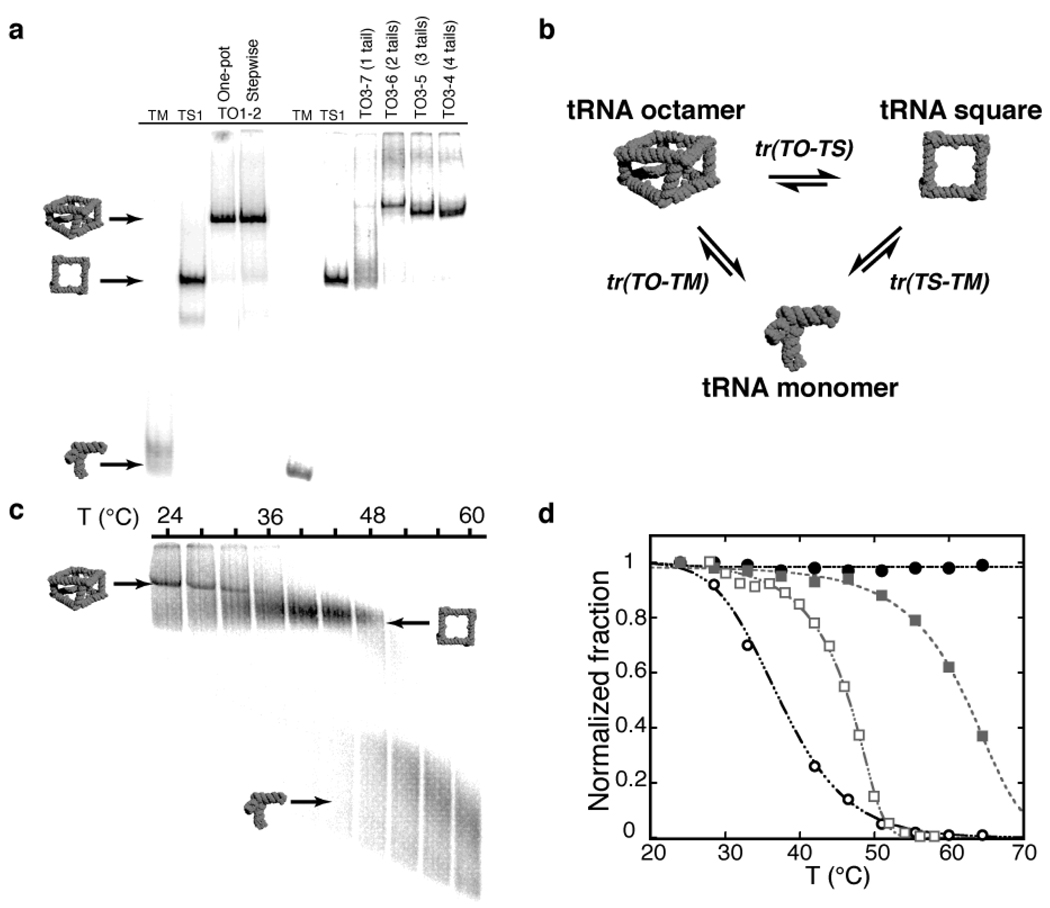
tRNA octamer self-assembly and thermal stability. (a) Characterization of tRNA supramolecular assembly of various tRNA octamers (TO) by non-denaturing PAGE at 2 mM Mg(OAc)2: lane M is for the monomer tRNA unit control (400 nM), lane TS1 are for a control tRNA square (TS1, 100 nM), lanes TO1–2 show octamer products (50 nM) after one pot or stepwise assembly. Lanes TO3–4 to TO3–7 (50 nM) correspond to octamers with a varying number of tail connectors. (b) Schematic of the three major transitions of TO disassembly observed by TGGE analysis (Materials and Methods and Supplementary Information). (c) Example of TGGE gel showing the cooperative biphasic dissociation of TO3–4 (20 nM) into squares and monomers at 0.2 mM Mg(OAc)2 (see also Table 1). (d) Comparison of melting curves for TS3 (grey squares) and TO3–4 (black circles) obtained from TGGE gels at 0.2 mM (empty symbols) and 15 mM (solid symbols) Mg(OAc)2.
Figure 3
Figure 3
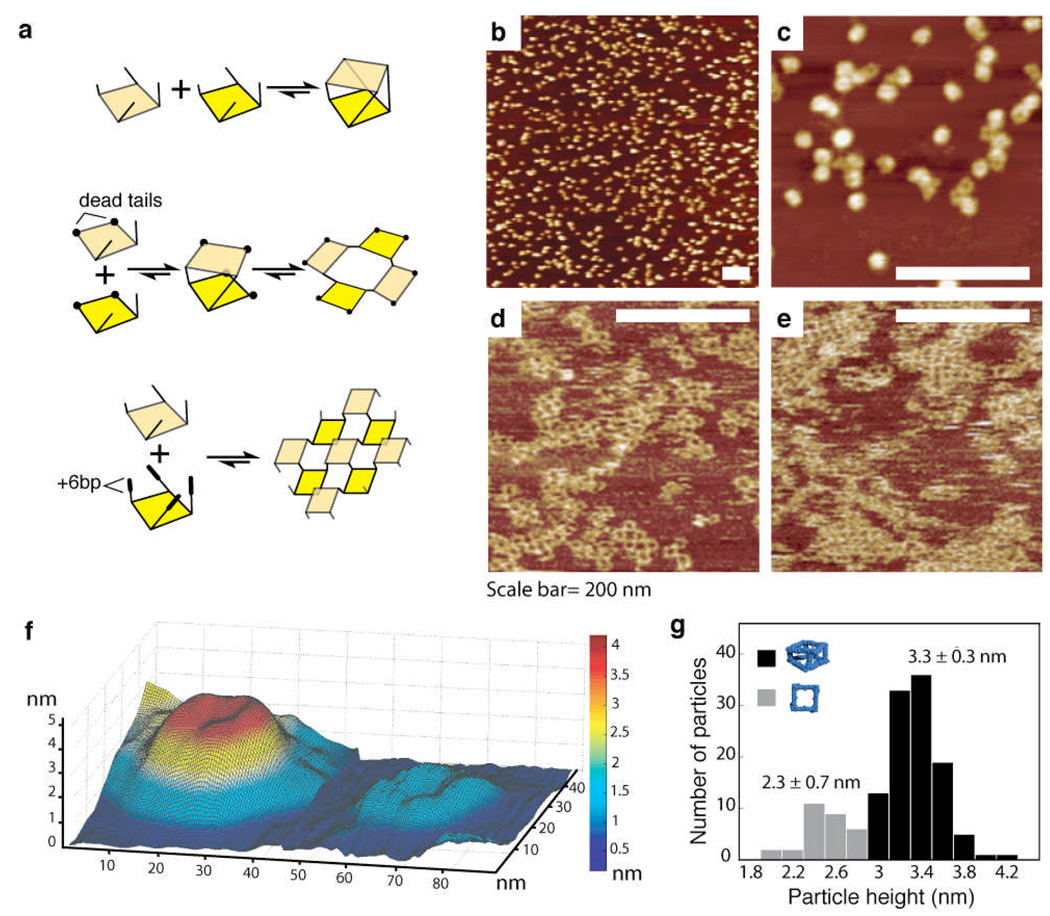
Structural characterization of tRNA architectures by AFM. (a) Top-to-bottom: Hierarchical stepwise assembly schemes for tRNA squares designed to assemble into (b–c) the antiprism TO3–4, (d) the "open" octamer TO3–6 and (e) the planar TS10–11 array (TS10 + TS11). TO3–4 and TS10–TS11 have tail-tail connectors in cis and trans configuration, respectively. TO3–6 has two tail-tail connectors missing with respect to TO3–4. Corresponding AFM images were obtained in air. (f) 3D rendering of AFM image data to compare the relative height of "closed" octamer versus square. (g) Height distribution of octamers obtained from AFM analysis indicates that more than 70% of supra-molecular assemblies correspond to two superimposed squares.
Figure 4
Figure 4
Structural characterization of tRNA architectures by Cryo-EM with single image particle reconstruction. (a) Typical cryo-EM image of antiprism particles. More than 85% of the objects seen are well-formed antiprisms. (b) Reconstructed 3D model of the non-uniform square antiprism TO1–2 at 24.5 Å resolution. The view orientations are similar to those in Figure 1e. (c) Class averages of particles with similar views observed by cryo-EM (EM) with the corresponding projections of the RNA antiprism 3D structure reconstructed from the cryo-EM images (recon) and the corresponding view of the initial antiprism model (model). These particle views are selected from different image frames to represent views at different orientations (Figure S3).
Figure 5
Figure 5
Coupling streptavidin to spatially addressable antiprims (TO8–9). (a) The location of the 3’ tail-tail connector in the variable arm determines the orientation of the iodoacetyl-biotin linker, and thus can be used to control the positioning of streptavidin with respect to the antiprism. (b–c) Antiprisms with biotin oriented inward form small antiprism-streptavidin complexes. (d–e) Antiprisms with biotin oriented outward form antiprism-streptavidin filaments. Corresponding AFM images of the streptavidin-antiprism conjugates, formed at ratio of streptavidin vs antiprism is 1:1 (50 nM), are shown (see Figure S5, Supplementary Information and Materials and Methods). (f) Distribution of the population of antiprisms in function of antiprism-streptavidin chain lengths and inward or outward orientation of conjugated biotin. The frequency (in percent) stands for the total occurrence of antiprisms in an antiprism-streptavidin complex of specific length (indicated in number of constituent antiprisms). These experiments were reproduced at least twice.

References

    1. Gesteland RF, Cech TR, Atkins JF. The RNA world. Third Edition. Cold Spring Harbor, New York: Cold Spring Harbor Laboratory Press; 2005.
    1. Leontis NB, Lescoute A, Westhof E. The building blocks and motifs of RNA architecture. Curr. Opin. Struct. Biol. 2006;16:279–287. - PMC - PubMed
    1. Holbrook SR. Structural principles from large RNAs. Annu Rev Biophys. 2008;37:445–464. - PubMed
    1. Jaeger L, Verzemnieks EJ, Geary C. The UA_handle: a versatile submotif in stable RNA architectures. Nucleic Acids Res. 2009;37:215–230. - PMC - PubMed
    1. Guo P. RNA nanotechnology: engineering, assembly and applications in detection, gene delivery and therapy. J. Nanosci. Nanotechnol. 2005;5:1964–1982. - PMC - PubMed

Publication types

MeSH terms