


A New, Once-daily, Optimized, Fixed Combination of Clindamycin Phosphate 1.2% and Low-concentration Benzoyl Peroxide 2.5% Gel for the Treatment of Moderate-to-Severe Acne
- PMID: 20729964
- PMCID: PMC2924134
A New, Once-daily, Optimized, Fixed Combination of Clindamycin Phosphate 1.2% and Low-concentration Benzoyl Peroxide 2.5% Gel for the Treatment of Moderate-to-Severe Acne
Abstract
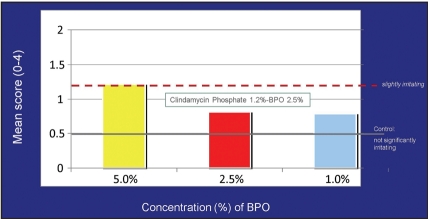
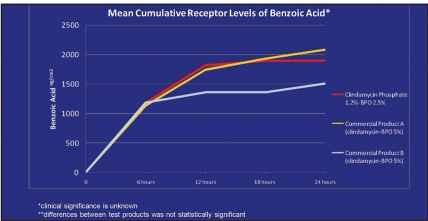
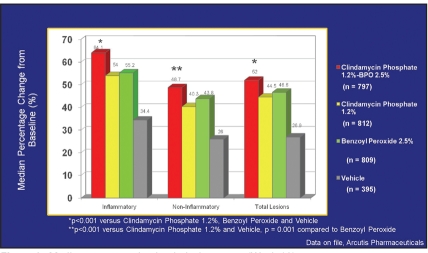
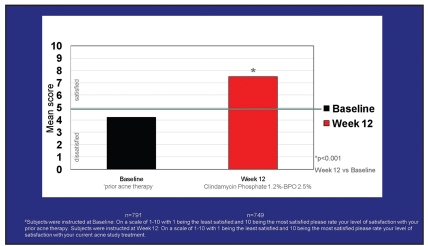
The treatment of acne with combination therapy is commonplace with treatment aimed at sustained efficacy with minimal side effects, maximum adherence, and the avoidance of bacterial resistance. Combinations containing clindamycin and benzoyl peroxide have been shown to be effective, but the irritation caused by the concentration of benzoyl peroxide 5% in the more commonly used, fixed combinations can be limiting. In addition, surfactants, preservatives, and high levels of organic solvents, including alcohols, often used in combination with benzoyl peroxide, are potential irritants. An optimized formulation of clindamycin and benzoyl peroxide using a lower concentration of benzoyl peroxide (clindamycin-benzoyl peroxide 2.5% gel) has been developed without the use of surfactants or alcohol. It was recently introduced for the once-daily treatment of inflammatory and noninflammatory lesions in moderate-to-severe acne. Following a clinical program that studied more than 2,800 patients, clindamycin-benzoyl peroxide 2.5% was found to be highly effective and well tolerated. This review highlights the development of clindamycin-benzoyl peroxide 2.5% gel and the data from clinical trials.(J Clin Aesthetic Dermatol. 2009;2(5):44-48.).
Figures
References
-
- White GM. Recent findings in the epidemiologic evidence, classification and subtypes of acne vulgaris. J Am Acad Dermatol. 1998;39(Suppl):S34–S37. - PubMed
-
- Gollnick H, Cunliffe W, Berson D, et al. Management of acne: a report from the alliance to improve outcomes in acne. J Am Acad Dermatol. 2003;49(Suppl):S1–38. - PubMed
-
- Webster GF, Jeyden JJ, McGinley KJ, McArthur WP. Suppression of polymorphonuclear leucocyte chemotactic factor production in Propionibacterium acnes by subminimal inhibitory concentrations of tetracycline, ampicillin, minocycline, and erythromycin. Antimicrob Agents Chemother. 1982;21:770–772. - PMC - PubMed
-
- Gupta AK, Lynde CW, Kunynetz RA, et al. A randomized, double-blind, multicenter, parallel group study to compare relative efficacies of the topical gels 3% erythromycin/5% benzoyl peroxide and 0.025% tretinoin/erythromycin 4% in the treatment of moderate acne vulgaris of the face. J Cutan Med Surg. 2003;7:31–37. - PubMed
-
- Waller JM, Dreher F, Behnam S, et al. Keratolytic properties of benzoyl peroxide and retinoic acid resemble salicylic acid in man. Skin Pharmacol Physiol. 2006;19:283–289. - PubMed
LinkOut - more resources
Full Text Sources
Other Literature Sources