. 2010 May 15:4:62.
doi: 10.3389/neuro.01.011.2010. eCollection 2010.

Open source tools for the information theoretic analysis of neural data

Affiliations

Open source tools for the information theoretic analysis of neural data

Robin A A Ince et al. Front Neurosci. .

Abstract

The recent and rapid development of open source software tools for the analysis of neurophysiological datasets consisting of simultaneous multiple recordings of spikes, field potentials and other neural signals holds the promise for a significant advance in the standardization, transparency, quality, reproducibility and variety of techniques used to analyze neurophysiological data and for the integration of information obtained at different spatial and temporal scales. In this review we focus on recent advances in open source toolboxes for the information theoretic analysis of neural responses. We also present examples of their use to investigate the role of spike timing precision, correlations across neurons, and field potential fluctuations in the encoding of sensory information. These information toolboxes, available both in MATLAB and Python programming environments, hold the potential to enlarge the domain of application of information theory to neuroscience and to lead to new discoveries about how neurons encode and transmit information.

Keywords: bias; entropy; information theory; mutual information; open source.


Figures
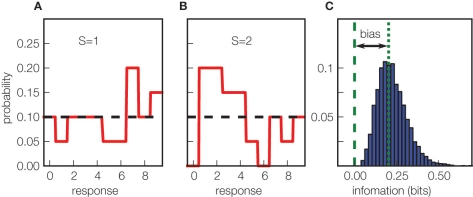
Figure 1
Figure 1
The origin of the limited sampling bias in information measures. (A, B) Simulation of a toy uninformative neuron, responding on each trial with a uniform distribution of spike counts ranging from 0 to 9, regardless of which of two stimuli (S = 1 in (A) and S = 2 in (B)) are presented. The black dotted horizontal line is the true response distribution, solid red lines are estimates sampled from 40 trials. The limited sampling causes the appearance of spurious differences in the two estimated conditional response distributions, leading to an artificial positive value of mutual information. (C) The distribution (over 5000 simulations) of the mutual information values obtained (without using any bias correction) estimating Eq. 1 from the stimulus–response probabilities computed with 40 trials. The dashed green vertical line indicates the true value of the mutual information carried by the simulated system (which equals 0 bits); the difference between this and the mean observed value (dotted green line) is the bias.
Figure 2
Figure 2
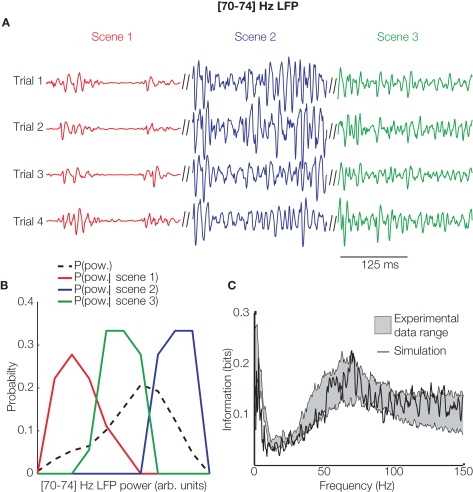
Computing the information content of LFP spectrum in models and cortical data. (A) The time course of the 70–74 Hz component of simulated LFP's generated from the recurrent inhibitory–excitatory neural network model of Mazzoni et al. (2008) for four repetitions of the same thalamic input signal during three 2-s nonoverlapping movie intervals (“scenes”), each coded with a different color. The power of the 70–74 Hz band varies reliably from scene to scene. (B) The distribution across 30 trials of the time-averaged instantaneous power within each scene (red, green, and blue lines coded as in (A)) is different across different scenes and from the distribution of power across all available scenes (black dashed line). This shows that the power in this frequency band carries some single-trial information about movie scenes. (C) The mutual information (about which scene of the movie was being presented) carried by the power of the LFP recorded from primary visual cortex (grey area represents the mean ± SEM over recoding locations) and by the power of the LFP simulated by the recurrent network model of Mazzoni et al. (2008) (black line), from which this panel is reprinted. The model accurately reproduced the spectral information of recorded LFP's y = Wx
Figure 3
Figure 3
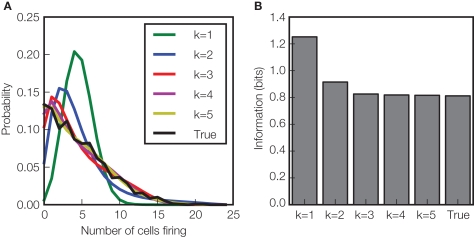
Effect of higher order correlations on response distributions and information transmission. This figure illustrates the potential role of high order interactions in shaping the response distributions and the amount of information about the velocity of whisker deflection carried by population of neurons in rat somatosensory cortex (Montani et al., 2009). (A) The probability of the number of cells firing in a population of neurons (recorded simultaneously from 24 locations) in response to stimulus velocity 2.66 mm s−1 during the [5–25] ms post-stimulus time window. The experimentally observed “true” probability distribution (black line) is compared to that of a maximum entropy probability model, preserving all interactions up to order k (k = 1,…5), but imposing no other interactions of order higher than k. Clearly, the model discarding all interactions (k = 1) gives a distribution very far from the real one. Including interactions across neurons (k > 1) improves the fit dramatically, and including interactions of order 3 is enough to get a statistically acceptable fit (χ2, p < 0.05). (B) To investigate the effect of the interactions on information, we simulated a system with these maximum entropy stimulus conditional distributions, generating the same number of trials as were available in the experimental data set. The information in this hierarchical family of model systems (averaged over 1000 simulations) is plotted and compared to the information carried by the “true” distribution observed experimentally. Correlations of order three are required to match the information carried by the true neural population responses, but fourth order and above had no effect on the information transmitted. Data from Montani et al. (2009) were redrawn and reanalyzed to create this figure.
Figure 4
Figure 4
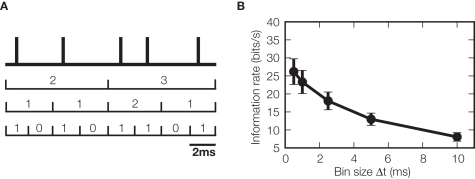
Effect of temporal resolution of spike times on information. (A) The response of a neuron is initially recorded as a series of spike times. To investigate the temporal resolution at which spike times carry information, the spike train is binned at a variety of different time resolutions, by labeling the response at each time with the number of spikes occurring within that bin, thereby transforming the response into a discrete integer sequence. (B) The information rate (information per unit time) about whisker deflections carried by VPm thalamic neurons as a function of bin width, Δt, used to bin neural responses (data from Montemurro et al. (2007) were redrawn and reanalyzed to create this panel). Information rate increased when decreasing the bin width even down to a resolution as fine as 0.5 ms, the limit of the experimental setup. This shows that a very fine temporal resolution is needed to read out the sensory messages carried by these thalamic spike trains.
Figure 5
Figure 5
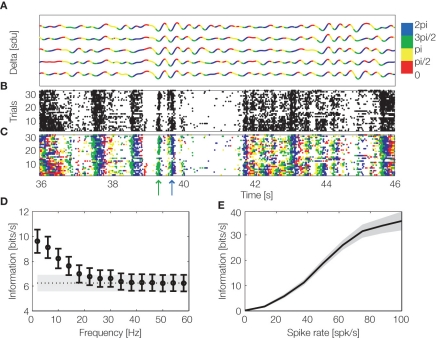
Encoding of information by spike count and phase of firing. LFPs and spiking activity were recorded from primary visual cortex of anesthetized macaques during binocular presentation of a naturalistic color movie. (A) Delta band (1–4 Hz) LFP traces from an example recording site during five repetitions of the same visual stimulus. The line is colored according to the phase quadrant of the instantaneous LFP phase. (B) Multiunit spiking activity from the same site over thirty repetitions of the same movie stimulus. (C) The same multiunit activity as in (B), but with spikes colored according to the concurrent instantaneous LFP phase quadrant at which they were emitted (phase of firing). The movie scenes indicated by green and blue arrows can be better discriminated by considering phase of firing (colored spikes) than by using the spike counts alone (black spikes). (D) Black circles show information carried by the LFP phase of firing as a function of the LFP frequency (mean ± SEM over the entire dataset). The black dashed line shows the spike count information (averaged over the dataset, with grey area showing SEM). For LFP frequencies below 20 Hz the phase of firing carries more information than the spike count. (E) Information carried by delta band phase of firing was calculated for movie scenes eliciting exactly the same spike rate and was plotted as a function of the elicited spike rate. This shows that the information carried by phase of firing is not redundant with spike rate, since it is able to disambiguate stimuli eliciting exactly the same spike rate. Figure reproduced (with permission) from Montemurro et al. (2008).

References

    1. Adrian E. D. (1928). The Basis of Sensation. New York, Norton
    1. Arieli A., Sterkin A., Grinvald A., Aertsen A. (1996). Dynamics of ongoing activity: explanation of the large variability in evoked cortical responses. Science 273, 1868–1871 10.1126/science.273.5283.1868 - DOI - PubMed
    1. Ascoli G. A. (2006). The ups and downs of neuroscience shares. Neuroinformatics 4, 213–216 10.1385/NI:4:3:213 - DOI - PubMed
    1. Averbeck B. B., Latham P. E., Pouget A. (2006). Neural correlations, population coding and computation. Nat. Rev. Neurosci. 7, 358–366 10.1038/nrn1888 - DOI - PubMed
    1. Belitski A., Gretton A., Magri C., Murayama Y., Montemurro M. A., Logothetis N. K., Panzeri S. (2008). Low-frequency local field potentials and spikes in primary visual cortex convey independent visual information. J. Neurosci. 28, 5696–5709 10.1523/JNEUROSCI.0009-08.2008 - DOI - PMC - PubMed

LinkOut - more resources