


Scoring functions and their evaluation methods for protein-ligand docking: recent advances and future directions
- PMID: 20730182
- PMCID: PMC11103779
- DOI: 10.1039/c0cp00151a
Scoring functions and their evaluation methods for protein-ligand docking: recent advances and future directions
Abstract
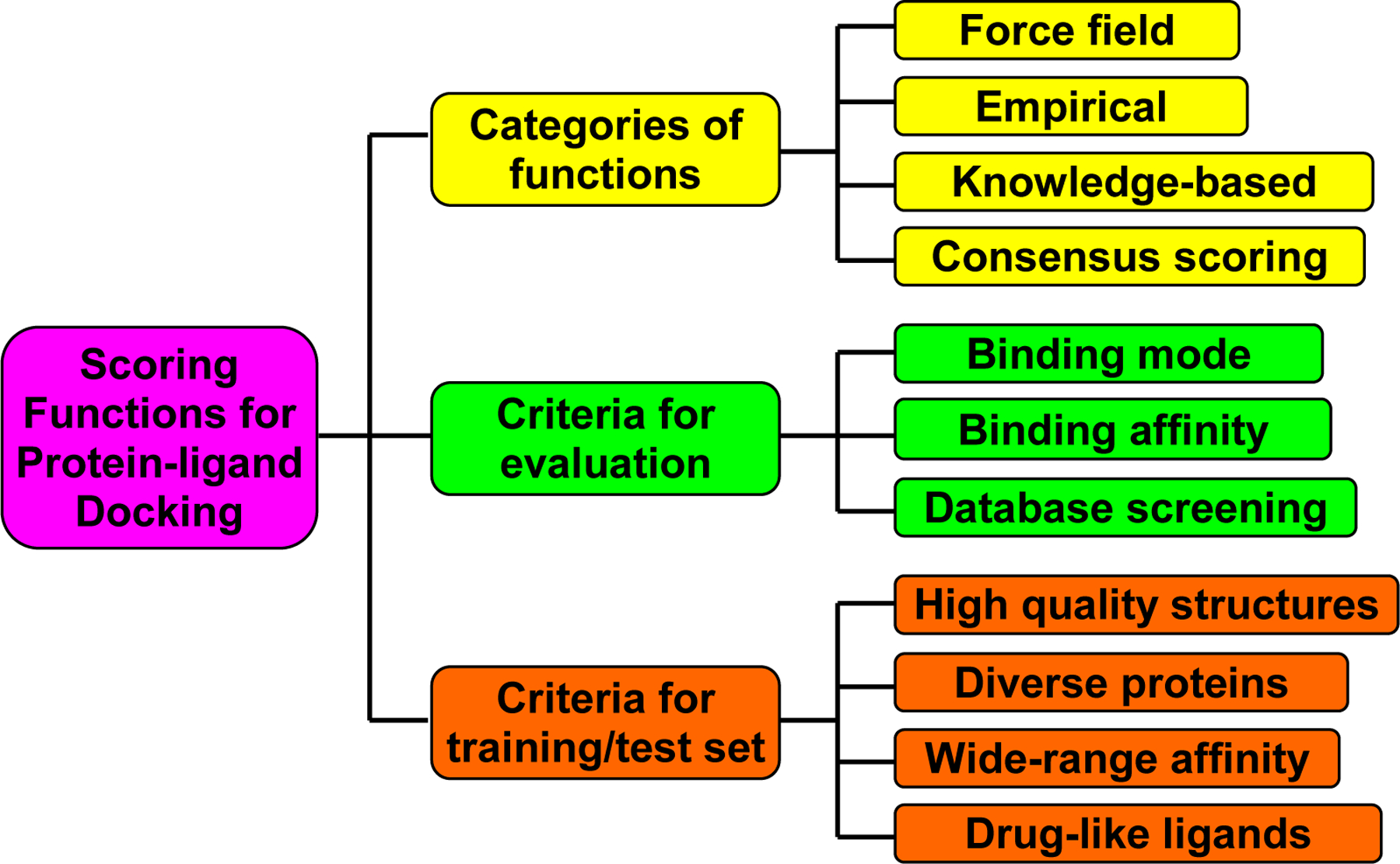
The scoring function is one of the most important components in structure-based drug design. Despite considerable success, accurate and rapid prediction of protein-ligand interactions is still a challenge in molecular docking. In this perspective, we have reviewed three basic types of scoring functions (force-field, empirical, and knowledge-based) and the consensus scoring technique that are used for protein-ligand docking. The commonly-used assessment criteria and publicly available protein-ligand databases for performance evaluation of the scoring functions have also been presented and discussed. We end with a discussion of the challenges faced by existing scoring functions and possible future directions for developing improved scoring functions.
Figures
References
-
- Brooijmans N and Kuntz ID., Annu. Rev. Biophys. Biomol. Struct, 2003, 32, 335–373. - PubMed
-
- Böhm HJ and Stahl M, Rev. Comput. Chem, 2002, 18, 41–87.
-
- Wang W, Donini O, Reyes CM and Kollman PA, Annu. Rev. Biophys. Biomol. Struct, 2001, 30, 211–243. - PubMed
-
- Shoichet BK, McGovern SL, Wei B and Irwin JJ, Curr. Opin. Chem. Biol, 2002, 6, 439–446. - PubMed
-
- Reddy MR and Erion MD, Free Energy Calculations in Rational Drug Design, Kluwer Academic: New York, 2001.
Publication types
MeSH terms
Substances
Grants and funding
LinkOut - more resources
Full Text Sources
Other Literature Sources
