. 2010 Oct 1;202(7):991-1001.
doi: 10.1086/656044.

Influenza virus-cytokine-protease cycle in the pathogenesis of vascular hyperpermeability in severe influenza

Affiliations

Influenza virus-cytokine-protease cycle in the pathogenesis of vascular hyperpermeability in severe influenza

Siye Wang et al. J Infect Dis. .

Abstract

Background: Severe influenza is characterized by cytokine storm and multiorgan failure with edema. The aim of this study was to define the impact of the cytokine storm on the pathogenesis of vascular hyperpermeability in severe influenza.

Methods: Weanling mice were infected with influenza A WSN/33(H1N1) virus. The levels of proinflammatory cytokines, tumor necrosis factor (TNF) alpha, interleukin (IL) 6, IL-1beta, and trypsin were analyzed in the lung, brain, heart, and cultured human umbilical vein endothelial cells. The effects of transcriptional inhibitors on cytokine and trypsin expressions and viral replication were determined.

Results: Influenza A virus infection resulted in significant increases in TNF-alpha, IL-6, IL-1beta, viral hemagglutinin-processing protease trypsin levels, and viral replication with vascular hyperpermeability in lung and brain in the first 6 days of infection. Trypsin upregulation was suppressed by transcriptional inhibition of cytokines in vivo and by anti-cytokine antibodies in endothelial cells. Calcium mobilization and loss of tight junction constituent, zonula occludens-1, associated with cytokine- and trypsin-induced endothelial hyperpermeability were inhibited by a protease-activated receptor-2 antagonist and a trypsin inhibitor.

Conclusions: The influenza virus-cytokine-protease cycle is one of the key mechanisms of vascular hyperpermeability in severe influenza.


Conflict of interest statement

Potential conflicts of interest: none reported.

Figures
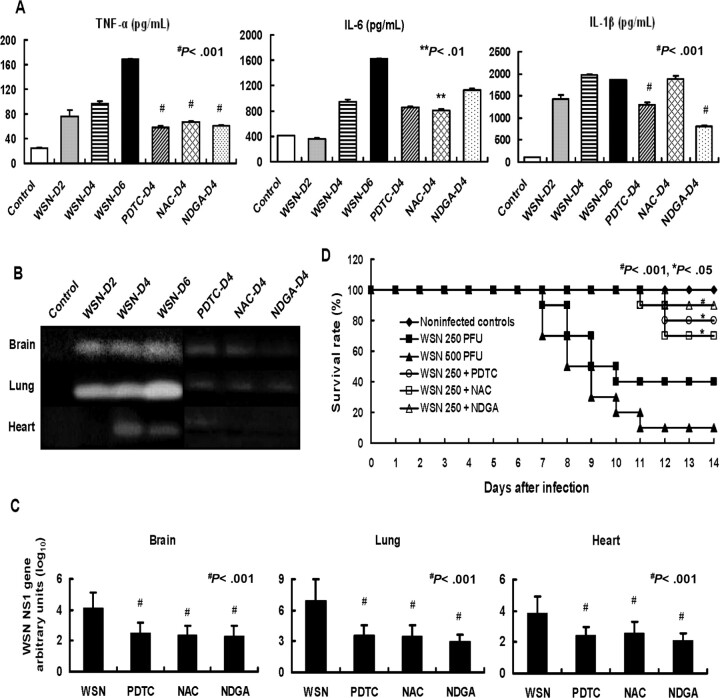
Figure 1
Figure 1
Upregulation of cytokines and trypsin, increase in viral RNA after influenza A virus infection in mice, and effects of nuclear factor-kappa B (NF−κB) and activator protein 1 inhibitors on the upregulation and survival of infected mice. A, Mice were infected with 250 plaque-forming units (PFU) of influenza A WSN/33(H1N1) virus (WSN) with and without treatment with pyrrolidine dithiocarbamate (PDTC), N-acetyl-L-cysteine (NAC), and nordihydroguaiaretic acid (NDGA). Levels of tumor necrosis factor (TNF) α, interleukin (IL) 6, and IL-1β in lung homogenates (n=3) were analyzed before (Control) and at day 2 (WSN-D2), day 4 (WSN-D4), and day 6 (WSN-D6) after infection. Cytokine levels in lungs of animals treated once daily for 4 days with PDTC (PDTC-D4), NAC (NAC-D4), and NDGA (NDGA-D4) were also measured. Data are mean value ± standard error of the mean (SEM). **P < .01, #P < .001, versus WSN-D4. B, Trypsin activities analyzed by gelatin zymography of infected mice for 0–6 days. Animals were treated with PDTC, NAC, and NDGA once daily for 4 days. Each lane represents the same experimental conditions as in A. C, Mice were infected with WSN and also treated with PDTC, NAC, and NDGA. Quantitative analysis of viral NS1 RNA copies normalized by b-actin at day 4 after infection was conducted by real-time polymerase chain reaction (n=3). Data are mean ± SEM. #P < .001 versus without drug treatment. D, Mice of each group (n=10) were infected with WSN at 250 PFU and 500 PFU. Animals infected with WSN at 250 PFU were treated with PDTC, NAC, and NDGA once daily for 4 days, and the survival rates of the different groups were compared. *P < .05, #P < .001 versus without drug treatment.
Figure 2
Figure 2
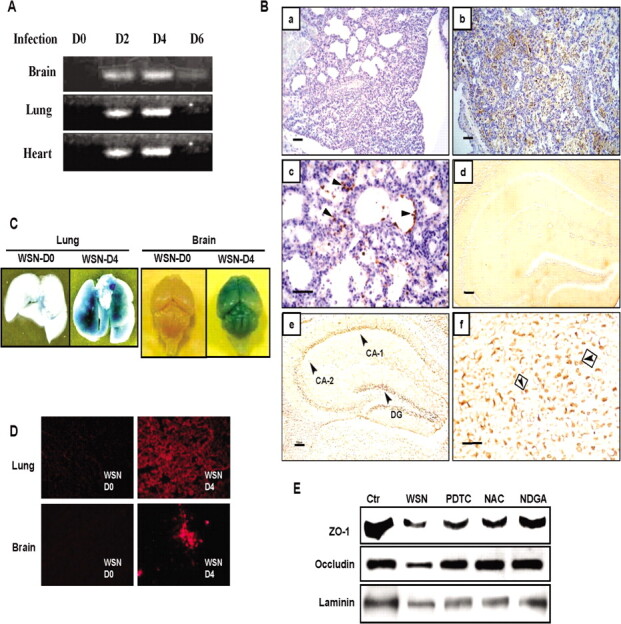
Kinetics of viral proliferation, viral protein accumulation, increase in vascular permeability, and loss of tight-junction proteins in various organs after influenza A WSN/33(H1N1) virus (WSN) infection. A, Detection of viral NS1 gene by reverse-transcription polymerase chain reaction (RTPCR) in the lung, heart, and brain of mice during 0-6 days after infection. B, Immunohistochemical detection of viral antigens in mouse lung and brain at day 4 after infection. a, Hematoxylin and eosin staining of the lung (original magnificationm, ×200). b, Immunoreactive deposits in the lung (original magnification, ×200). c, Viral antigen (arrowheads) in epithelial cells of respiratory bronchioles and infiltrated leukocytes in alveoli (original magnification, ×400). d, No immunoreactive deposits in the brain before infection (original magnification, ×200). e, Virus antigen in the cornu ammonis (CA) 1 and CA-2 and in the stratum granulosum of the dentate gyrus (DG) of the hippocampus (original magnification,×200). f, Virus antigen (arrowheads) in the enlarged image of CA-1 (original magnification, ×400). Scale bars are 100 µm.C, Vascular permeability in the lung and brain analyzed by Evan's blue dye extravasation before (WSN-D0) and after infection at day 4 (WSN-D4). D, Fluorescent micrographs of Evan's blue leakage from capillaries in the brain and lung before and after infection at day 4. E, Loss of tight-junction proteins, zonula occludens (ZO) 1 and occludin, and laminin in the brain analyzed by Western immunoblotting at day 4 after infection and its restoration by pyrrolidine dithiocarbamate (PDTC), N-acetyl-L-cysteine (NAC), and nordihydroguaiaretic acid (NDGA) treatments. The levels before infection are shown as control (Ctr).
Table 1
Table 1
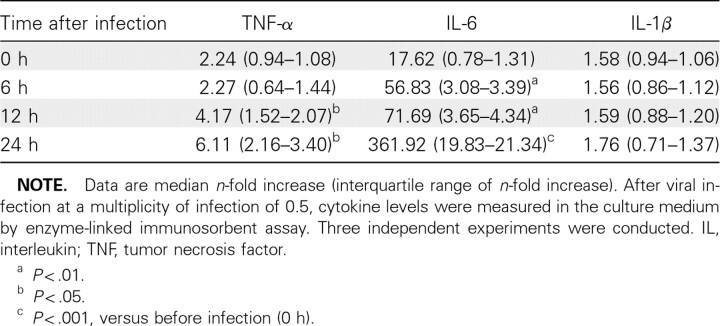
Proinflammatory Cytokine Levels in the Culture Media of Human Endothelial Cells after Influenza A WSN/33(H1N1) Virus Infection
Figure 3
Figure 3
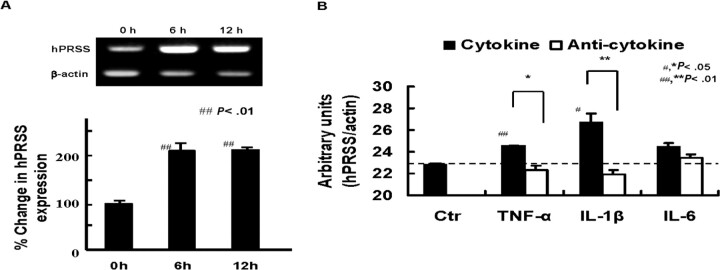
Increase in human trypsin (hPRSS) expression in endothelial cells after influenza A WSN/33(H1N1) virus (WSN) infection and cytokine treatment and its suppression by anti-cytokine antibodies. A, hPRSS messenger RNA (mRNA) levels in the cells measured by reverse-transcription polymerase chain reaction (RT-PCR) after viral infection for 0–12 h and the percentage change in the expression. B, Increase in hPRSS mRNA levels in the cells after treatment with cytokine (tumor necrosis factor [TNF] α, interleukin [IL] 6, and IL-1β) for 6 h and its suppression by anti-cytokine antibodies. Data are mean value ± standard error of the mean. ##P < .01, #P < .05 versus the control. **P < .01, *P < .05, versus treatment with each antibod
Figure 4
Figure 4
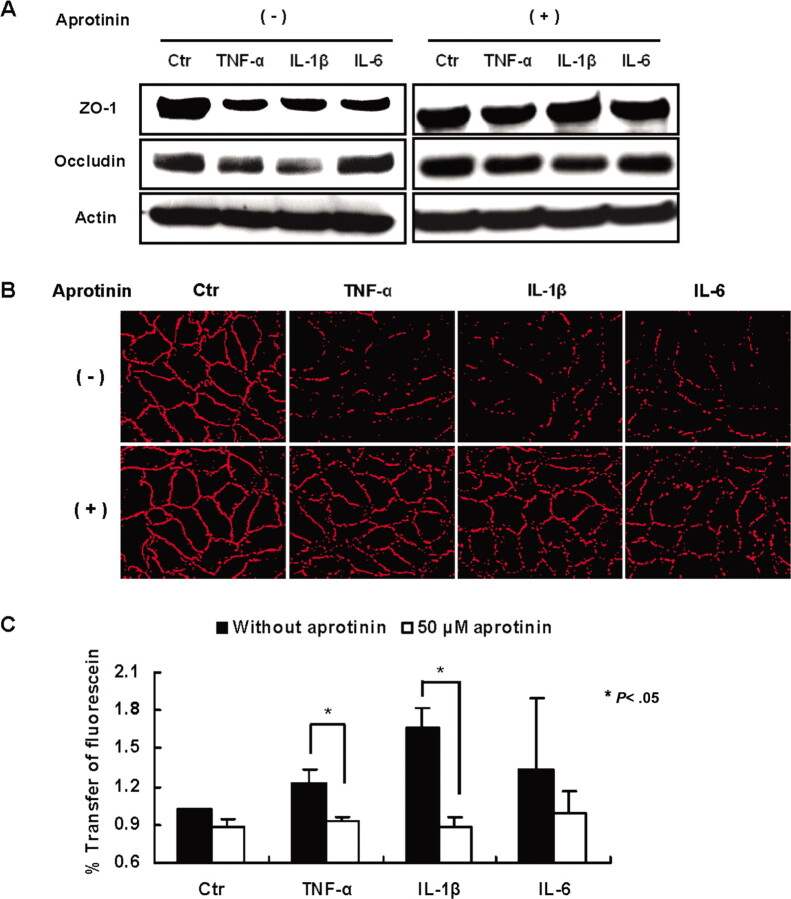
Loss of tight-junctions by cytokine treatment and its rescue by trypsin inhibitor. A, Western blotting analysis of tight-junction proteins, zonula occludens (ZO) 1 and occludin after treatment of the cells with cytokines for 12 h in the absence and presence of 50 µM aprotinin. Actin as an internal control (Ctr). B, Representative example (from 3 separate experiments) of immunofluorescence showing decreased ZO-1 with cytokine treatment and its restoration by aprotinin. C, Increased permeability of the cells treated with cytokines and its rescue by aprotinin (n=3). Data are mean value ± standard error of the mean. *P < .05 between the values with and without aprotinin.
Figure 6
Figure 6
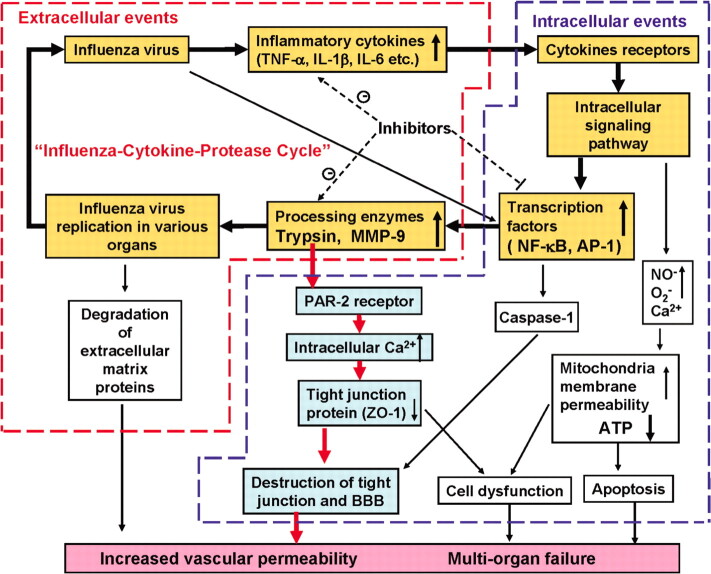
The hypothesis of influenza virus-cytokine-protease cycle, which may affect the pathogenesis of vascular hyperpermeability and tissue destruction in severe influenza. AP-1, activator protein 1; BBB, blood-brain barrier; PAR-2, protease-activated receptor 2; ZO-1 zonula, occludens-1.
Figure 5
Figure 5
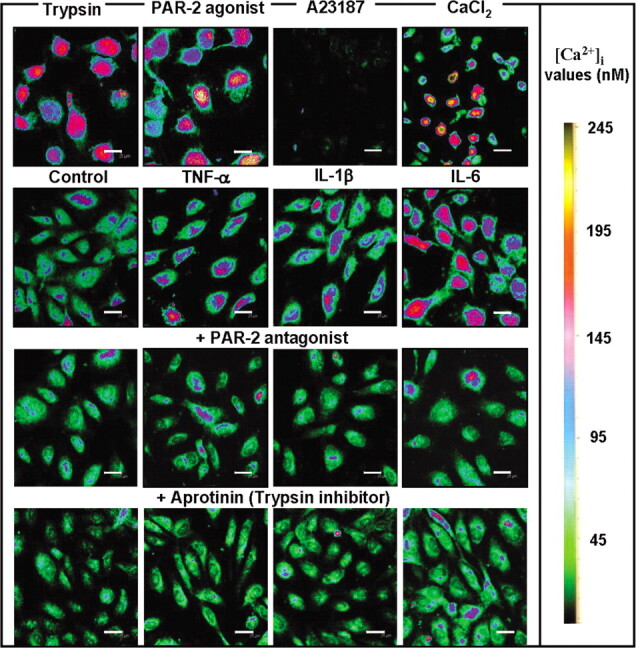
Effects of cytokines trypsin, and protease-activated receptor (PAR) 2 agonist on [Ca2+]i and rescue of the increase in [Ca2+]i by PAR-2 antagonist and aprotinin in endothelial cells. The cells were treated for 10 h with 1 µg/mL trypsin, 10 µM PAR-2 agonist, 10 mM calcium ionophore A23187, and 2 mM CaCl2. The cells were stimulated without (control) or with 10 ng/mL tumor necrosis factor (TNF) α, interleukin (IL) 1β, and IL-6. For inhibition studies on [Ca2+]i, the cells were pretreated for 30 min with 20 µM PAR-2 antagonist FSY-NH2 or 50 µM aprotinin and then treated with these cytokines. Fluorescence images of the cells were analyzed by a confocal microscope. [Ca2+]i values (nM) are displayed using a color scale. Scale bars are 25 µm.

References

    1. Lipatov AS, Govorkova EA, Webby RJ, et al. Influenza: emergence and control. J Virol. 2004;78:8951–8959. - PMC - PubMed
    1. Kim HM, Brandt CD, Arrobio JO, Murphy B, Chanock RM, Parrott RH. Influenza A and B virus infection in infants and young children during the years 1957–1976. Am J Epidemiol. 1979;109:464–79. - PubMed
    1. Dolorme L, Middleton PJ. Influenza A virus associated with acute encephalopathy. Am J Dis Child. 1979;133:822–824. - PubMed
    1. Fujimoto S, Kobayashi M, Uemura O, et al. PCR on cerebrospinal fluid to show influenza-associated acute encephalopathy or encephalitis. Lancet. 1998;352:873–875. - PubMed
    1. Kawada J, Kimura H, Ito Y, et al. Systemic cytokine responses in patients with influenza-associated encephalopathy. J Infect Dis. 2003;188:690–698. - PubMed

Publication types