


What do language barriers cost? An exploratory study among asylum seekers in Switzerland
- PMID: 20731818
- PMCID: PMC2939598
- DOI: 10.1186/1472-6963-10-248
What do language barriers cost? An exploratory study among asylum seekers in Switzerland
Abstract
Background: Language barriers have a major impact on both the quality and the costs of health care. While there is a growing body of evidence demonstrating the detrimental effects of language barriers on the quality of health care provision, less is known about their impact on costs. This purpose of this study was to investigate the association between language barriers and the costs of health care.
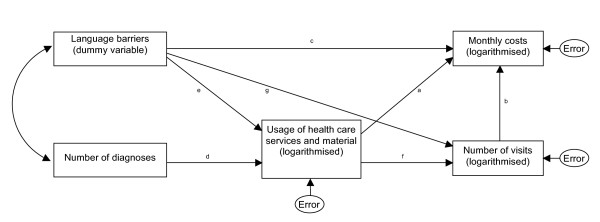
Methods: The data source was a representative set of asylum seekers whose health care was provided by a Swiss Health Maintenance Organisation (HMO). A cross-sectional survey was conducted: data was collected on all the asylum seekers' health care costs including consultations, diagnostic examinations, medical interventions, stays in the clinic, medication, and interpreter services. The data were analysed using path analysis.
Results: Asylum seekers showed higher health care costs if there were language barriers between them and the health professionals. Most of these increased costs were attributable to those patients who received interpreter services: they used more health care services and more material. However, these patients also had a lower number of visits to the HMO than patients who faced language barriers but did not receive interpreter services.
Conclusion: Language barriers impact health care costs. In line with the limited literature, the results of this study seem to show that interpreter services lead to more targeted health care, concentrating higher health care utilisation into a smaller number of visits. Although the initial costs are higher, it can be posited that the use of interpreter services prevents the escalation of long-term costs. A future study specially designed to examine this presumption is needed.
Figures
References
-
- Castles S, Miller MJ. The age of migration: international population movements in the modern world. Houndmills [etc.]: MacMillan; 1993.
-
- Messias DKH, McDowell L, Estrada RD. Language Interpreting as Social Justice Work: Perspectives of Formal and Informal Healthcare Interpreters. Advances in Nursing Science. 2009;32(2):128–143. 110.1097/ANS.1090b1013e3181a1093af1097. - PubMed
MeSH terms
LinkOut - more resources
Full Text Sources
Medical
