Performance of a craving criterion in DSM alcohol use disorders
- PMID: 20731972
- PMCID: PMC2930058
- DOI: 10.15288/jsad.2010.71.674
Performance of a craving criterion in DSM alcohol use disorders
Abstract
Objective: Adding a craving criterion--presently in the International Classification of Diseases, 10th Revision, diagnosis of alcohol dependence--has been under consideration as one possible improvement to the Diagnostic and Statistical Manual of Mental Disorders, Fourth Edition (DSM-IV), and was recently proposed for inclusion by the DSM Substance-Related Disorders Work Group in the Fifth Revision of diagnostic criteria for alcohol use disorders. To inform cross-cultural applicability of this modification, performance of a craving criterion was examined in emergency departments in four countries manifesting distinctly different culturally based drinking patterns (Mexico, Poland, Argentina, United States).
Method: Exploratory factor analysis and item response theory were used to examine psychometric properties and individual item characteristics of the 11 DSM-IV abuse and dependence criteria with and without craving for each country separately. Differential item functioning analysis was performed to examine differences in the difficulty of endorsement (severity) and discrimination of craving across countries.
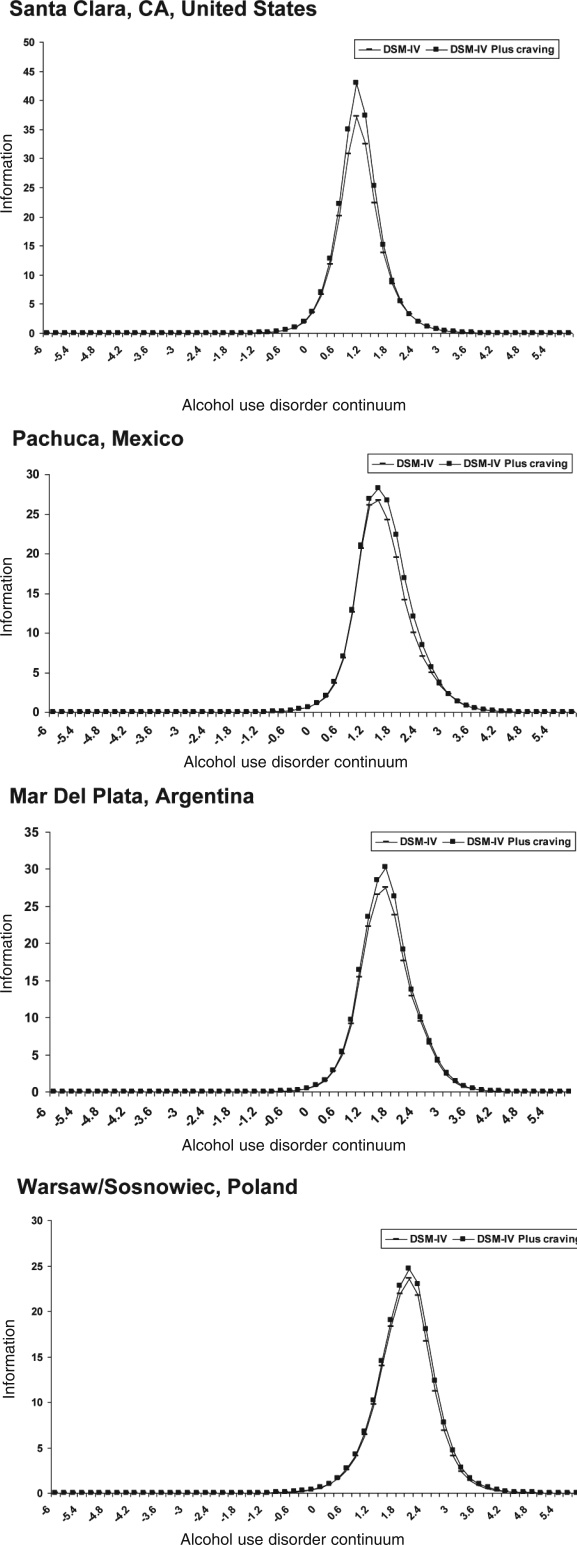
Results: Exploratory factor analysis found craving fit well within a one-dimensional solution, and factor loadings were high across all countries. Results from item-response theory analyses indicated that both discrimination and difficulty estimates for the craving item were located in the middle of the corresponding discrimination and difficulty ranges for the other 11 items for each country but did not substantially increase the efficiency (or information) of the overall diagnostic scheme. Across the four countries, no differential item functioning was found for difficulty, but significant differential item functioning was found for discrimination (similar to other DSM-IV criteria).
Conclusions: Findings suggest that, although craving performed similarly across emergency departments in the four countries, it does not add much in identification of individuals with alcohol use disorders.
Figures
References
-
- American Psychiatric Association. Diagnostic and statistical manual of mental disorders (4th ed., text rev.) Washington, DC: Author; 2000.
-
- American Psychiatric Association. DSM-5 development: Substance-related disorders. Arlington, VA: Author; 2010. Retrieved from http://wwwdsm5.org/ProposedRevisions/Pages/Substance-RelatedDisorders.aspx.
-
- Bucholz KK, Agrawal A. Should craving be added as a criterion for alcohol use disorders in DSM-V? (abstract) Alcoholism: Clinical and Experimental Research. 2009;33(Supplement):268A.
-
- Cherpitel CJ. A study of alcohol use and injuries among emergency room patients. In: Giesbrecht N, Gonzales R, Grant M, Öster-berg E, Room R, Rootman I, Towle L, editors. Drinking and casualties: Accidents, poisonings and violence in an international perspective. New York: Tavistock/Routledge; 1989. pp. 288–299.
Publication types
MeSH terms
Grants and funding
LinkOut - more resources
Full Text Sources