


Autism in fragile X syndrome: a category mistake?
- PMID: 20732628
- PMCID: PMC2943372
- DOI: 10.1016/j.jaac.2010.07.001
Autism in fragile X syndrome: a category mistake?
Abstract
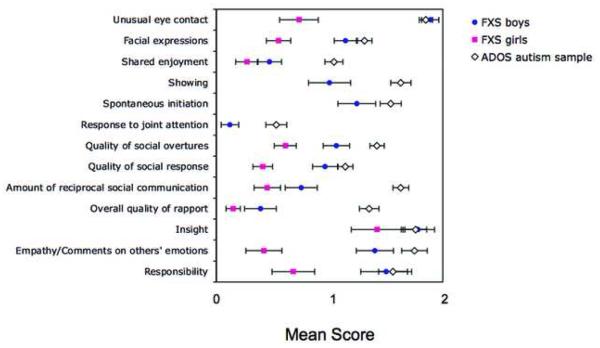
Objective: Many investigators now routinely classify children with fragile X syndrome (FXS) according to whether or not they also meet diagnostic criteria for autism. To determine whether this classification is appropriate, we examined the profiles of autistic behaviors shown by boys and girls with FXS.
Method: Individuals with FXS, aged 5 to 25 years, were assessed on two established measures of autism, the Social Communication Questionnaire (SCQ) and the Autism Diagnostic Observation Schedule (ADOS).
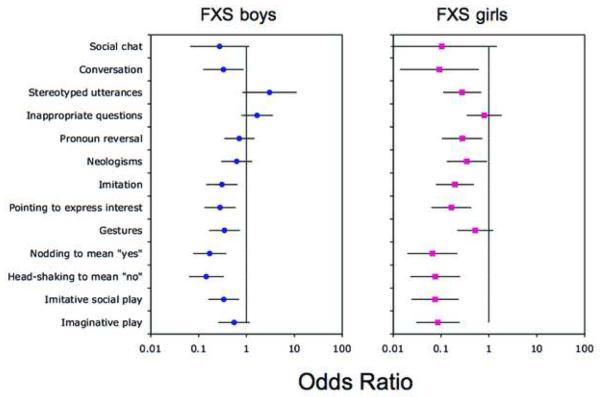
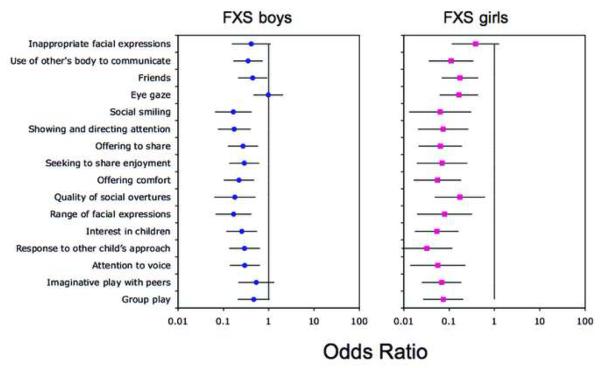
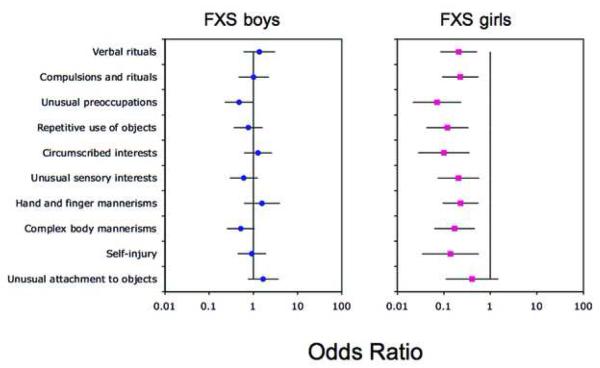
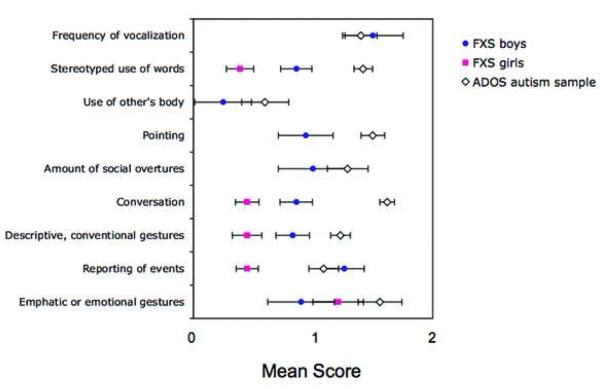
Results: We found that 35.1% of boys and 4.3% of girls with FXS scored in the "autism" category on both instruments. Analysis of the symptom profile indicated that both boys and girls with FXS showed lower rates of impairment on communication and reciprocal social interaction items than the reference autism samples on the measures. Furthermore, a regression model showed that IQ was significantly negatively associated with the SCQ total score in both boys and girls with FXS, when controlling for age, medication use, and FMRP levels.
Conclusions: These data suggest that there are significant differences in the profile of social and communicative symptomatology in FXS compared with individuals diagnosed with idiopathic autism. Given these differences, the implementation of standard autism interventions for individuals with FXS may not be optimal. Maintaining the conceptual distinction between FXS (an established biological disease) and idiopathic autism (a phenomenologically defined behavioral disorder) may also facilitate the development of more targeted and thus effective interventions for individuals with FXS in the future.
2010 American Academy of Child and Adolescent Psychiatry. Published by Elsevier Inc. All rights reserved.
Figures
References
-
- Cohen IL, Vietze PM, Sudhalter V, Jenkins EC, Brown WT. Parent-child dyadic gaze patterns in fragile X males and in non-fragile X males with autistic disorder. J Child Psychol Psychiatry. 1989 Nov;30(6):845–856. - PubMed
-
- Sudhalter V, Cohen IL, Silverman W, Wolf-Schein EG. Conversational analyses of males with fragile X, Down syndrome, and autism: comparison of the emergence of deviant language. Am J Ment Retard. 1990 Jan;94(4):431–441. - PubMed
-
- Bailey DB, Jr., Hatton DD, Skinner M, Mesibov G. Autistic behavior, FMR1 protein, and developmental trajectories in young males with fragile X syndrome. J Autism Dev Disord. 2001 Apr;31(2):165–174. - PubMed
-
- Brown WT, Jenkins EC, Friedman E, et al. Autism is associated with the fragile-X syndrome. J Autism Dev Disord. 1982 Sep;12(3):303–308. - PubMed
Publication types
MeSH terms
Grants and funding
LinkOut - more resources
Full Text Sources
Medical
