Review
. 2010 Oct;22(10):797-803.
doi: 10.1093/intimm/dxq437. Epub 2010 Aug 23.

Making memories that last a lifetime: heritable functions of self-renewing memory CD8 T cells

Affiliations
Review

Making memories that last a lifetime: heritable functions of self-renewing memory CD8 T cells

Ben Youngblood et al. Int Immunol. 2010 Oct.

Abstract

Clonal expansion of virus-specific naive T cells during an acute viral infection results in the formation of memory CD8 T cells that provide the host with long-term protective immunity against the pathogen. Memory CD8 T cells display enhanced effector functions compared with their naive precursors, allowing them to respond more rapidly and effectively to antigen re-encounter. The enhanced functions of memory CD8 T cells are mediated by heritable changes in gene regulation. Expression of select transcription factors along with locus-specific epigenetic modifications are coupled to and are essential in the formation of memory-specific gene expression patterns. Here, we will review the changes in gene expression that accompany development of memory CD8 T cells and discuss chromatin modifications as a potential means for heritable propagation of these changes during homeostatic cell division of self-renewing memory CD8 T cells. Also, we will discuss therapies that manipulate heritable gene regulation as a potential mechanism to restore function to non-functional memory CD8 T cells to combat chronic viral infection.


Figures
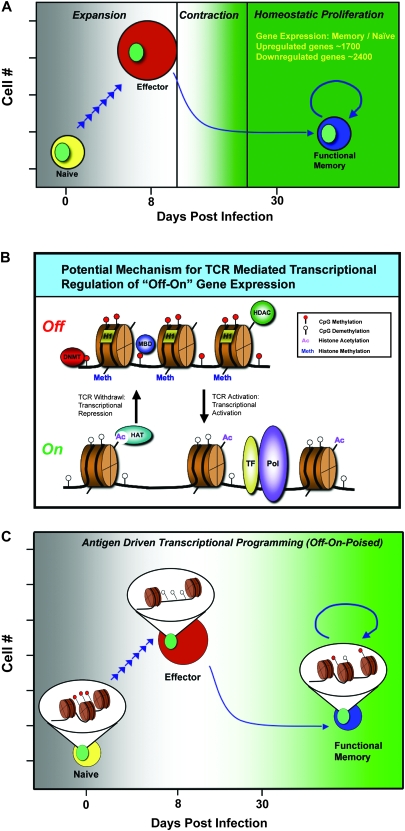
Fig. 1.
Fig. 1.
Mechanisms for acquired heritable changes in gene expression in the formation of functional memory CD8 T cells. (A) Cartoon depiction of antigen-driven clonal expansion (∼105 fold) of naive CD8 T cells differentiating into cytolytic effector cells. The effector cell population contracts 90–95% yielding a functional memory cell population that is capable of antigen-independent homeostatic proliferation. Gray = slow antigen-driven response, white = active antigen-driven response and green = poised for rapid antigen-driven response. The y-axis is a log scale. Differential gene expression values of memory versus naive cells were reported by Sarkar et al. (17). (B) Heritable chromatin accessibility is mediated by epigenetic modifications. Histone (brown cylinder) hypoacetylation and DNA (black line) hypomethylation correspond to transcriptional activation. Compact heterochromatin contains Mbd proteins and other to be determined proteins that block transcription factors (TF) and the RNA polymerase (Pol) from accessing the gene of interest. A list of known enzymes and proteins involved in the epigenetic process includes histone acetlyltransferases (HAT), DNA methyltransferases (Dnmt), histone deacetylases (HDAC) and proteins containing a methylated DNA binding domain (Mbd). Modifications to epigenetic marks are acquired for several different genes following TCR signaling of CD8 T cells. Genes programmed for downregulation obtain repressive marks correlated with chromatin condensation during the “off” stage of transcription, while activating marks are obtained by genes that become accessible to transcription factors and polymerase. (C) An emerging mechanism to explain the rapid recall potential of memory CD8 T cells suggests that genes that are rapidly expressed upon TCR-mediated activation have an acquired epigenetic program that either allows quick access by TF or is a result of the persistent presence of a TF.

References

    1. Wherry EJ, Ahmed R. Memory CD8 T-cell differentiation during viral infection. J. Virol. 2004;78:5535. - PMC - PubMed
    1. Ahmed R, Gray D. Immunological memory and protective immunity: understanding their relation. Science. 1996;272:54. - PubMed
    1. Bevan MJ, Goldrath AW. T-cell memory: you must remember this. Curr. Biol. 2000;10:R338. - PubMed
    1. Doherty PC, Topham DJ, Tripp RA. Establishment and persistence of virus-specific CD4+ and CD8+ T cell memory. Immunol. Rev. 1996;150:23. - PubMed
    1. Lefrancois L, Masopust D. T cell immunity in lymphoid and non-lymphoid tissues. Curr. Opin. Immunol. 2002;14:503. - PubMed

Publication types
