


Predicting sensation seeking from dopamine genes. A candidate-system approach
- PMID: 20732903
- PMCID: PMC3031097
- DOI: 10.1177/0956797610380699
Predicting sensation seeking from dopamine genes. A candidate-system approach
Abstract
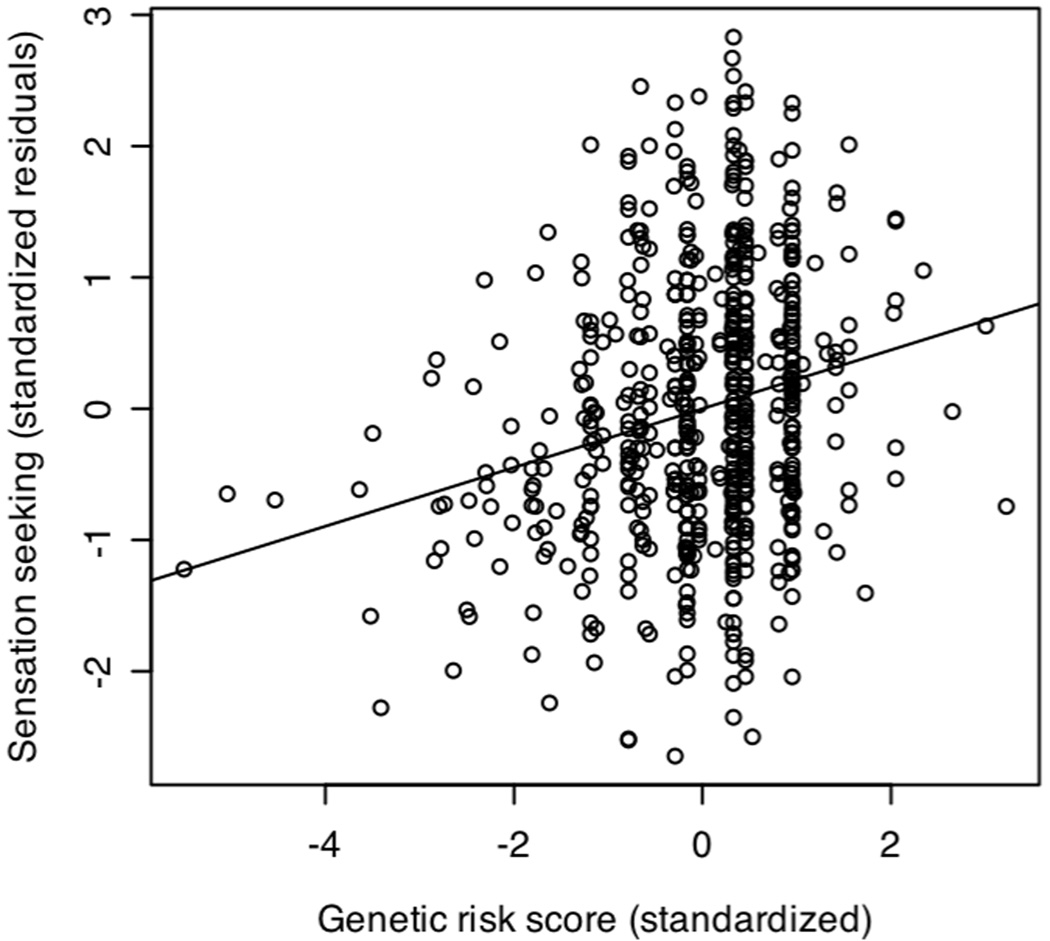
Sensation seeking is a heritable personality trait that has been reliably linked to behavioral disorders. The dopamine system has been hypothesized to contribute to variations in sensation seeking between different individuals, and both experimental and observational studies in humans and nonhuman animals provide evidence for the involvement of the dopamine system in sensation-seeking behavior. In this study, we took a candidate-system approach to genetic association analysis of sensation-seeking behavior. We analyzed single-nucleotide polymorphisms (SNPs) from a number of dopaminergic genes. Using 273 SNPs from eight dopamine genes in a sample of 635 unrelated individuals, we examined the aggregate effect of SNPs that were significantly associated with sensation-seeking behavior. Multiple SNPs in four dopamine genes accounted for significant variance in sensation-seeking behavior between individuals. These results suggest that multiple SNPs, aggregated within genes that are relevant to a specific neurobiological system, form a genetic-risk score that may explain a significant proportion of observed variance in human traits such as sensation-seeking behavior.
Figures
Comment in
-
Predicting sensation seeking from dopamine genes: use and misuse of genetic prediction.Psychol Sci. 2011 Mar;22(3):413-5. doi: 10.1177/0956797610397669. Epub 2011 Jan 26. Psychol Sci. 2011. PMID: 21270448 No abstract available.
References
-
- Akaike H. A new look at the statistical model identification. IEEE Transactions on Automatic Control. 1974;19:716–723.
-
- Ball SA, Carroll KM, Rounsaville BJ. Sensation seeking, substance abuse, and psychopathology in treatment-seeking and community cocaine abusers. Journal of Consulting and Clinical Psychology. 1994;62:1053–1057. - PubMed
-
- Beaver KM. The interaction between genetic risk and childhood sexual abuse in the prediction of adolescent violent behavior. Sexual Abuse: A Journal of Research and Treatment. 2009;20:426–443. - PubMed
-
- Benjamin J, Ebstein RP, Belmaker RH. Genes for human personality traits: “Endophenotypes” of psychiatric disorders? World Journal of Biological Psychology. 2001;2:54–57. - PubMed
-
- Benjamini Y, Hochberg Y. Controlling the false discovery rate: A practical and powerful approach to multiple testing. Journal of the Royal Statistical Society. Series B, Statistical Methodology. 1995;57:289–300.
Publication types
MeSH terms
Substances
Grants and funding
- U01HG004438/HG/NHGRI NIH HHS/United States
- U01 HG004438/HG/NHGRI NIH HHS/United States
- DA024722/DA/NIDA NIH HHS/United States
- P01 CA089392/CA/NCI NIH HHS/United States
- K01 DA024722/DA/NIDA NIH HHS/United States
- HHSN268200782096C/HG/NHGRI NIH HHS/United States
- U01 HG004422/HG/NHGRI NIH HHS/United States
- K02 AA018755/AA/NIAAA NIH HHS/United States
- N01 HG072096/HG/NHGRI NIH HHS/United States
- U01 DE017018/DE/NIDCR NIH HHS/United States
- U10 AA008401/AA/NIAAA NIH HHS/United States
- U10AA008401/AA/NIAAA NIH HHS/United States
- U01 HG004446/HG/NHGRI NIH HHS/United States
- R01 DA019963/DA/NIDA NIH HHS/United States
- R01 DA013423/DA/NIDA NIH HHS/United States
LinkOut - more resources
Full Text Sources
Other Literature Sources
