


Cortico-striatal connections predict control over speed and accuracy in perceptual decision making
- PMID: 20733082
- PMCID: PMC2936628
- DOI: 10.1073/pnas.1004932107
Cortico-striatal connections predict control over speed and accuracy in perceptual decision making
Abstract
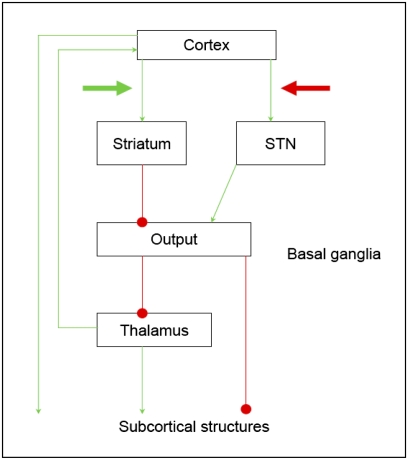
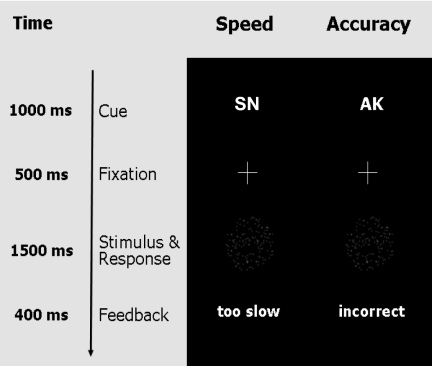
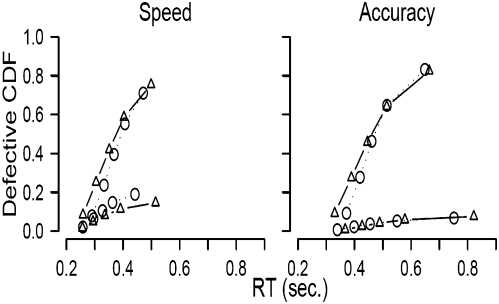
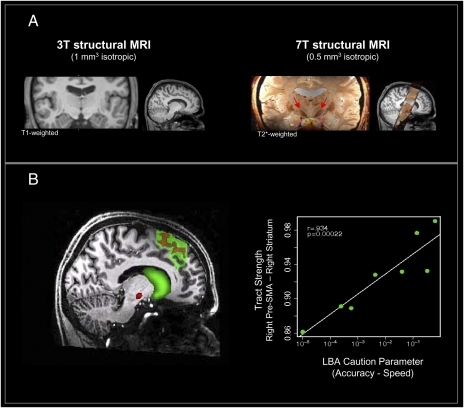
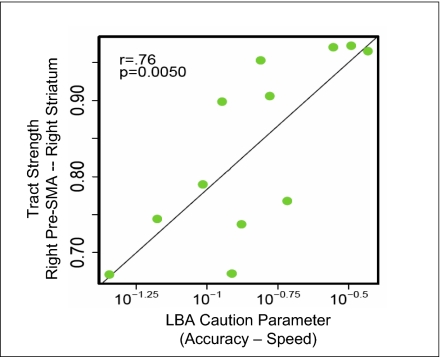
When people make decisions they often face opposing demands for response speed and response accuracy, a process likely mediated by response thresholds. According to the striatal hypothesis, people decrease response thresholds by increasing activation from cortex to striatum, releasing the brain from inhibition. According to the STN hypothesis, people decrease response thresholds by decreasing activation from cortex to subthalamic nucleus (STN); a decrease in STN activity is likewise thought to release the brain from inhibition and result in responses that are fast but error-prone. To test these hypotheses-both of which may be true-we conducted two experiments on perceptual decision making in which we used cues to vary the demands for speed vs. accuracy. In both experiments, behavioral data and mathematical model analyses confirmed that instruction from the cue selectively affected the setting of response thresholds. In the first experiment we used ultra-high-resolution 7T structural MRI to locate the STN precisely. We then used 3T structural MRI and probabilistic tractography to quantify the connectivity between the relevant brain areas. The results showed that participants who flexibly change response thresholds (as quantified by the mathematical model) have strong structural connections between presupplementary motor area and striatum. This result was confirmed in an independent second experiment. In general, these findings show that individual differences in elementary cognitive tasks are partly driven by structural differences in brain connectivity. Specifically, these findings support a cortico-striatal control account of how the brain implements adaptive switches between cautious and risky behavior.
Conflict of interest statement
The authors declare no conflict of interest.
Figures
References
-
- Bogacz R, Wagenmakers EJ, Forstmann BU, Nieuwenhuis S. The neural basis of the speed-accuracy tradeoff. Trends Neurosci. 2010;33:10–16. - PubMed
-
- Chittka L, Dyer AG, Bock F, Dornhaus A. Psychophysics: Bees trade off foraging speed for accuracy. Nature. 2003;424:388. - PubMed
-
- Uchida N, Mainen ZF. Speed and accuracy of olfactory discrimination in the rat. Nat Neurosci. 2003;6:1224–1229. - PubMed
-
- Rinberg D, Koulakov A, Gelperin A. Speed-accuracy tradeoff in olfaction. Neuron. 2006;51:351–358. - PubMed
MeSH terms
LinkOut - more resources
Full Text Sources
