


Accelerated repetitive transcranial magnetic stimulation for treatment-resistant depression
- PMID: 20734360
- PMCID: PMC3020591
- DOI: 10.1002/da.20731
Accelerated repetitive transcranial magnetic stimulation for treatment-resistant depression
Abstract
Background: Repetitive transcranial magnetic stimulation (rTMS) has shown safety and efficacy for treatment-resistant depression, but requires daily treatment for 4-6 weeks. Accelerated TMS, with all treatments delivered over a few days, would have significant advantages in terms of access and patient acceptance.
Methods: Open-label accelerated TMS (aTMS), consisting of 15 rTMS sessions administered over 2 days, was tested in 14 depressed patients not responding to at least one antidepressant medication. Effects on depression, anxiety, and cognition were assessed the day following treatment, then after 3 and 6 weeks.
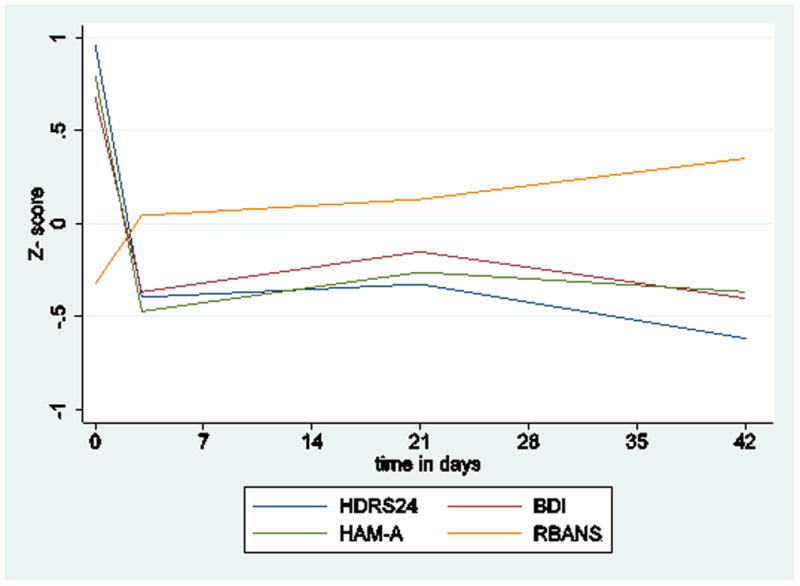
Results: No seizure activity was observed and only one patient had a serious adverse event (increased suicidal ideation). Two patients failed to complete a full course of aTMS treatments, and 36% did not complete all study visits. Depression and anxiety significantly decreased following aTMS treatments and improvements persisted 3 and 6 weeks later. Response rates immediately following treatment and at 3 and 6 weeks were 43, 36, and 36%, respectively. Remission rates at the same timepoints were 29, 36, and 29%.
Conclusions: Accelerated TMS demonstrated an excellent safety profile with efficacy comparable to that achieved in daily rTMS in other trials. Limitations primarily include open-label treatment and a small sample size.
Depression and Anxiety, 2010. © 2010 Wiley-Liss, Inc.
Conflict of interest statement
CONFLICT OF INTEREST STATEMENT
PEH has received grant funding from the Dana Foundation, Greenwall Foundation, NARSAD, National Institute of Mental Health (NIMH) (K23 MH077869), National Institutes of Health Loan Repayment Program, Northstar, Inc., Stanley Medical Research Institute, and Woodruff Foundation; he has received consulting fees from AvaCat Consulting, St. Jude Medical Neuromodulation and Oppenheimer & Co.
WMM has received grant funding from the NIMH (R01 MH069886: Optimization of TMS in the Treatment of Depression) which uses Neuronetics transcranial magnetic stimulators. Dr. McDonald works for Emory University which holds the patent for the magnetic stimulators gused in that trial. Dr. McDonald also receives grant funding from the National Institute of Neurological Disease and Stroke (R01 NS046487) for a trial that is evaluating antidepressant medication in PD donated by Smith Kline (Paxil CR) and Wyeth (Effexor XR).
CME has received patent royalties and consulting fees from Neuronetics, Inc. (Note that the present study did not receive any support from Neuronetics. Neuronetics did not contribute to the design of the study or data analyses, nor did the study use a Neuronetics device.) Dr. Epstein has received research support from GlaxoSmithKline, Inc. and UCB, Inc. for studies unrelated to depression.
No other authors report any conflicts of interest over the past 3 years.
Figures
References
-
- O’Reardon JP, Solvason HB, Janicak PG, et al. Efficacy and safety of transcranial magnetic stimulation in the acute treatment of major depression: a multisite randomized controlled trial. Biol Psychiatry. 2007;62(11):1208–16. - PubMed
-
- Avery DH, Holtzheimer PE, 3rd, Fawaz W, et al. A controlled study of repetitive transcranial magnetic stimulation in medication-resistant major depression. Biol Psychiatry. 2006;59(2):187–94. - PubMed
-
- Avery DH, Isenberg KE, Sampson SM, et al. Transcranial magnetic stimulation in the acute treatment of major depressive disorder: clinical response in an open-label extension trial. J Clin Psychiatry. 2008;69(3):441–51. - PubMed
-
- Lisanby SH, Husain MM, Rosenquist PB, et al. Daily left prefrontal repetitive transcranial magnetic stimulation in the acute treatment of major depression: clinical predictors of outcome in a multisite, randomized controlled clinical trial. Neuropsychopharmacology. 2009;34(2):522–34. - PubMed
-
- George MS, Lisanby SH, Avery D, et al. Daily left prefrontal transcranial magnetic stimulation therapy for major depressive disorder: A sham-controlled randomized trial. Arch Gen Psychiatry. 2010;67(5):507–516. - PubMed
Publication types
MeSH terms
Substances
Grants and funding
LinkOut - more resources
Full Text Sources
Other Literature Sources
Medical
