


Familial hemiplegic migraine Ca(v)2.1 channel mutation R192Q enhances ATP-gated P2X3 receptor activity of mouse sensory ganglion neurons mediating trigeminal pain
- PMID: 20735819
- PMCID: PMC2940876
- DOI: 10.1186/1744-8069-6-48
Familial hemiplegic migraine Ca(v)2.1 channel mutation R192Q enhances ATP-gated P2X3 receptor activity of mouse sensory ganglion neurons mediating trigeminal pain
Abstract
Background: The R192Q mutation of the CACNA1A gene, encoding for the α1 subunit of voltage-gated P/Q Ca2+ channels (Ca(v)2.1), is associated with familial hemiplegic migraine-1. We investigated whether this gain-of-function mutation changed the structure and function of trigeminal neuron P2X3 receptors that are thought to be important contributors to migraine pain.
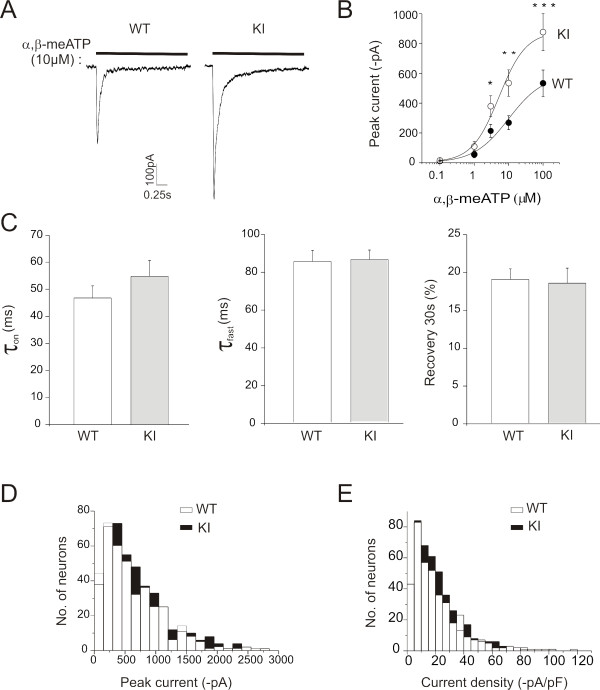
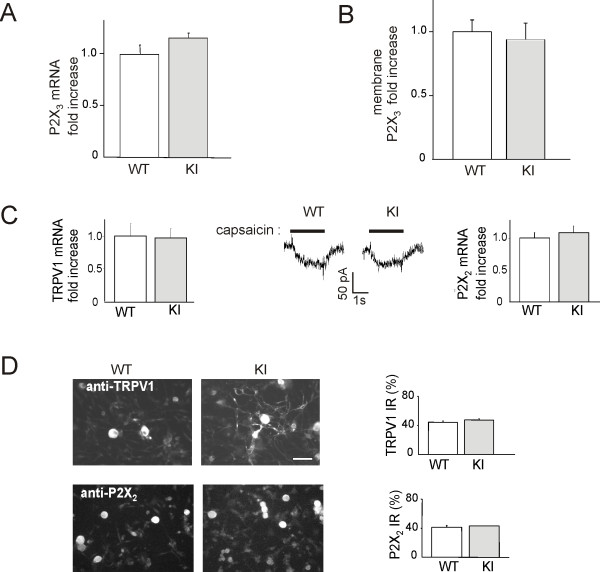
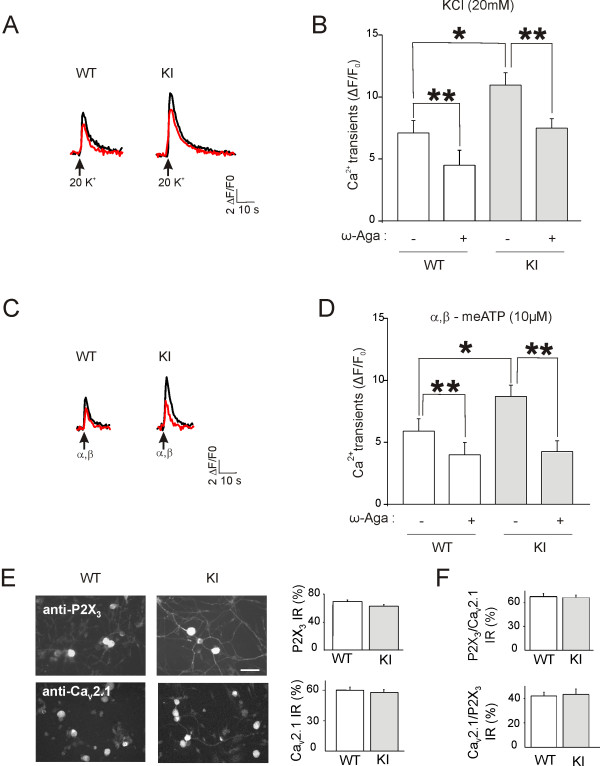
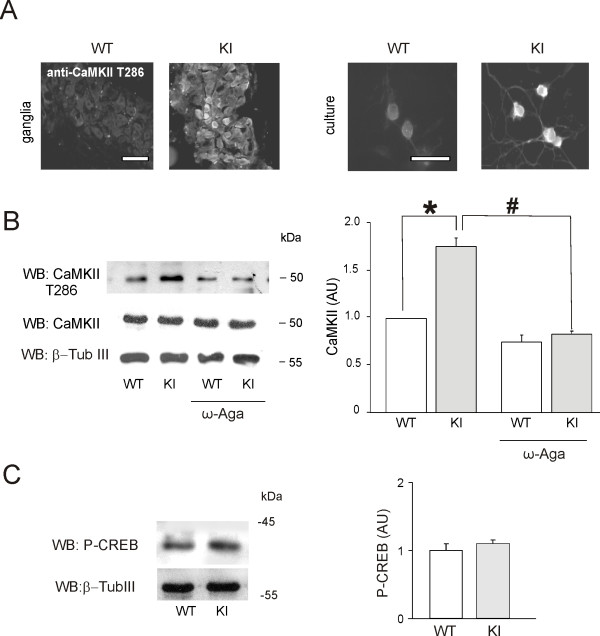
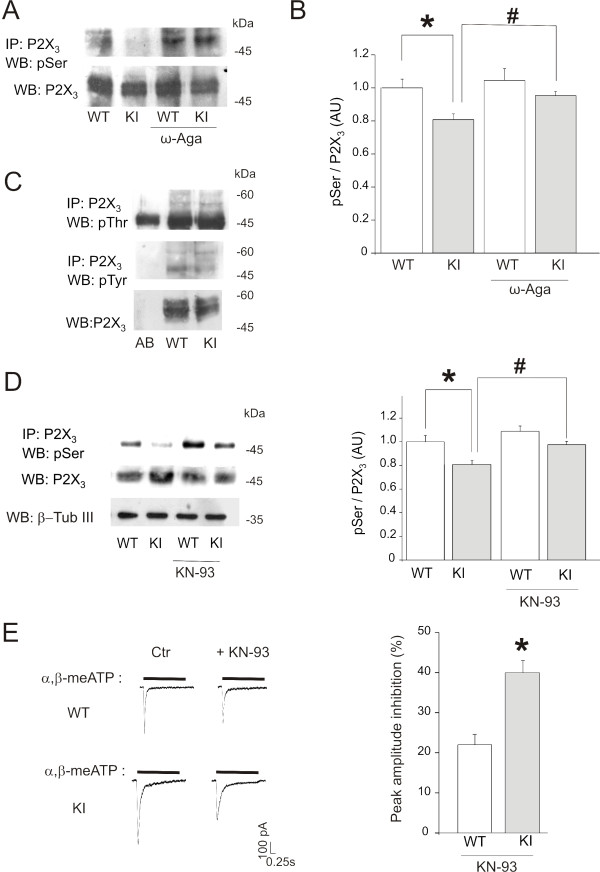
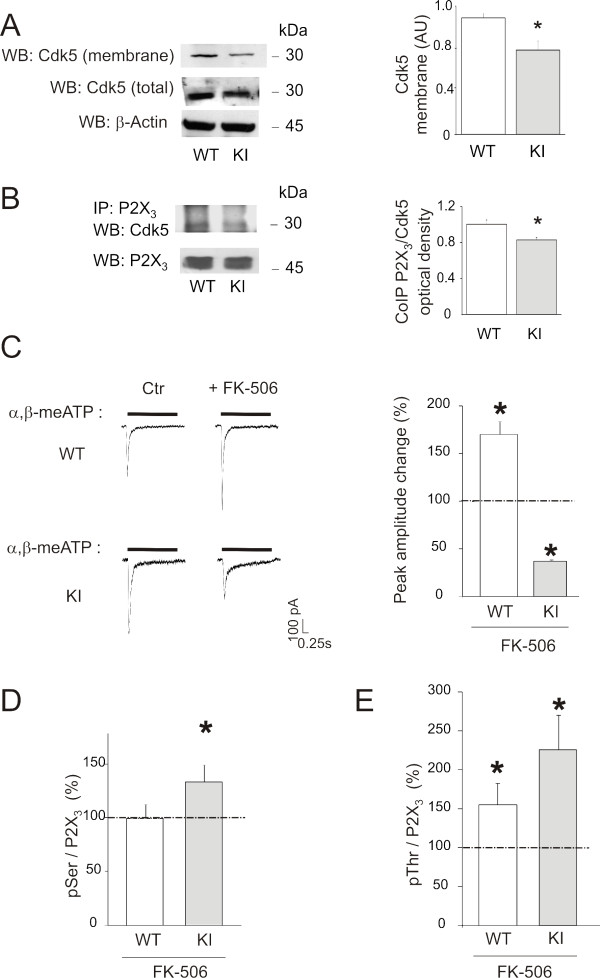
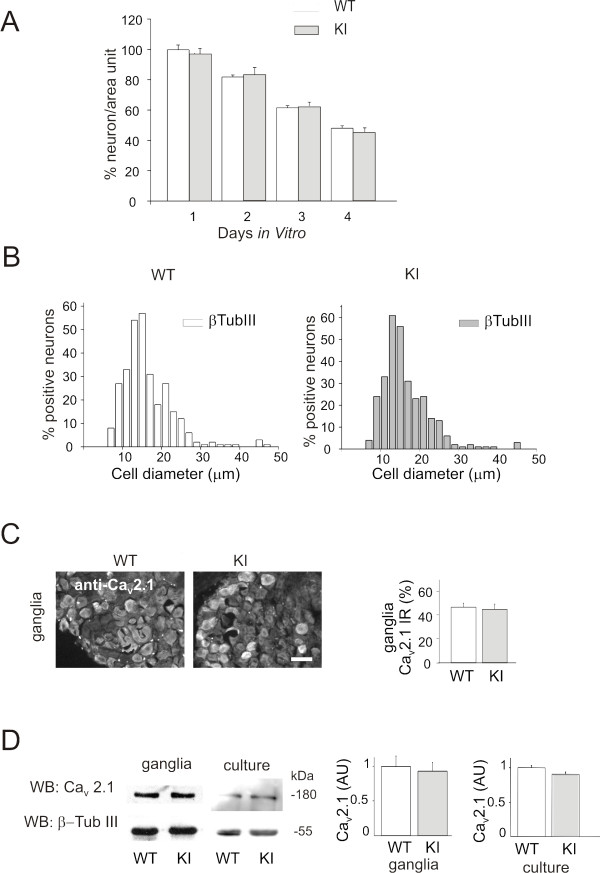
Results: Using in vitro trigeminal sensory neurons of a mouse genetic model knockin for the CACNA1A R192Q mutation, we performed patch clamp recording and intracellular Ca2+ imaging that showed how these knockin ganglion neurons generated P2X3 receptor-mediated responses significantly larger than wt neurons. These enhanced effects were reversed by the Ca(v)2.1 blocker ω-agatoxin. We, thus, explored intracellular signalling dependent on kinases and phosphatases to understand the molecular regulation of P2X3 receptors of knockin neurons. In such cells we observed strong activation of CaMKII reversed by ω-agatoxin treatment. The CaMKII inhibitor KN-93 blocked CaMKII phosphorylation and the hyperesponsive P2X3 phenotype. Although no significant difference in membrane expression of knockin receptors was found, serine phosphorylation of knockin P2X3 receptors was constitutively decreased and restored by KN-93. No change in threonine or tyrosine phosphorylation was detected. Finally, pharmacological inhibitors of the phosphatase calcineurin normalized the enhanced P2X3 receptor responses of knockin neurons and increased their serine phosphorylation.
Conclusions: The present results suggest that the CACNA1A mutation conferred a novel molecular phenotype to P2X3 receptors of trigeminal ganglion neurons via CaMKII-dependent activation of calcineurin that selectively impaired the serine phosphorylation state of such receptors, thus potentiating their effects in transducing trigeminal nociception.
Figures
References
-
- International Headache Society. The International Classification of Headache Disorders, 2nd edition. Cephalalgia. 2004;24:S1–S160. - PubMed
-
- Ophoff RA, Terwindt GM, Vergouwe MN, van Eijk R, Oefner PJ, Hoffman SM, Lamerdin JE, Mohrenweiser HW, Bulman DE, Ferrari M, Haan J, Lindhout D, van Ommen GJ, Hofker MH, Ferrari MD, Frants RR. Familial hemiplegic migraine and episodic ataxia type-2 are caused by mutations in the Ca2+ channel gene CACNL1A4. Cell. 1996;87:543–552. doi: 10.1016/S0092-8674(00)81373-2. - DOI - PubMed
-
- Tottene A, Conti R, Fabbro A, Vecchia D, Shapovalova M, Santello M, van den Maagdenberg AM, Ferrari MD, Pietrobon D. Enhanced excitatory transmission at cortical synapses as the basis for facilitated spreading depression in CaV2.1 knockin migraine mice. Neuron. 2009;61:762–773. doi: 10.1016/j.neuron.2009.01.027. - DOI - PubMed
-
- van den Maagdenberg AM, Pietrobon D, Pizzorusso T, Kaja S, Broos LA, Cesetti T, van de Ven RC, Tottene A, van der Kaa J, Plomp JJ, Frants RR, Ferrari MD. A Cacna1a knockin migraine mouse model with increased susceptibility to cortical spreading depression. Neuron. 2004;41:701–710. doi: 10.1016/S0896-6273(04)00085-6. - DOI - PubMed
Publication types
MeSH terms
Substances
Grants and funding
LinkOut - more resources
Full Text Sources
Medical
Miscellaneous
