Cognitive behavioral therapy vs relaxation with educational support for medication-treated adults with ADHD and persistent symptoms: a randomized controlled trial
- PMID: 20736471
- PMCID: PMC3641654
- DOI: 10.1001/jama.2010.1192
Cognitive behavioral therapy vs relaxation with educational support for medication-treated adults with ADHD and persistent symptoms: a randomized controlled trial
Abstract
Context: Attention-deficit/hyperactivity disorder (ADHD) in adulthood is a prevalent, distressing, and impairing condition that is not fully treated by pharmacotherapy alone and lacks evidence-based psychosocial treatments.
Objective: To test cognitive behavioral therapy for ADHD in adults treated with medication but who still have clinically significant symptoms.
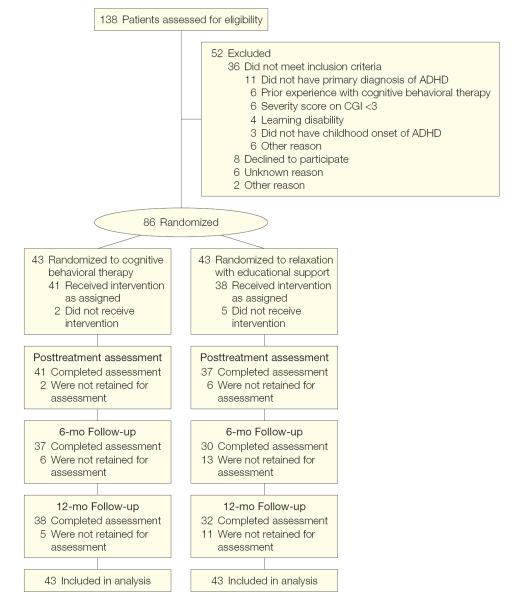
Design, setting, and patients: Randomized controlled trial assessing the efficacy of cognitive behavioral therapy for 86 symptomatic adults with ADHD who were already being treated with medication. The study was conducted at a US hospital between November 2004 and June 2008 (follow-up was conducted through July 2009). Of the 86 patients randomized, 79 completed treatment and 70 completed the follow-up assessments.
Interventions: Patients were randomized to 12 individual sessions of either cognitive behavioral therapy or relaxation with educational support (which is an attention-matched comparison).
Main outcome measures: The primary measures were ADHD symptoms rated by an assessor (ADHD rating scale and Clinical Global Impression scale) at baseline, posttreatment, and at 6- and 12-month follow-up. The assessor was blinded to treatment condition assignment. The secondary outcome measure was self-report of ADHD symptoms.
Results: Cognitive behavioral therapy achieved lower posttreatment scores on both the Clinical Global Impression scale (magnitude -0.0531; 95% confidence interval [CI], -1.01 to -0.05; P = .03) and the ADHD rating scale (magnitude -4.631; 95% CI, -8.30 to -0.963; P = .02) compared with relaxation with educational support. Throughout treatment, self-reported symptoms were also significantly more improved for cognitive behavioral therapy (beta = -0.41; 95% CI, -0.64 to -0.17; P <001), and there were more treatment responders in cognitive behavioral therapy for both the Clinical Global Impression scale (53% vs 23%; odds ratio [OR], 3.80; 95% CI, 1.50 to 9.59; P = .01) and the ADHD rating scale (67% vs 33%; OR, 4.29; 95% CI, 1.74 to 10.58; P = .002). Responders and partial responders in the cognitive behavioral therapy condition maintained their gains over 6 and 12 months.
Conclusion: Among adults with persistent ADHD symptoms treated with medication, the use of cognitive behavioral therapy compared with relaxation with educational support resulted in improved ADHD symptoms, which were maintained at 12 months.
Trial registration: clinicaltrials.gov Identifier: NCT00118911.
Figures

Comment in
-
CBT is effective in reducing symptoms in adults with ADHD whose symptoms persist following pharmacotherapy.Evid Based Ment Health. 2011 Feb;14(1):28. doi: 10.1136/ebmh.14.1.28. Evid Based Ment Health. 2011. PMID: 21266625 No abstract available.
References
-
- American Psychiatric Association . Diagnostic and Statistical Manual of Mental Disorders. 4th ed, text revision American Psychiatric Association; Washington, DC: 2000.
-
- Prince J, Wilens T, Spencer T, Biederman J. Pharmacotherapy of ADHD in adults. In: Barkley RA, editor. Attention-Deficit Hyperactivity Disorder: A Handbook for Diagnosis and Treatment. 3rd ed Guilford; New York, NY: 2006. pp. 704–736.
-
- Steele M, Jensen PS, Quinn DMP. Remission versus response as the goal of therapy in ADHD: a new standard for the field? Clin Ther. 2006;28(11):1892–1908. - PubMed
Publication types
MeSH terms
Associated data
Grants and funding
LinkOut - more resources
Full Text Sources
Other Literature Sources
Medical