


NRAS mutations are rare in colorectal cancer
- PMID: 20736745
- PMCID: PMC2929976
- DOI: 10.1097/PDM.0b013e3181c93fd1
NRAS mutations are rare in colorectal cancer
Abstract
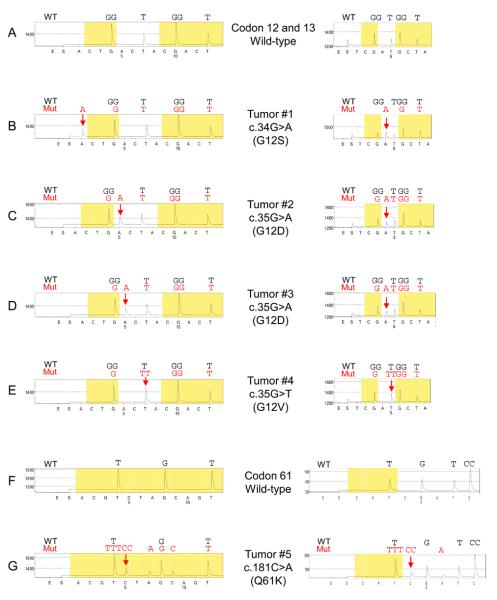
Activating mutations in members of the RAS oncogene family (KRAS, HRAS, and NRAS) have been found in a variety of human malignancies, suggesting a dominant role in carcinogenesis. In colon cancers, KRAS mutations are common and clearly contribute to malignant progression. The frequency of NRAS mutations and their relationship with clinical, pathologic, and molecular features remains uncertain. We developed and validated a Pyroseqencing assay to detect NRAS mutations at codons 12, 13, and 61. Using a collection of 225 colorectal cancers from 2 prospective cohort studies, we examined the relationship between NRAS mutations, clinical outcome, and other molecular features, including mutation of KRAS, BRAF, and PIK3CA, microsatellite instability, and the CpG island methylator phenotype. Finally, we examined whether NRAS mutation was associated with patient survival or prognosis. NRAS mutations were detected in 5 (2.2%) of the 225 colorectal cancers and tended to occur in left-sided cancers arising in women, but did not seem to be associated with any of the molecular features that were examined.
Figures
References
-
- Banerji U, Affolter A, Judson I, et al. BRAF and NRAS mutations in melanoma: potential relationships to clinical response to HSP90 inhibitors. Mol Cancer Ther. 2008;7:737–739. - PubMed
-
- Barault L, Veyrie N, Jooste V, et al. Mutations in the RAS-MAPK, PI(3)K (phosphatidylinositol-3-OH kinase) signaling network correlate with poor survival in a population-based series of colon cancers. Int J Cancer. 2008;122:2255–2259. - PubMed
-
- Boland CR, Thibodeau SN, Hamilton SR, et al. A National Cancer Institute Workshop on Microsatellite Instability for cancer detection and familial predisposition: development of international criteria for the determination of microsatellite instability in colorectal cancer. Cancer Res. 1998;58:5248–5257. - PubMed
-
- Bos JL. ras oncogenes in human cancer: a review. Cancer Res. 1989;49:4682–4689. - PubMed
-
- Campbell SL, Khosravi-Far R, Rossman KL, et al. Increasing complexity of Ras signaling. Oncogene. 1998;17:1395–1413. - PubMed
Publication types
MeSH terms
Substances
Grants and funding
LinkOut - more resources
Full Text Sources
Medical
Research Materials
Miscellaneous
