


Diet, but not oral probiotics, effectively reduces urinary oxalate excretion and calcium oxalate supersaturation
- PMID: 20736987
- PMCID: PMC3923490
- DOI: 10.1038/ki.2010.310
Diet, but not oral probiotics, effectively reduces urinary oxalate excretion and calcium oxalate supersaturation
Abstract
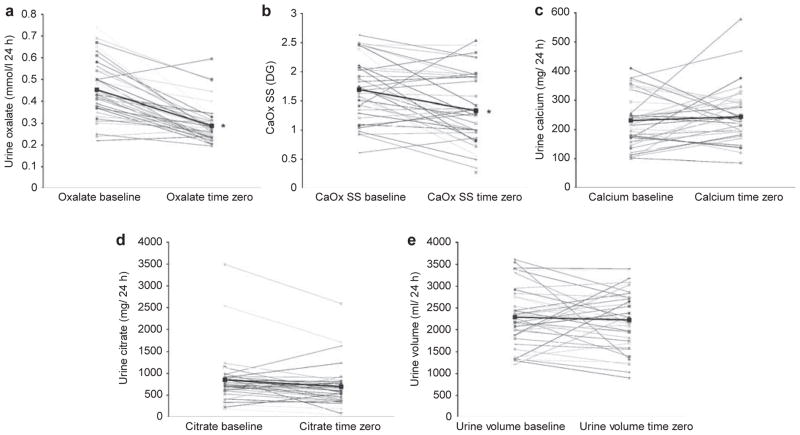
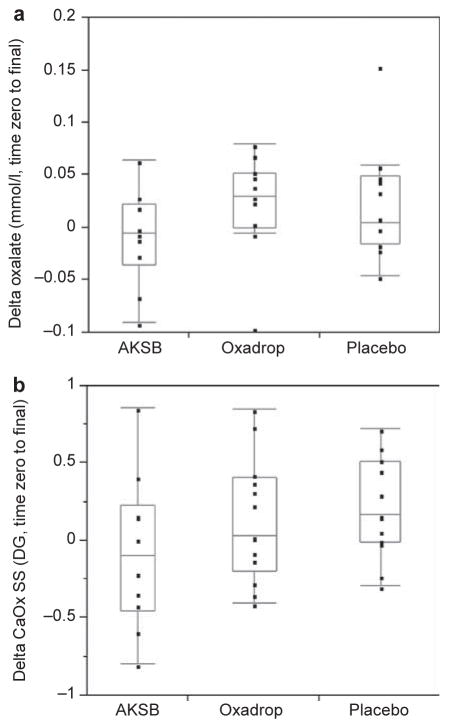
We examined the effect of a controlled diet and two probiotic preparations on urinary oxalate excretion, a risk factor for calcium oxalate kidney stone formation, in patients with mild hyperoxaluria. Patients were randomized to a placebo, a probiotic, or a synbiotic preparation. This tested whether these probiotic preparations can increase oxalate metabolism in the intestine and/or decrease oxalate absorption from the gut. Patients were maintained on a controlled diet to remove the confounding variable of differing oxalate intake from food. Urinary oxalate excretion and calcium oxalate supersaturation on the controlled diet were significantly lower compared with baseline on a free-choice diet. Neither study preparation reduced urinary oxalate excretion nor calcium oxalate supersaturation. Fecal lactobacilli colony counts increased on both preparations, whereas enterococcal and yeast colony counts were increased on the synbiotic. Total urine volume and the excretion of oxalate and calcium were all strong independent determinants of urinary calcium oxalate supersaturation. Hence, dietary oxalate restriction reduced urinary oxalate excretion, but the tested probiotics did not influence urinary oxalate levels in patients on a restricted oxalate diet. However, this study suggests that dietary oxalate restriction is useful for kidney stone prevention.
Trial registration: ClinicalTrials.gov NCT00587041.
Conflict of interest statement
DISCLOSURE
Agri-King performed quantitative stool cultures for the study, and VSL and Agri-King supplied the study preparations used in this protocol. One of the authors (CDS) has a financial interest in VSL.
Figures

Comment in
-
Probiotics and dietary manipulations in calcium oxalate nephrolithiasis: two sides of the same coin?Kidney Int. 2010 Dec;78(11):1063-5. doi: 10.1038/ki.2010.345. Kidney Int. 2010. PMID: 21076446
-
Re: diet, but not oral probiotics, effectively reduces urinary oxalate excretion and calcium oxalate supersaturation.J Urol. 2011 Feb;185(2):549-50. doi: 10.1016/S0022-5347(11)60120-1. J Urol. 2011. PMID: 22088636 No abstract available.
References
-
- Unwin R, Wrong O, Cohen E, et al. Unraveling of the molecular mechanisms of kidney stones. Lancet. 1996;348:1561–1565. - PubMed
-
- Smith LH. Diet and hyperoxaluria in the syndrome of idiopathic calcium oxalate urolithiasis. Am J Kidney Dis. 1994;17:370–375. - PubMed
-
- Lieske JC, Spargo B, Toback FG. Endocytosis of calcium oxalate crystals and proliferation of renal tubular epithelial cells in a patient with type 1 primary hyperoxaluria. J Urol. 1992;148:1517–1519. - PubMed
-
- Mandell I, Krauss E, Millan JC. Oxalate-induced acute renal failure in Crohn’s disease. Am J Med. 1980;69:628–632. - PubMed
-
- Gelbart DR, Brewer LL, Fajardo LF, et al. Oxalosis and chronic renal failure after intestinal bypass. Arch Intern Med. 1977;137:239–243. - PubMed
Publication types
MeSH terms
Substances
Associated data
Grants and funding
LinkOut - more resources
Full Text Sources
Other Literature Sources
Medical
