


Scopolamine produces larger antidepressant and antianxiety effects in women than in men
- PMID: 20736989
- PMCID: PMC3055321
- DOI: 10.1038/npp.2010.131
Scopolamine produces larger antidepressant and antianxiety effects in women than in men
Abstract
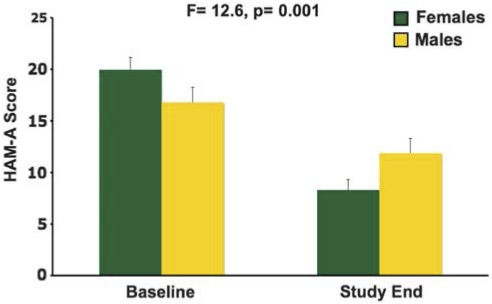
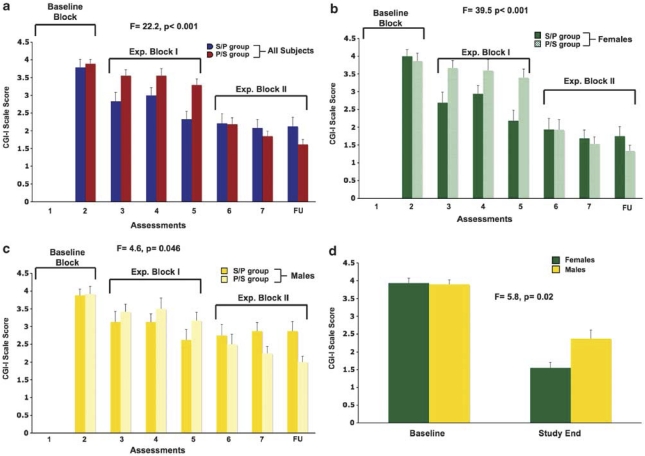
Some antidepressant agents generate differential benefit based on gender. Blocking cholinergic muscarinic receptors using scopolamine produces robust and rapid antidepressant effects in males and females combined. This study evaluated if males and females differ in the antidepressant response magnitude following scopolamine administration. A total of 52 male and female outpatients meeting criteria for recurrent major depressive or bipolar disorder participated in a double-blind, randomized, placebo-controlled, crossover clinical trial involving seven i.v. infusions of placebo or scopolamine (4 μg/kg). Following a single-blind placebo lead-in, participants entered either a placebo-block/scopolamine-block or a scopolamine-block/placebo-block sequence. Each block included three sessions. Clinical ratings were acquired before each infusion and included the Montgomery-Asberg Depression Rating Scale (MADRS) and the Hamilton Anxiety Rating Scale (HAM-A). A treatment group × block interaction (F=21.0, p<0.001) was observed in MADRS scores across gender, and the reduction was significant by the evaluation following the first scopolamine administration (F=8.4, p=0.006). The treatment group × block interaction was also significant in males (F=3.8, p=0.043) and females (F=35.6, p<0.001) separately. A block × gender interaction (F=7.4, p=0.009) indicated that the response magnitude was larger in women. The treatment × block interaction was significant for the HAM-A across gender (F=12.0, p<0.001), and was significant for females (F=24.9, p<0.001) but not for males (F=1.3, p=0.30). When comparing the baseline block to study end, the block × gender interaction (F=12.6, p=0.001) showed that the antianxiety response was greater in women. Men and women show a rapid antidepressant response following scopolamine, but the magnitude of response is larger in women than in men.
Figures


References
-
- American Psychiatric Association . Diagnostic and Statistical Manual of Mental Disorders, IV, Text Revision. American Psychiatric Association: Washington DC; 2000.
-
- Bebbington PE, Dunn G, Jenkins R, Lewis G, Brugha T, Farrell M, et al. The influence of age and sex on the prevalence of depressive conditions: report from the National Survey of Psychiatric Morbidity. Psychol Med. 1998;28:9–19. - PubMed
-
- Benmansour S, Piotrowski JP, Altamirano AV, Frazer A. Impact of ovarian hormones on the modulation of the serotonin transporter by fluvoxamine. Neuropsychopharmacology. 2009;34:555–564. - PubMed
-
- Berlanga C, Flores-Ramos M. Different gender response to serotonergic and noradrenergic antidepressants. A comparative study of the efficacy of citalopram and reboxetine. J Affect Disord. 2006;95:119–123. - PubMed
Publication types
MeSH terms
Substances
LinkOut - more resources
Full Text Sources
Other Literature Sources
Medical
