


Incorporating performance improvement methods into a needs assessment: experience with a nutrition and exercise curriculum
- PMID: 20737239
- PMCID: PMC2940444
- DOI: 10.1007/s11606-010-1404-z
Incorporating performance improvement methods into a needs assessment: experience with a nutrition and exercise curriculum
Abstract
Background: Clinical guidelines recommend that physicians counsel patients on diet and exercise; however, physician counseling remains suboptimal.
Objectives: To determine if incorporating performance improvement (PI) methodologies into a needs assessment for an internal medicine (IM) residency curriculum on nutrition and exercise counseling was feasible and enhanced our understanding of the curricular needs.
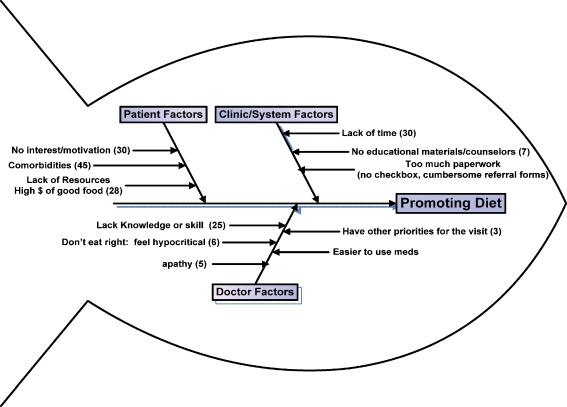
Design and participants: One hundred and fifty-eight IM residents completed a questionnaire to assess their knowledge, attitudes, and practices (KAP) about nutrition and exercise counseling for hypertensive patients. Residents' baseline nutrition and exercise counseling rates were also obtained using chart abstraction. Fishbone diagrams were created by the residents to delineate perceived barriers to diet and exercise counseling.
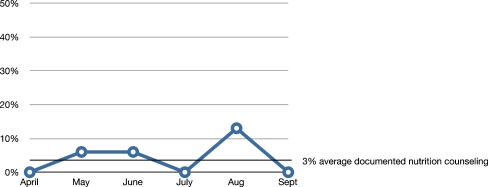
Main measures: The KAP questionnaire was analyzed using descriptive statistics. Chart abstraction data was plotted on run charts and average counseling rates were calculated. Pareto charts were developed from the fishbone diagrams depicting the number of times each barrier was reported.
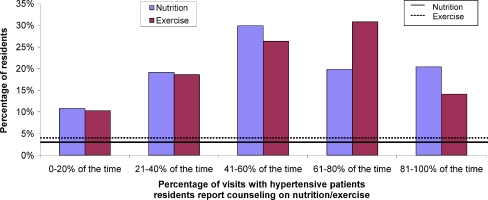
Key results: Almost 90% of the residents reported counseling their hypertensive patients about diet and exercise more than 20% of the time on the KAP questionnaire. In contrast, chart abstraction revealed average counseling rates of 3% and 4% for nutrition and exercise, respectively. The KAP questionnaire exposed a clinical knowledge deficit, lack of familiarity with the national guidelines, and low self-efficacy. In contrast, the fishbone analysis highlighted patient apathy, patient co-morbidities, and time pressure as the major perceived barriers.
Conclusions: We found that incorporating PI methods into a needs assessment for an IM residency curriculum on nutrition and exercise counseling for patients at risk of cardiovascular disease was feasible, provided additional information not obtained through other means, and provided the opportunity to pilot the use of PI techniques as an educational strategy and means of measuring outcomes. Our findings suggest that utilization of PI principles provides a useful framework for developing and implementing a medical education curriculum and measuring its effectiveness.
Figures


References
-
- Pearson TA, Blair SN, Daniels SR, et al. AHA Guidelines for primary prevention of cardiovascular disease and stroke: 2002 Update. Consensus panel guide to comprehensive risk reduction for adult patients without coronary or other atherosclerotic vascular diseases. Circulation. 2002;106:388–91. doi: 10.1161/01.CIR.0000020190.45892.75. - DOI - PubMed
-
- Redberg RF, Benjamin EJ, Bittner V, et al. ACCF/AHA 2009 performance measures for primary prevention of cardiovascular disease in adults. A report of the American College of Cardiology Foundation/American Heart Association Task Force on Performance Measures (Writing committee to develop performance measures for primary prevention of cardiovascular disease). Developed in collaboration with the American Academy of Family Physicians; American Association of Cardiovascular and Pulmonary Rehabilitation; and Preventive Cardiovascular Nurses Association. Endorsed by the American College of Preventive Medicine, American College of Sports Medicine, and Society for Women’s Health Research. J Am Coll Cardiol. 2009;54:1364–405. doi: 10.1016/j.jacc.2009.08.005. - DOI - PubMed
Publication types
MeSH terms
LinkOut - more resources
Full Text Sources
Medical
Research Materials
Miscellaneous
