


doi: 10.1016/0165-3806(90)90055-4.
Bicuculline induced seizures in infant rats: ontogeny of behavioral and electrocortical phenomena
Affiliations
- PMID: 2073726
- PMCID: PMC3139479
- DOI: 10.1016/0165-3806(90)90055-4
Item in Clipboard
Bicuculline induced seizures in infant rats: ontogeny of behavioral and electrocortical phenomena
Brain Res Dev Brain Res.
.
Abstract
The effects of bicuculline, a gamma-aminobutyric acid (GABA) antagonist, were investigated in 258 immature rats between the third and 22nd postnatal days. Behavioral and electrocorticographic events were correlated. Bicuculline induced both behavioral and electrographic seizures as early as the third postnatal day, an age when the CD50 for bicuculline was lowest, and therefore the sensitivity to it was the greatest. Bicuculline may thus be a suitable convulsant for epilepsy studies involving rats during the first postnatal week.
Figures
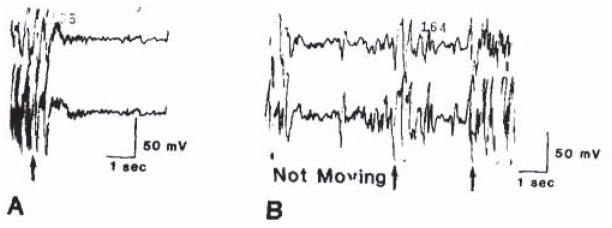
Effect of bicuculline on the electrocorticogram (ECoG) of a 3 day old rat. A: ECoG prior to bicuculline administration. B: ECoG following bicuculline, 2 mg/kg. i.p., The arrows indicate motion artifacts.
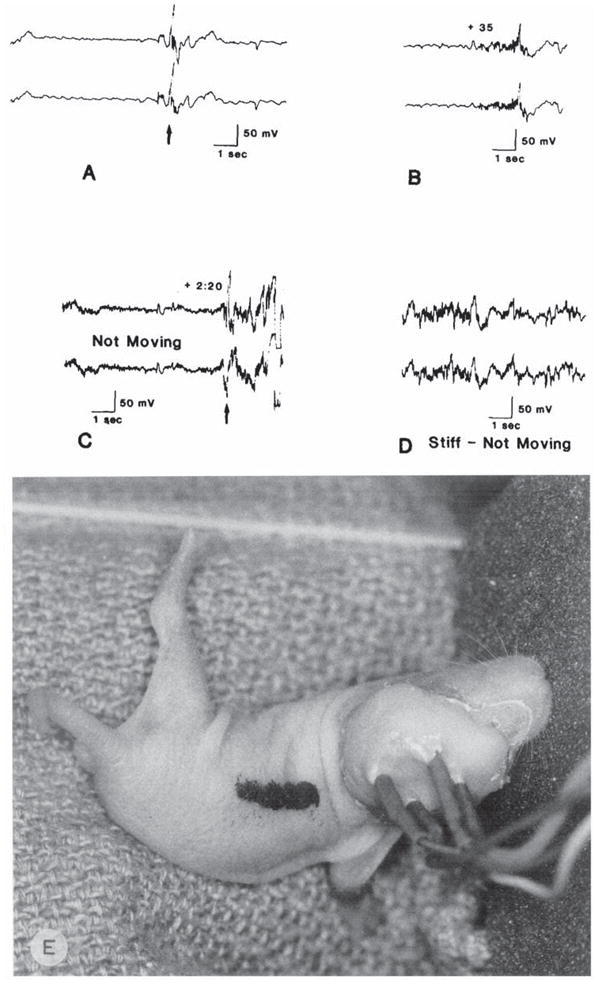
Electrocorticograms of a 5 day old rat: effects of bicuculline (2 mg/kg, i.p.) administration. A: prior to the drug. B: 35 s after bicuculline. C: 150 s after bicuculline. D: 6 min following injection. E: behavioral effect of bicuculline in a different 5 day old rat: tonic extension of a single extremity and tail. Arrows in A and C indicate motion artifacts.

Electrocorticograms of a 7 day old rat prior to (A), and subsequent to (B) bicuculline administration. Arrows indicate motion.
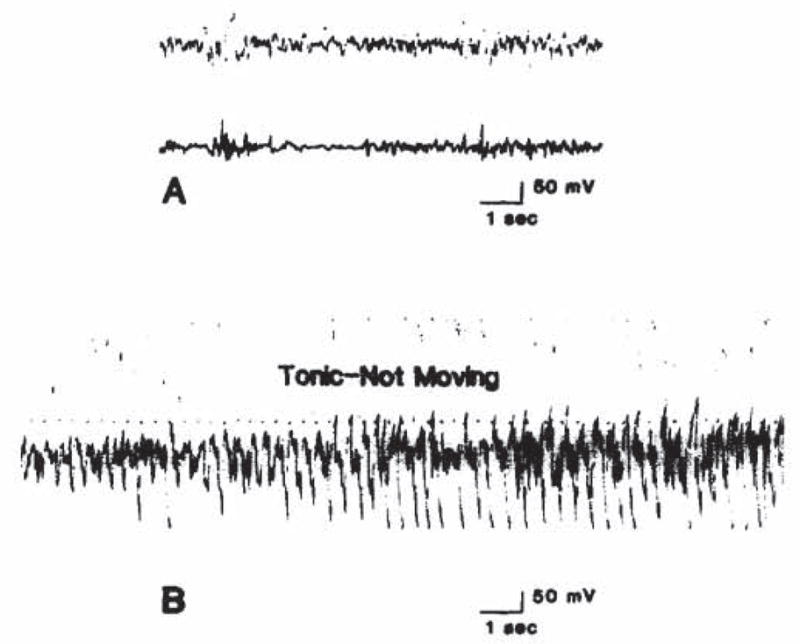
Electrocorticograms of a 10 day old rat injected with 2 mg/kg bicuculline. A: before injection; B: 2.25 min after injection.
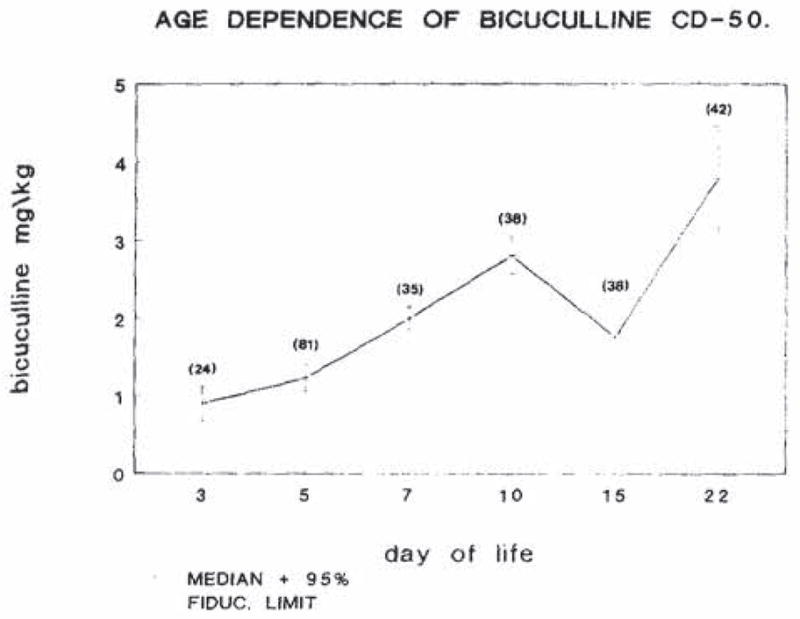
Age dependence of the CD50 for bicuculline in infant rats. CD50 was determined as described in the materials and methods section. The vertical bracketed lines at each point represent 95% fiducial intervals. Numbers in parentheses denote the number of animals used at each age.
References
-
- Borgstrom L, Chapman AG, Siesjo BK. Glucose consumption in the cerebral cortex of the rat during bicuculline-induced status epilepticus. J Neurochem. 1976;27:971–973. - PubMed
-
- Browning RA, Nelson DK. Variation in threshold and pattern of electroshock-induced seizures in rats depending on site of stimulation. Life Sci. 1985;37:2205–2212. - PubMed
-
- Cavalheiro EA, Delrio FS, Turski WA, et al. The susceptibility of rats to pilocarpine-induced seizures is age dependent. Dev Brain Res. 1987;37:43–58. - PubMed
-
- Coyle JT, Enna SJ. Neurochemical aspects of the ontogenesis of GABAergic neurons in the rat brain. Brain Res. 1976;111:119–123. - PubMed
-
- Coyle JT, Singer H, Beaulieu M, Johnston MV. Development of central neurotransmitter-specified neuronal systems: implications for pediatric neuropsychiatric disorders. Acta Neurol Scand. 1984;69:1–11. - PubMed
