


Identification of novel carcinogen-mediated mammary tumor susceptibility loci in the rat using the chromosome substitution technique
- PMID: 20737482
- PMCID: PMC2943010
- DOI: 10.1002/gcc.20812
Identification of novel carcinogen-mediated mammary tumor susceptibility loci in the rat using the chromosome substitution technique
Abstract
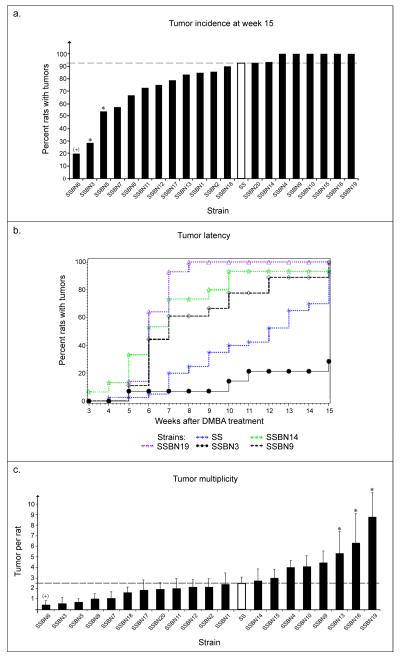
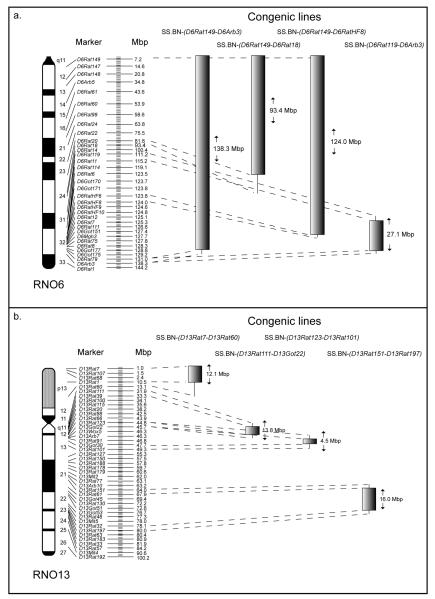
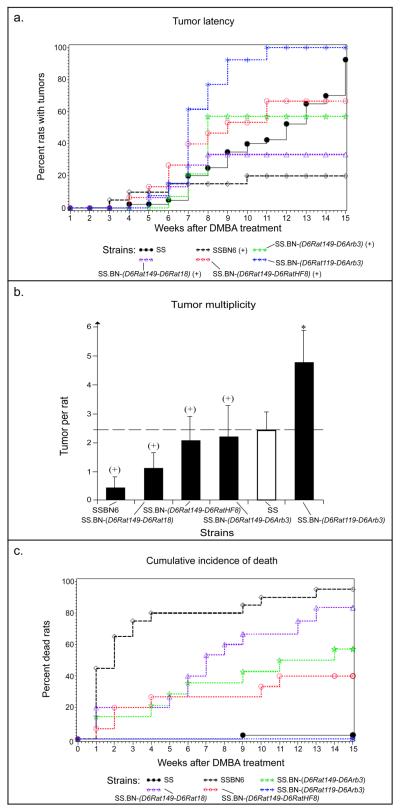
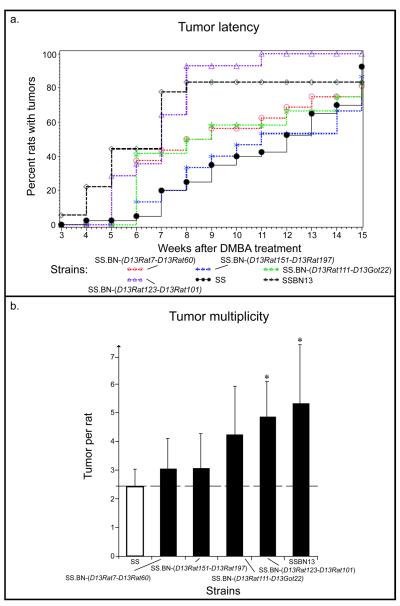
We here report the genetic basis for susceptibility and resistance to carcinogen-mediated [7,12-dimethylbenz[a]anthracene (DMBA)] mammary tumorigenesis using the full panel of SS/BN consomic rat strains, in which substitutions of individual chromosomes from the resistant BN strain onto the genomic background of the susceptible SS strain were made. Analysis of 252 consomic females identified rat mammary Quantitative Trait Loci (QTLs) affecting tumor incidence on chromosomes 3 and 5, latency on chromosomes 3, 9, 14, and 19, and multiplicity on chromosomes 13, 16, and 19. In addition, we unexpectedly identified a novel QTL on chromosome 6 controlling a lethal toxic phenotype in response to DMBA. Upon further investigation with chromosomes 6 and 13 congenic lines, in which an additional 114 rats were investigated, we mapped (1) a novel mammary tumor QTL to a region of 27.1 Mbp in the distal part of RNO6, a region that is entirely separated from the toxicity phenotype, and (2) a novel and powerful mammary tumor susceptibility locus of 4.5 Mbp that mapped to the proximal q-arm of RNO13. Comparison of genetic strain differences using existing rat genome databases enabled us to further construct priority lists containing single breast cancer candidate genes within the defined QTLs, serving as potential functional variants for future testing.
© 2010 Wiley-Liss, Inc.
Figures
References
-
- Adamovic T, McAllister D, Rowe J, Wang T, Jacob HJ, Sugg SLS. Genetic mapping of mammary tumor traits to rat chromosome 10 using a novel panel of consomic rats. Cancer Genet Cytogenet. 2008;186:41–48. - PubMed
-
- Adamovic T, McAllister D, Guryev V, Wang X, Andrae JW, Cuppen E, Jacob HJ, Sugg SL. Microalterations of inherently unstable genomic regions in rat mammary carcinomas as revealed by long oligonucleotide array-based comparative genomic hybridization. Cancer Res. 2009;69:5159–5167. - PubMed
-
- Aitman T, Critser J, Cuppen E, Dominiczak A, Fernandez-Suarez XM, Flint J, Gauguier D, Geurts AM, Gould M, Harris PC, Holmdahl R, Hubner N, Izsvák Z, Jacob HJ, Kuramoto T, Kwitek AE, Marrone A, Mashimo T, Moreno C, Mullins J, Mullins L, Olsson T, Pravenec M, Riley L, Saar K, Serikawa T, Shull JD, Szpirer C, Twigger SN, Voigt B, Worley K. Progress and prospects in rat genetics: a community view. Nat Genet. 2008;40:516–522. - PubMed
-
- Carroll JS, Liu XS, Brodsky AS, Li W, Meyer CA, Szary AJ, Eeckhoute J, Shao W, Hestermann EV, Geistlinger TR, Fox EA, Silver PA, Brown M. Chromosome-wide mapping of estrogen receptor binding reveals long-range regulation requiring the forkhead protein FoxA1. Cell. 2005;122:33–43. - PubMed
-
- Clemons M, Goss P. Estrogen and the risk of breast cancer. N Engl J Med. 2001;344:276–285. - PubMed
Publication types
MeSH terms
Substances
Grants and funding
LinkOut - more resources
Full Text Sources
Miscellaneous
