


Seroepidemiology of pandemic influenza A (H1N1) 2009 virus infections in Pune, India
- PMID: 20738878
- PMCID: PMC2936412
- DOI: 10.1186/1471-2334-10-255
Seroepidemiology of pandemic influenza A (H1N1) 2009 virus infections in Pune, India
Abstract
Background: In India, Pune was one of the badly affected cities during the influenza A (H1N1) 2009 pandemic. We undertook serosurveys among the risk groups and general population to determine the extent of pandemic influenza A (H1N1) 2009 virus infections.
Methods: Pre-pandemic sera from the archives, collected during January 2005 to March 2009, were assayed for the determination of baseline seropositivity. Serosurveys were undertaken among the risk groups such as hospital staff, general practitioners, school children and staff and general population between 15th August and 11th December 2009. In addition, the PCR-confirmed pandemic influenza A (H1N1) 2009 cases and their household contacts were also investigated. Haemagglutination-inhibition (HI) assays were performed using turkey red blood cells employing standard protocols. A titre of >or=1:40 was considered seropositive.
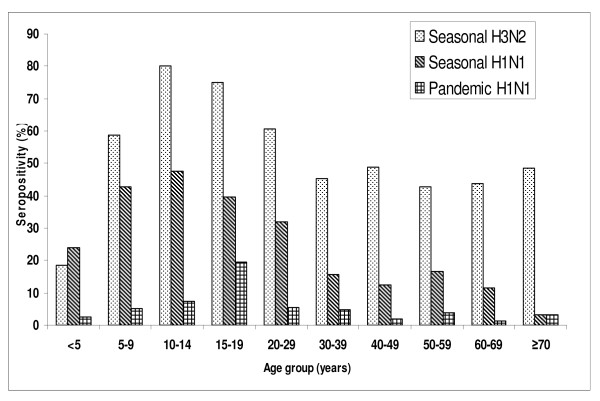
Results: Only 2 (0.9%) of the 222 pre-pandemic sera were positive. The test-retest reliability of HI assay in 101 sera was 98% for pandemic H1N1, 93.1% for seasonal H1N1 and 94% for seasonal H3N2. The sera from 48 (73.8%) of 65 PCR-confirmed pandemic H1N1 cases in 2009 were positive. Seropositivity among general practitioners increased from 4.9% in August to 9.4% in November and 15.1% in December. Among hospital staff, seropositivity increased from 2.8% in August to 12% in November. Seropositivity among the schools increased from 2% in August to 10.7% in September. The seropositivity among students (25%) was higher than the school staff in September. In a general population survey in October 2009, seropositivity was higher in children (9.1%) than adults (4.3%). The 15-19 years age group showed the highest seropositivity of 20.3%. Seropositivity of seasonal H3N2 (55.3%) and H1N1 (26.4%) was higher than pandemic H1N1 (5.7%) (n = 2328). In households of 74 PCR-confirmed pandemic H1N1 cases, 25.6% contacts were seropositive. Almost 90% pandemic H1N1 infections were asymptomatic or mild. Considering a titre cut off of 1:10, seropositivity was 1.5-3 times as compared to 1:40.
Conclusions: Pandemic influenza A (H1N1) 2009 virus infection was widespread in all sections of community. However, infection was significantly higher in school children and general practitioners. Hospital staff had the lowest infections suggesting the efficacy of infection-control measures.
Figures
References
-
- Ministry of Health and Family Welfare, Government of India. Update of influenza A (H1N1) as on 17th May, 2009. Press release dated 17th May, 2009. http://mohfw.nic.in/Status_as_on_16.5.2009_at_4.30_p.m.doc [Dated 15 Jun 2010]
-
- World Health Organization. Human infection with new influenza A (H1N1) virus: clinical observations from Mexico and other affected countries, May 2009. Wkly Epidemiol Rec. 2009;84:185–189. - PubMed
Publication types
MeSH terms
Substances
LinkOut - more resources
Full Text Sources
Medical
