


Effect of HLA class I and class II alleles on progression from autoantibody positivity to overt type 1 diabetes in children with risk-associated class II genotypes
- PMID: 20739684
- PMCID: PMC2992790
- DOI: 10.2337/db10-0167
Effect of HLA class I and class II alleles on progression from autoantibody positivity to overt type 1 diabetes in children with risk-associated class II genotypes
Abstract
Objective: Class II alleles define the main HLA effect on type 1 diabetes, but there is an independent effect of certain class I alleles. Class II and class I molecules are differently involved in the initiation and effector phases of the immune response, suggesting that class I alleles would be important determinants in the rate of β-cell destruction. To test this hypothesis we analyzed the role of HLA class I and class II gene polymorphisms in the progression from diabetes-associated autoimmunity to clinical disease.
Research design and methods: The effect of HLA-DR-DQ haplotypes and a panel of class I HLA-A and -B alleles on the progression from autoantibody seroconversion to clinical diabetes was studied in 249 children persistently positive for at least one biochemical diabetes-associated autoantibody in addition to islet cell autoantibody.
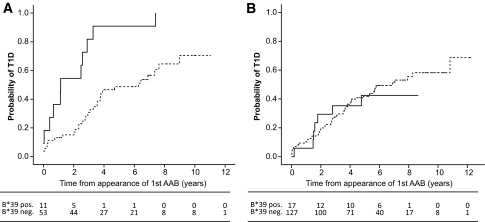
Results: The progression to clinical disease was separately analyzed after the appearance of the first and the second persistent biochemical autoantibody using Cox regression. Multivariate analysis demonstrated a significant protective effect of the A*03 allele (odds ratio [OR] 0.61, P = 0.042 after the first and OR 0.55, P = 0.027 after the second autoantibody), whereas the B*39 allele had a promoting effect after seroconversion for the second autoantibody (OR 2.4, P = 0.014). When children with the DR3/DR4 genotype were separately analyzed, HLA-B*39 had a strong effect (OR 6.6, P = 0.004 and OR 7.5, P = 0.007, after the appearance of the first and the second autoantibody, respectively). The protective effect of A*03 was seen only among children without the DR3/DR4 combination.
Conclusions: These results confirm that class I alleles affect the progression of diabetes-associated autoimmunity and demonstrate interactions between class I and class II alleles.
Figures
References
-
- Pihoker C, Gilliam LK, Hampe CS, Lernmark Å: Autoantibodies in diabetes. Diabetes 2005;54(Suppl. 2):S52–S61 - PubMed
-
- Nejentsev S, Howson JM, Walker NM, Szeszko J, Field SF, Stevens HE, Reynolds P, Hardy M, King E, Masters J, Hulme J, Maier LM, Smyth D, Bailey R, Cooper JD, Ribas G, Campbell RD, Clayton DG, Todd JAWellcome Trust Case Control Consortium Localization of type 1 diabetes susceptibility to the MHC class I genes HLA-B and HLA-A. Nature 2007;450:887–892 - PMC - PubMed
-
- Reijonen H, Nejentsev S, Tuokko J, Koskinen S, Tuomilehto-Wolf E, Akerblom HK, Ilonen J: HLA-DR4 subtype and -B alleles in DQB1*0302-positive haplotypes associated with IDDM. The Childhood Diabetes in Finland Study Group. Eur J Immunogen 1997;24:357–363 - PubMed
Publication types
MeSH terms
Substances
LinkOut - more resources
Full Text Sources
Medical
Research Materials
