


Heat stress attenuates the increase in arterial blood pressure during the cold pressor test
- PMID: 20798269
- PMCID: PMC2980377
- DOI: 10.1152/japplphysiol.00292.2010
Heat stress attenuates the increase in arterial blood pressure during the cold pressor test
Abstract
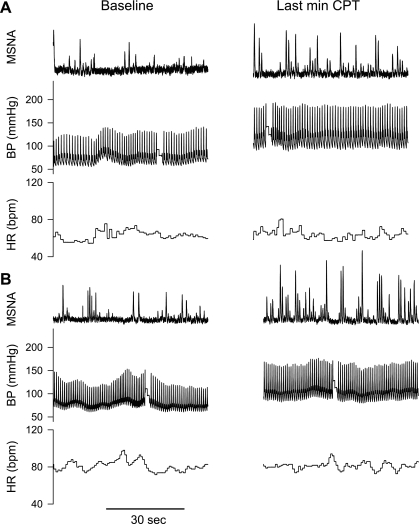
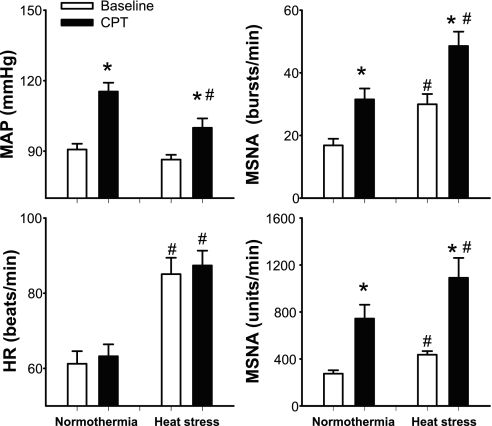
The mechanisms by which heat stress impairs the control of blood pressure leading to compromised orthostatic tolerance are not thoroughly understood. A possible mechanism may be an attenuated blood pressure response to a given increase in sympathetic activity. This study tested the hypothesis that whole body heating attenuates the blood pressure response to a non-baroreflex-mediated sympathoexcitatory stimulus. Ten healthy subjects were instrumented for the measurement of integrated muscle sympathetic nerve activity (MSNA), mean arterial blood pressure (MAP), heart rate, sweat rate, and forearm skin blood flow. Subjects were exposed to a cold pressor test (CPT) by immersing a hand in an ice water slurry for 3 min while otherwise normothermic and while heat stressed (i.e., increase core temperature ~0.7°C via water-perfused suit). Mean responses from the final minute of the CPT were evaluated. In both thermal conditions CPT induced significant increases in MSNA and MAP without altering heart rate. Although the increase in MSNA to the CPT was similar between thermal conditions (normothermia: Δ14.0 ± 2.6; heat stress: Δ19.1 ± 2.6 bursts/min; P = 0.09), the accompanying increase in MAP was attenuated when subjects were heat stressed (normothermia: Δ25.6 ± 2.3, heat stress: Δ13.4 ± 3.0 mmHg; P < 0.001). The results demonstrate that heat stress can attenuate the pressor response to a sympathoexcitatory stimulus.
Figures
References
-
- Allen J, Crossley R. Effect of controlled elevation in body temperature on human tolerance to 1Gz acceleration. J Appl Physiol 33: 418–420, 1972 - PubMed
-
- Boddi M, Sacchi S, Lammel RM, Mohseni R, Serneri GG. Age-related and vasomotor stimuli-induced changes in renal vascular resistance detected by Doppler ultrasound. Am J Hypertens 9: 461–466, 1996 - PubMed
-
- Chaudhuri KR, Thomaides T, Hernandez P, Alam M, Mathias CJ. Noninvasive quantification of superior mesenteric artery blood flow during sympathoneural activation in normal subjects. Clin Auton Res 1: 37–42, 1991 - PubMed
-
- Crandall CG. Carotid baroreflex responsiveness in heat-stressed humans. Am J Physiol Heart Circ Physiol 279: H1955–H1962, 2000 - PubMed
Publication types
MeSH terms
Grants and funding
LinkOut - more resources
Full Text Sources
Medical
