


Interactions of gastrointestinal peptides: ghrelin and its anorexigenic antagonists
- PMID: 20798884
- PMCID: PMC2925274
- DOI: 10.1155/2010/817457
Interactions of gastrointestinal peptides: ghrelin and its anorexigenic antagonists
Abstract
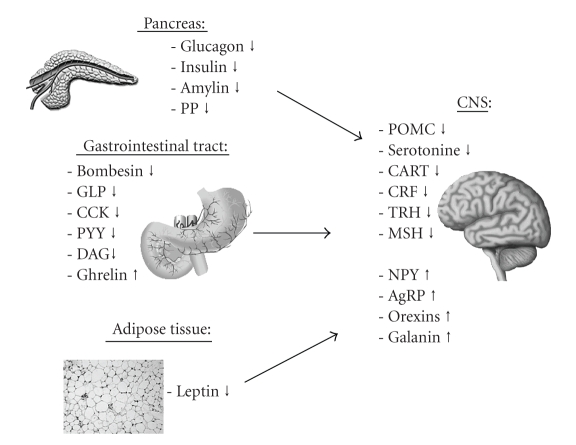
Food intake behaviour and energy homeostasis are strongly regulated by a complex system of humoral factors and nerval structures constituting the brain-gut-axis. To date the only known peripherally produced and centrally acting peptide that stimulates food intake is ghrelin, which is mainly synthesized in the stomach. Recent data indicate that the orexigenic effect of ghrelin might be influenced by other gastrointestinal peptides such as cholecystokinin (CCK), bombesin, desacyl ghrelin, peptide YY (PYY), as well as glucagon-like peptide (GLP). Therefore, we will review on the interactions of ghrelin with several gastrointestinal factors known to be involved in appetite regulation in order to elucidate the interdependency of peripheral orexigenic and anorexigenic peptides in the control of appetite.
Figures
References
-
- Mayer J. Glucostatic mechanism of regulation of food intake. The New England Journal of Medicine. 1953;249:13–16. - PubMed
-
- Kennedy GC. The role of depot fat in the hypothalamic control of food intake in the rat. Proceedings of the Royal Society of London. Series B. 1953;140:578–596. - PubMed
-
- Zhang Y, Proenca R, Maffei M, Barone M, Leopold L, Friedman JM. Positional cloning of the mouse obese gene and its human homologue. Nature. 1994;372(6505):425–432. - PubMed
-
- Konturek SJ, Konturek JW, Pawlik T, Brzozowki T. Brain-gut axis and its role in the control of food intake. Journal of Physiology and Pharmacology. 2004;55(1):137–154. - PubMed
-
- Arora S, Anubhuti Role of neuropeptides in appetite regulation and obesity—a review. Neuropeptides. 2006;40(6):375–401. - PubMed
LinkOut - more resources
Full Text Sources
