


Exposure matrices of endotoxin, (1→3)-β-d-glucan, fungi, and dust mite allergens in flood-affected homes of New Orleans
- PMID: 20800874
- PMCID: PMC6785014
- DOI: 10.1016/j.scitotenv.2010.07.087
Exposure matrices of endotoxin, (1→3)-β-d-glucan, fungi, and dust mite allergens in flood-affected homes of New Orleans
Abstract
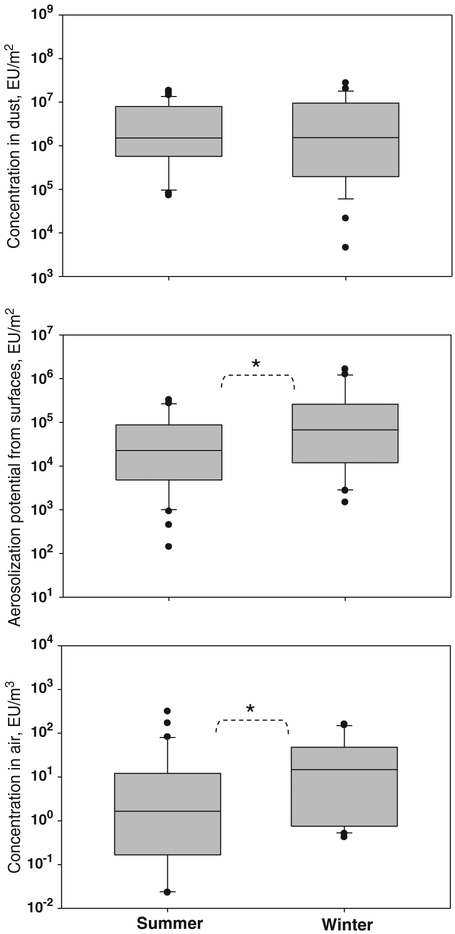
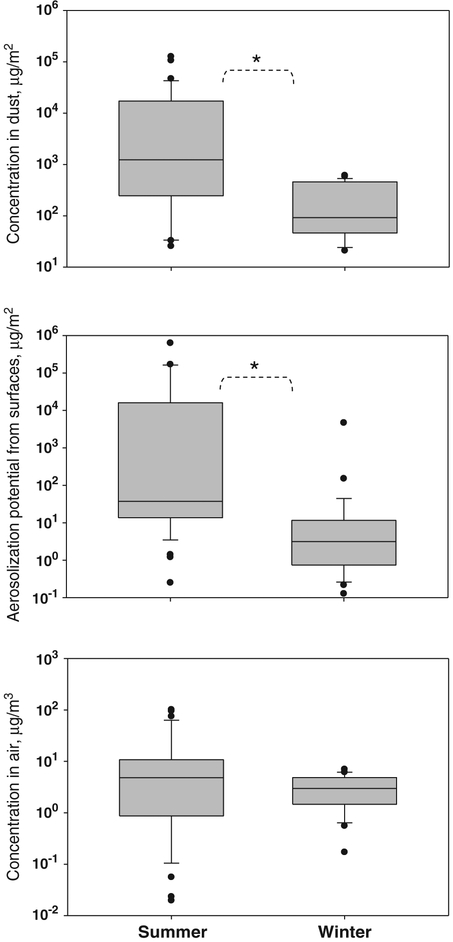
This study examined: (i) biocontaminant levels in flooded homes of New Orleans two years after the flooding; (ii) seasonal changes in biocontaminant levels, and (iii) correlations between biocontaminant levels obtained by different environmental monitoring methods. Endotoxin, (1→3)-β-d-glucan, fungal spores, and dust mite allergens were measured in 35 homes during summer and winter. A combination of dust sampling, aerosolization-based microbial source assessment, and long-term inhalable bioaerosol sampling aided in understanding exposure matrices. On average, endotoxin found in the aerosolized fraction accounted for <2% of that measured in the floor dust, suggesting that vacuuming could overestimate inhalation exposures. In contrast, the (1→3)-β-d-glucan levels in the floor dust and aerosolized fractions were mostly comparable, and 25% of the homes showed aerosolizable levels even higher than the dust-borne levels. The seasonal patterns for endotoxin in dust and the aerosolizable fraction were different from those found for (1→3)-β-d-glucan, reflecting the temperature and humidity effects on bacterial and fungal contamination. While the concentration of airborne endotoxin followed the same seasonal trend as endotoxin aerosolized from surfaces, no significant seasonal difference was identified for the concentrations of airborne (1→3)-β-d-glucan and fungal spores. This was attributed to the difference in the particle size; smaller endotoxin-containing particles can remain airborne for longer time than larger fungal spores or (1→3)-β-d-glucan-containing particles. It is also possible that fungal aerosolization in home environments did not reach its full potential. Detectable dust mite allergens were found only in dust samples, and more commonly in occupied homes. Levels of endotoxin, (1→3)-β-d-glucan, and fungi in air had decreased during the two-year period following the flooding as compared to immediate measurements; however, the dust-borne endotoxin and (1→3)-β-d-glucan levels remained elevated. No conclusive correlations were found between the three environmental monitoring methods. The findings support the use of multiple methods when assessing exposure to microbial contaminants.
Copyright © 2010 Elsevier B.V. All rights reserved.
Figures
References
-
- Adhikari A, Martuzevicius D, Reponen T, Grinshpun SA, Cho SH, Sivasubramani SK, et al. Performance of the Button Personal Inhalable Sampler for the measurement of outdoor aeroallergens. Atmos Environ 2003;37:4723–33.
-
- Adhikari A, Reponen T, Lee SA, Grinshpun SA. Assessment of human exposure to airborne fungi in agricultural confinements: personal inhalable sampling versus stationary sampling. Ann Agric Environ Med 2004;11:269–77. - PubMed
-
- Arlian LG, Bernstein D, Bernstein IL, Friedman S, Grant A, Lieberman P, et al. Prevalence of dust mites in the homes of people with asthma living in eight different geographic areas of the United States. J Allergy Clin Immunol 1992;90:292–300. - PubMed
-
- Chew GL, Higgins KM, Milton DK, Burge HA. The effects of carpet fresheners on the behaviour of indoor allergen assays. Clin Exp Allergy 1999;29:470–7. - PubMed
Publication types
MeSH terms
Substances
Grants and funding
LinkOut - more resources
Full Text Sources
Medical
