Associations of cumulative sun exposure and phenotypic characteristics with histologic solar elastosis
- PMID: 20802019
- PMCID: PMC2976811
- DOI: 10.1158/1055-9965.EPI-10-0686
Associations of cumulative sun exposure and phenotypic characteristics with histologic solar elastosis
Abstract
Background: Solar elastosis adjacent to melanomas in histologic sections is regarded as an indicator of sun exposure, although the associations of UV exposure and phenotype with solar elastosis are yet to be fully explored.
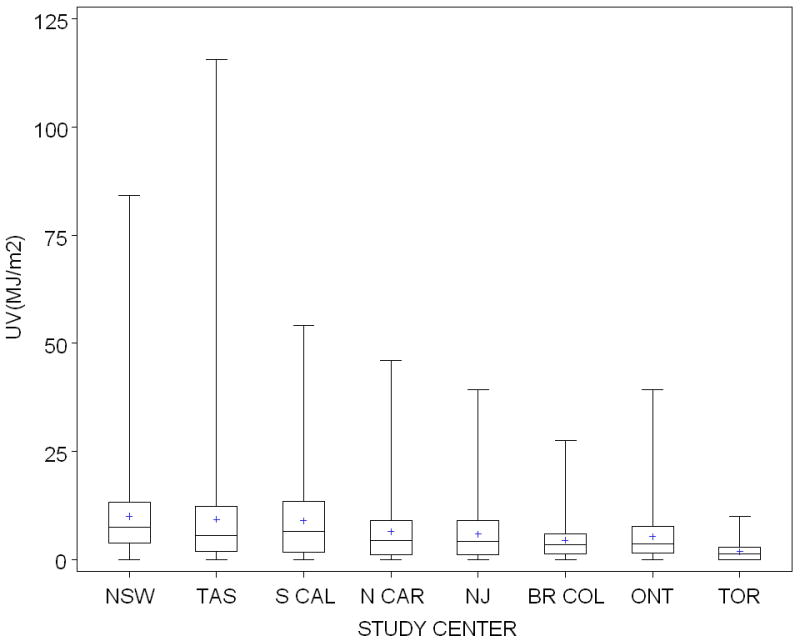
Methods: The study included 2,589 incident primary melanoma patients with assessment of histologic solar elastosis in the population-based Genes, Environment, and Melanoma study. Ambient erythemal UV (UVE) at places of residence and sun exposure hours, including body site-specific exposure, were collected. We examined the association of cumulative site-specific and non-site-specific sun exposure hours and ambient UVE with solar elastosis in multivariable models adjusted for age, sex, center, pigmentary characteristics, nevi, and, where relevant, body site.
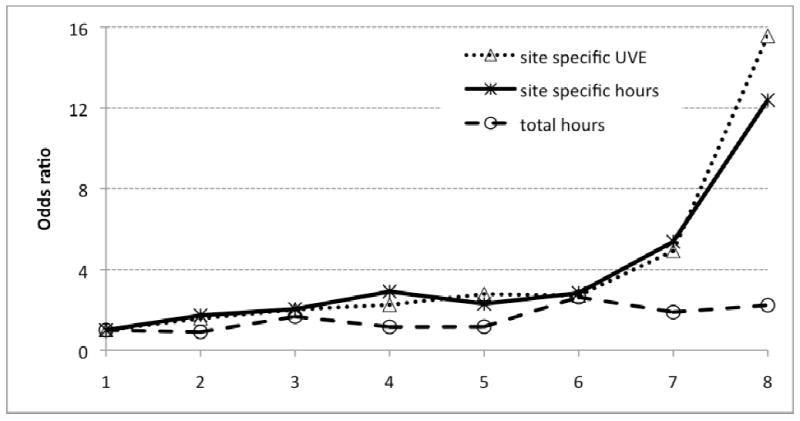
Results: Solar elastosis was associated most strongly with site-specific UVE [odds ratio (OR) for top exposure quartile, 5.20; 95% confidence interval (95% CI), 3.40-7.96; P for trend <0.001] and also with site-specific sun exposure (OR for top quartile, 5.12; 95% CI, 3.35-7.83; P for trend <0.001). Older age (OR at >70 years, 7.69; 95% CI, 5.14-11.52; P for trend < 0.001) and having more than 10 back nevi (OR, 0.77; 95% CI, 0.61-0.97; P = 0.03) were independently associated with solar elastosis.
Conclusion: Solar elastosis had a strong association with higher site-specific UVE dose, older age, and fewer nevi.
Impact: Solar elastosis could be a useful biomarker of lifetime site-specific UV. Future research is needed to explore whether age represents more than simple accumulation of sun exposure and to determine why people with more nevi may be less prone to solar elastosis.
©2010 AACR.
Figures
References
-
- Gandini S, Sera F, Cattaruzza MS, et al. Meta-analysis of risk factors for cutaneous melanoma: II. Sun exposure. Eur J Cancer. 2005;41:45–60. - PubMed
-
- Uitto J. The role of elastin and collagen in cutaneous aging: intrinsic aging versus photoexposure. J Drugs Dermatol. 2008;7:s12–6. - PubMed
-
- Rijken F, Bruijnzeel PL. The pathogenesis of photoaging: the role of neutrophils and neutrophil-derived enzymes. J Investig Dermatol Symp Proc. 2009;14:67–72. - PubMed
-
- Kligman LH, Sayre RM. An action spectrum for ultraviolet induced elastosis in hairless mice: quantification of elastosis by image analysis. Photochem Photobiol. 1991;53:237–42. - PubMed
-
- Lee EY, Williamson R, Watt P, et al. Sun exposure and host phenotype as predictors of cutaneous melanoma associated with neval remnants or dermal elastosis. Int J Cancer. 2006;119:636–42. - PubMed
Publication types
MeSH terms
Grants and funding
- ES014635/ES/NIEHS NIH HHS/United States
- P30 ES010126/ES/NIEHS NIH HHS/United States
- U01 CA083180/CA/NCI NIH HHS/United States
- P30 CA016086/CA/NCI NIH HHS/United States
- K07 CA102096/CA/NCI NIH HHS/United States
- R01 CA098438/CA/NCI NIH HHS/United States
- R01 CA112243/CA/NCI NIH HHS/United States
- R01 CA112524-05S2/CA/NCI NIH HHS/United States
- CA098438/CA/NCI NIH HHS/United States
- R01 CA112243-05S1/CA/NCI NIH HHS/United States
- R03 CA103089/CA/NCI NIH HHS/United States
- R01 112524/PHS HHS/United States
- P01 ES014635/ES/NIEHS NIH HHS/United States
- R01 CA112524/CA/NCI NIH HHS/United States
- P30 CA16086/CA/NCI NIH HHS/United States
- U01 CA83180/CA/NCI NIH HHS/United States
LinkOut - more resources
Full Text Sources