


Folic acid mitigated cardiac dysfunction by normalizing the levels of tissue inhibitor of metalloproteinase and homocysteine-metabolizing enzymes postmyocardial infarction in mice
- PMID: 20802128
- PMCID: PMC2993194
- DOI: 10.1152/ajpheart.00577.2010
Folic acid mitigated cardiac dysfunction by normalizing the levels of tissue inhibitor of metalloproteinase and homocysteine-metabolizing enzymes postmyocardial infarction in mice
Abstract
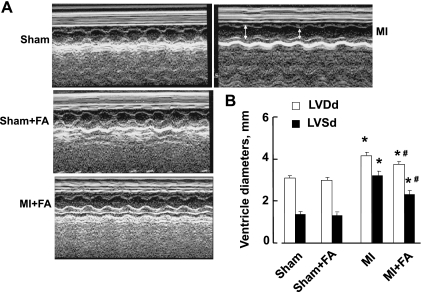
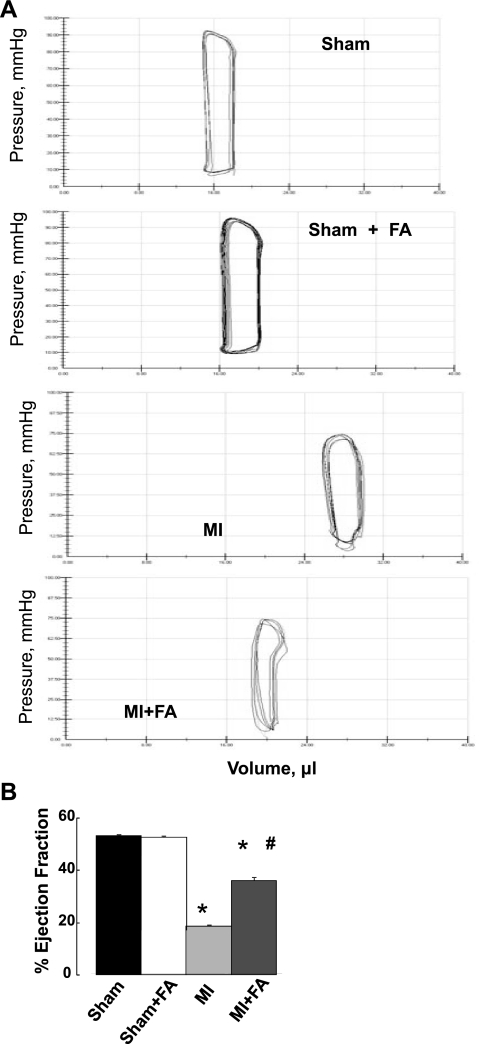
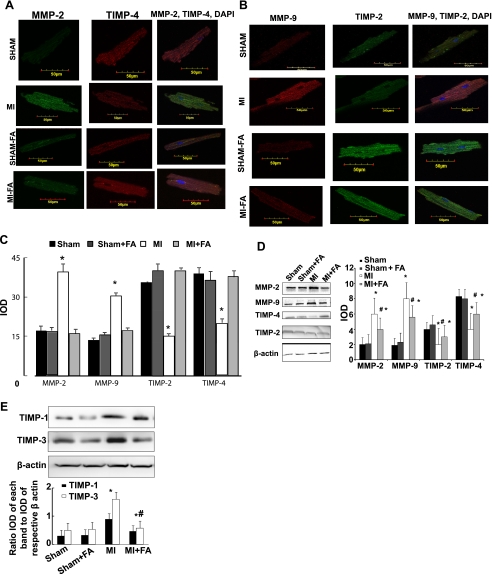
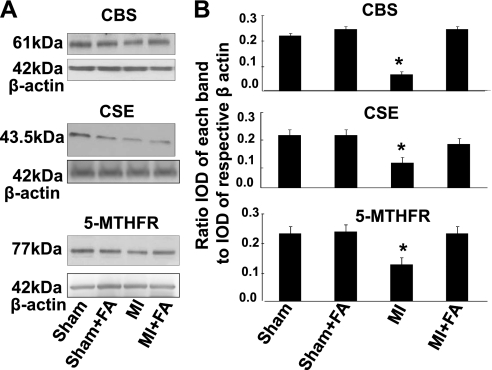
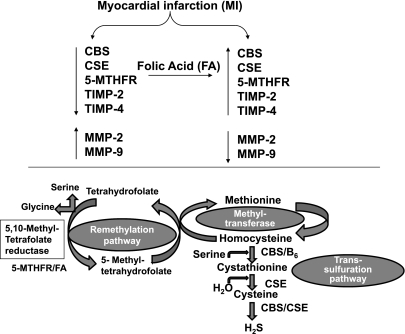
Myocardial infarction (MI) results in significant metabolic derangement, causing accumulation of metabolic by product, such as homocysteine (Hcy). Hcy is a nonprotein amino acid generated during nucleic acid methylation and demethylation of methionine. Folic acid (FA) decreases Hcy levels by remethylating the Hcy to methionine, by 5-methylene tetrahydrofolate reductase (5-MTHFR). Although clinical trials were inconclusive regarding the role of Hcy in MI, in animal models, the levels of 5-MTHFR were decreased, and FA mitigated the MI injury. We hypothesized that FA mitigated MI-induced injury, in part, by mitigating cardiac remodeling during chronic heart failure. Thus, MI was induced in 12-wk-old male C57BL/J mice by ligating the left anterior descending artery, and FA (0.03 g/l in drinking water) was administered for 4 wk after the surgery. Cardiac function was assessed by echocardiography and by a Millar pressure-volume catheter. The levels of Hcy-metabolizing enzymes, cystathionine β-synthase (CBS), cystathionine γ-lyase (CSE), and 5-MTHFR, were estimated by Western blot analyses. The results suggest that FA administered post-MI significantly improved cardiac ejection fraction and induced tissue inhibitor of metalloproteinase, CBS, CSE, and 5-MTHFR. We showed that FA supplementation resulted in significant improvement of myocardial function after MI. The study eluted the importance of homocysteine (Hcy) metabolism and FA supplementation in cardiovascular disease.
Figures
References
-
- Antoniades C, Shirodaria C, Warrick N, Cai S, de Bono J, Lee J, Leeson P, Neubauer S, Ratnatunga C, Pillai R, Refsum H, Channon KM. 5-Methyltetrahydrofolate rapidly improves endothelial function and decreases superoxide production in human vessels: effects on vascular tetrahydrobiopterin availability and endothelial nitric oxide synthase coupling. Circulation 114: 1193– 1201, 2006 - PubMed
-
- Boushey A quantitative assessment of plasma homocysteine as a risk factor for vascular disease. Probable benefits of increasing folic acid intakes. J Am Med Assoc 274: 1049–1057, 1995 - PubMed
-
- Butler GS, Apte SS, Willenbrock F, Murphy G. Human tissue inhibitor of metalloproteinases 3 interacts with both the N- and C-terminal domains of gelatinases A and B. J Biol Chem 274: 10846– 10851, 1999 - PubMed
-
- Carnicer RA, Navarro M, Arbonés-Mainar JM, Acín S, Guzmán MA, Surra JC, Arnal C, de las Heras M, Blanco-Vaca F, Osada J. Folic acid supplementation delays atherosclerotic lesion development in apoE-deficient mice. Life Sci 80: 638– 643, 2007 - PubMed
Publication types
MeSH terms
Substances
Grants and funding
LinkOut - more resources
Full Text Sources
Other Literature Sources
Medical
