


Sox17 modulates Wnt3A/beta-catenin-mediated transcriptional activation of the Lef-1 promoter
- PMID: 20802155
- PMCID: PMC2980392
- DOI: 10.1152/ajplung.00140.2010
Sox17 modulates Wnt3A/beta-catenin-mediated transcriptional activation of the Lef-1 promoter
Abstract
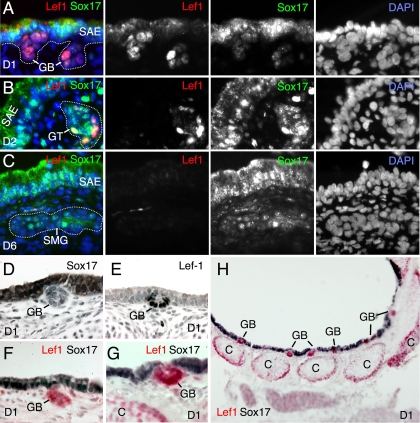
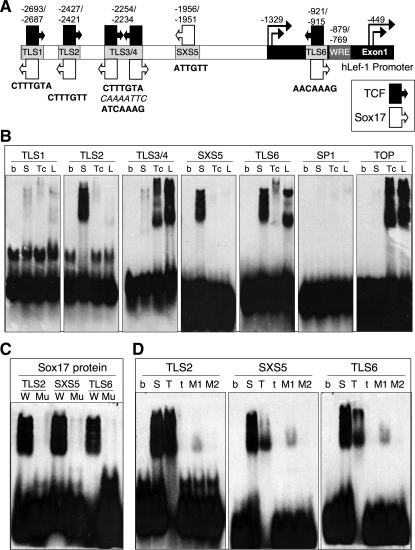
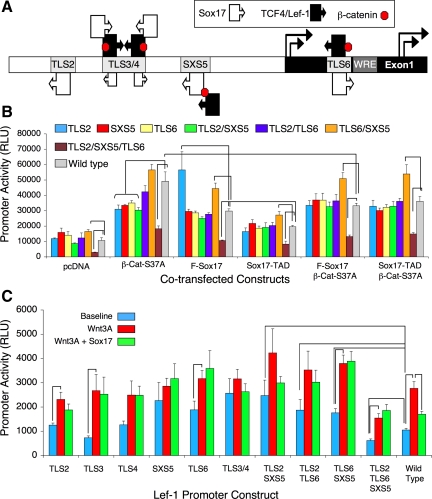
Wnt/β-catenin-dependent activation of lymphoid enhancer factor 1 (Lef-1) plays an important role in numerous developmental processes. In this context, transcription of the Lef-1 gene is increased by Wnt-mediated TCF4/β-catenin activation on the Lef-1 promoter through mechanisms that remain poorly defined. In mouse airway submucosal gland progenitor cells, Wnt3A transiently induces Lef-1 gene expression, and this process is required for epithelial cell proliferation and glandular morphogenesis. In the present study, we sought to identify additional candidate transcriptional regulators of the Lef-1 gene during glandular morphogenesis. To this end, we found that Sox17 expression is dramatically downregulated in early glandular progenitor cells that induce Lef-1 expression. Wnt stimulation of undifferentiated primary airway epithelial cells induced similar changes in Sox17 and Lef-1 expression. Reporter assays revealed that ectopic expression of Sox17 suppresses Wnt3A/β-catenin activation of the Lef-1 promoter in cell lines. EMSA and ChIP analyses defined several Sox17- and TCF4-binding sites that collaborate in transcriptional control of the Lef-1 promoter. More specifically, Sox17 bound to four sites in the Lef-1 promoter, either directly or indirectly through TCF complexes. The DNA- or β-catenin-binding domains of Sox17 controlled context-specific binding of Sox17/TCF complexes on the Lef-1 promoter. Combinatorial site-directed mutagenesis of Sox17- or TCF-binding sites in the Lef-1 promoter demonstrated that these sites control Wnt/β-catenin-mediated induction and/or repression. These findings demonstrate for the first time that Sox17 can directly regulate Wnt/β-catenin-dependent transcription of the Lef-1 promoter and reveal new context-dependent binding sites in the Lef-1 promoter that facilitate protein-protein interactions between Sox17 and TCF4.
Figures




References
-
- Anderson RD, Haskell RE, Xia H, Roessler BJ, Davidson BL. A simple method for the rapid generation of recombinant adenovirus vectors. Gene Ther 7: 1034–1038, 2000 - PubMed
-
- Arce L, Yokoyama NN, Waterman ML. Diversity of LEF/TCF action in development and disease. Oncogene 25: 7492–7504, 2006 - PubMed
-
- Atcha FA, Munguia JE, Li TW, Hovanes K, Waterman ML. A new beta-catenin-dependent activation domain in T cell factor. J Biol Chem 278: 16169–16175, 2003 - PubMed
Publication types
MeSH terms
Substances
Grants and funding
LinkOut - more resources
Full Text Sources
Other Literature Sources
Molecular Biology Databases
