. 2010 Aug 1;5(4):254-266.
doi: 10.1016/j.nantod.2010.05.005.

PROTEIN TEMPLATES IN HARD TISSUE ENGINEERING

Affiliations

PROTEIN TEMPLATES IN HARD TISSUE ENGINEERING

Anne George et al. Nano Today. .

Abstract

Biomineralization processes such as formation of bones and teeth require controlled mineral deposition and self-assembly into hierarchical biocomposites with unique mechanical properties. Ideal biomaterials for regeneration and repair of hard tissues must be biocompatible, possess micro and macroporosity for vascular invasion, provide surface chemistry and texture that facilitate cell attachment, proliferation, differentiation of lineage specific progenitor cells, and induce deposition of calcium phosphate mineral. To expect in-vivo like cellular response several investigators have used extracellular matrix proteins as templates to recreate in-vivo microenvironment for regeneration of hard tissues. Recently, several novel methods of designing tissue repair and restoration materials using bioinspired strategies are currently being formulated. Nanoscale structured materials can be fabricated via the spontaneous organization of self-assembling proteins to construct hierarchically organized nanomaterials. The advantage of such a method is that polypeptides can be specifically designed as building blocks incorporated with molecular recognition features and spatially distributed bioactive ligands that would provide a physiological environment for cells in-vitro and in-vivo. This is a rapidly evolving area and provides a promising platform for future development of nanostructured templates for hard tissue engineering. In this review we try to highlight the importance of proteins as templates for regeneration and repair of hard tissues as well as the potential of peptide based nanomaterials for regenerative therapies.


Figures

Fig 1
Fig 1. Mineralized collagen fibrils are the basic building block for bone and dentin formation
Fig 1A represents a generalized schematic representation of the self-assembly of the collagen fibrils subsequent nucleation and growth of hydroxyapatite within the compartment provided by the self-assembled collagen fibrils. The collagen matrix is responsible for the c-axis oriented hydroxyapatite formation. Hydroxyapatite is represented by grey blocks. Fig 1B represents a transmission electron micrograph of mineralized collagen in bovine dentin.
Fig 1
Fig 1. Mineralized collagen fibrils are the basic building block for bone and dentin formation
Fig 1A represents a generalized schematic representation of the self-assembly of the collagen fibrils subsequent nucleation and growth of hydroxyapatite within the compartment provided by the self-assembled collagen fibrils. The collagen matrix is responsible for the c-axis oriented hydroxyapatite formation. Hydroxyapatite is represented by grey blocks. Fig 1B represents a transmission electron micrograph of mineralized collagen in bovine dentin.
Fig 2
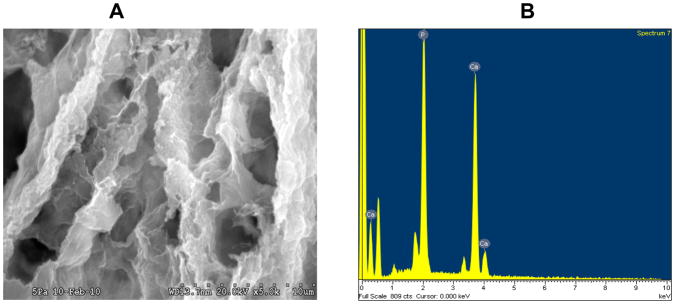
Fig 2. SEM analysis of calcium phosphate coated collagen-chitosan scaffold
Fig 2A represent an SEM image of collagen-chitosan (1:1) scaffold (25). The scaffold was immersed in 1M calcium chloride solution then washed with deionized water to remove non-specifically bound calcium and then immersed in 1M solution of sodium phosphate. The scaffold was then dried, processed and viewed under Hitachi S3000N variable pressure SEM. Fig 2B represent an energy dispersive X-ray scan of the mineralized deposits on the collagen-chitosan scaffold. The Ca/P ratio was 1.7 indicative of hydroxyapatite deposition.
Figure 3
Figure 3. Morphology differences between cells grown on 2-D and 3-D matrices
Fig 3A is a confocal image of rat marrow stromal cells (RMSCs) grown on tissue culture plates and stained with phalloidan conjugated to TRITC to label actin filaments. Fig 3B represents an x-y projection of a z-stack of confocal images of RMSCs embedded within a 1:1 type I collagen-chitosan biopolymer matrix. Note the differences in cellular maorphology between cells grown on 2D versus 3D surfaces. Fig 3C represents a scanning electron micrograph obtained by imaging a similar sample as in 2A using a field emission scanning electron microscope. The white arrow points to the adhesion of a cellular process to the extracellular matrix.
Figure 4
Figure 4. The natural ECM matrix
Fig 4A: SEM image of the ECM matrix synthesized by osteoblast cells. Note the cell process on the matrix. Fig 4B: SEM image of the matrix at higher magnification: Note the thick fibrous and porous architecture of the natural ECM.
Figure 5
Figure 5. Leucine zipper-DMP1 hydrogel promotes cell-matrix dialogue
Fig 5A is a schematic representation of the leucine zipper-DMP1 chimeric protein. Fig 5B is a light microscopy image showing cell attachment on a LZ-DMP1 substrate and less on the glass plate (control). Fig 5C & D shows actin stress fibers and cell-cell communication when coated on LZ-DMP1 substrate. Fig 5E is a scanning electron micrograph of a leucine zipper hydrogel imaged using a field emission scanning electron microscope. The image shows the porous nature of the hydrogel.
Figure 5
Figure 5. Leucine zipper-DMP1 hydrogel promotes cell-matrix dialogue
Fig 5A is a schematic representation of the leucine zipper-DMP1 chimeric protein. Fig 5B is a light microscopy image showing cell attachment on a LZ-DMP1 substrate and less on the glass plate (control). Fig 5C & D shows actin stress fibers and cell-cell communication when coated on LZ-DMP1 substrate. Fig 5E is a scanning electron micrograph of a leucine zipper hydrogel imaged using a field emission scanning electron microscope. The image shows the porous nature of the hydrogel.
Figure 5
Figure 5. Leucine zipper-DMP1 hydrogel promotes cell-matrix dialogue
Fig 5A is a schematic representation of the leucine zipper-DMP1 chimeric protein. Fig 5B is a light microscopy image showing cell attachment on a LZ-DMP1 substrate and less on the glass plate (control). Fig 5C & D shows actin stress fibers and cell-cell communication when coated on LZ-DMP1 substrate. Fig 5E is a scanning electron micrograph of a leucine zipper hydrogel imaged using a field emission scanning electron microscope. The image shows the porous nature of the hydrogel.

References

    1. He X, Ma J, Jabbari E. Langmuir. 2008;24:12508–12516. - PubMed
    1. Zhang L, Rodriguez J, Raez J, Myles AJ, Fenniri H, Webster TJ. Nanotechnology. 2009;20:175101. - PubMed
    1. He X, Jabbari E. Biomacromolecules. 2007;8:780–792. - PubMed
    1. Ortiz C, Boyce MC. Science. 2008;319:1053–1054. - PubMed
    1. Fratzl P, Barth FG. Nature. 2009;462:442–448. - PubMed

LinkOut - more resources