Review
. 2011 Jan;68(1):71-83.
doi: 10.1007/s00018-010-0513-5. Epub 2010 Aug 30.

Spotlight on post-transcriptional control in the circadian system

Affiliations
Review

Spotlight on post-transcriptional control in the circadian system

Dorothee Staiger et al. Cell Mol Life Sci. 2011 Jan.

Abstract

An endogenous timing mechanism, the circadian clock, causes rhythmic expression of a considerable fraction of the genome of most organisms to optimally align physiology and behavior with their environment. Circadian clocks are self-sustained oscillators primarily based on transcriptional feedback loops and post-translational modification of clock proteins. It is increasingly becoming clear that regulation at the RNA level strongly impacts the cellular circadian transcriptome and proteome as well as the oscillator mechanism itself. This review focuses on posttranscriptional events, discussing RNA-binding proteins that, by influencing the timing of pre-mRNA splicing, polyadenylation and RNA decay, shape rhythmic expression profiles. Furthermore, recent findings on the contribution of microRNAs to orchestrating circadian rhythms are summarized.


Figures
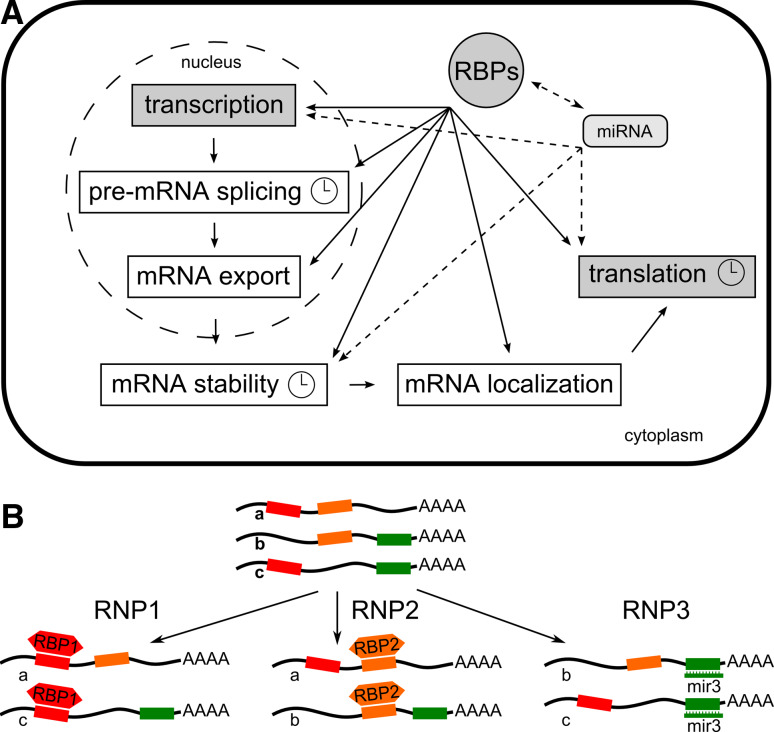
Fig. 1
Fig. 1
Post-transcriptional regulation of gene expression. a The steps of pre-mRNA processing controlled by RNA-binding proteins or microRNAs. Clock symbols denote events known to be associated with circadian regulation. b Post-transcriptional operons defined by RBPs or miRNAs binding to cognate cis-regulatory elements in mRNAs [11]
Fig. 2
Fig. 2
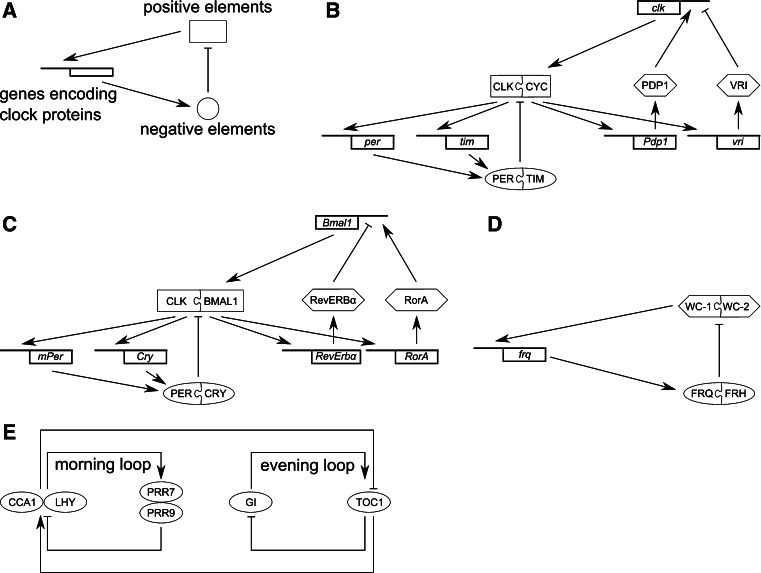
Transcriptional clock feedback loops. Common design principle (a) and model of the Drosophila (b), mammalian (c) and Neurospora (d) oscillator. See text for details. e Simplified scheme of the Arabidopsis oscillator consisting of the central CCA1/LHY-TOC1 loop, a morning-phase loop and an evening-phased loop [2, 32]
Fig. 3
Fig. 3
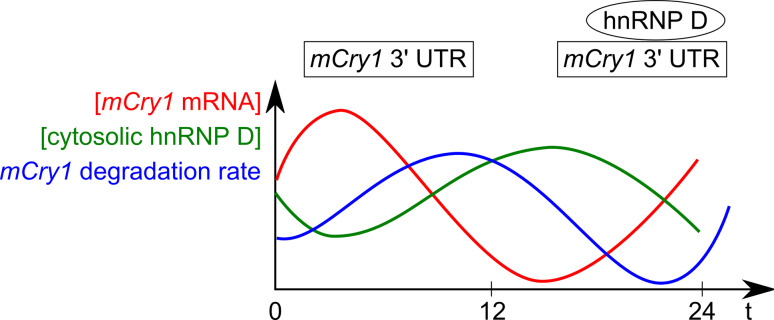
Scheme of the inverse mCry1 mRNA and cytoplasmic hnRNP D profiles. Relative levels of mCry1, hnRNP D protein abundance in the cytoplasm and mCry1 degradation rate across 1 day are shown (adapted from data in [43])
Fig. 4
Fig. 4
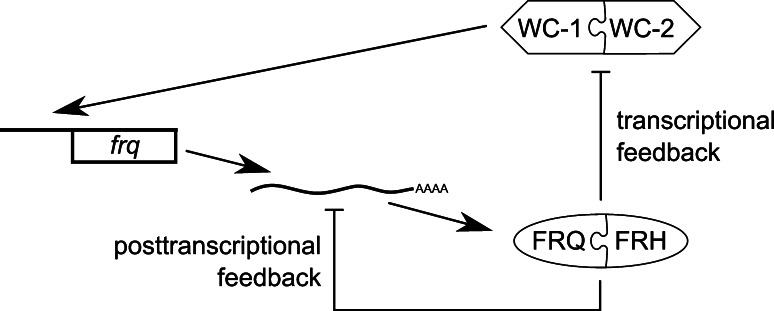
Transcriptional and post-transcriptional regulation by FRH. In the transcriptional feedback loop, FRQ and FRH inhibit WCC activity leading to repression of frq transcription. In the post-transcriptional feedback loop, FRQ and FRH promote frq decay through the exosome
Fig. 5
Fig. 5
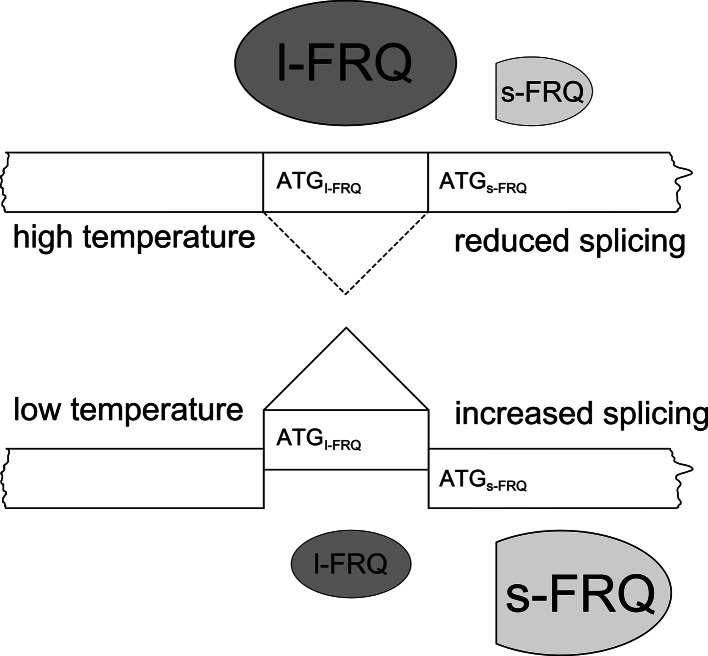
Temperature-dependent alternative splicing of an intron encompassing the l-FRQ start codon regulates the ratio of l-FRQ versus s-FRQ. The sizes of l-FRQ and s-FRQ symbols reflect their relative amounts
Fig. 6
Fig. 6
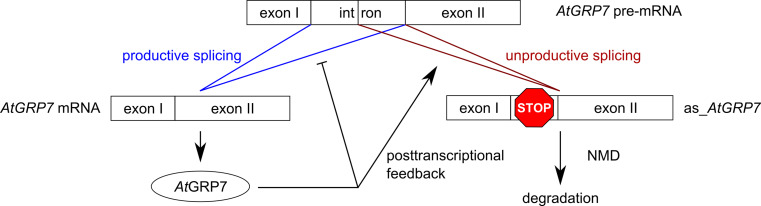
Negative autoregulation of the RNA-binding protein AtGRP7 through alternative splicing and subsequent nonsense-mediated decay (NMD) [70]. In the presence of elevated AtGRP7 protein levels a higher proportion of AtGRP7 pre-mRNA is spliced to a PTC-containing NMD substrate through binding of AtGRP7 to its own intron and subsequent use of a cryptic intronic 5′splice site. The alternative splice form (as_AtGRP7) contains a PTC and is degraded via NMD
Fig. 7
Fig. 7
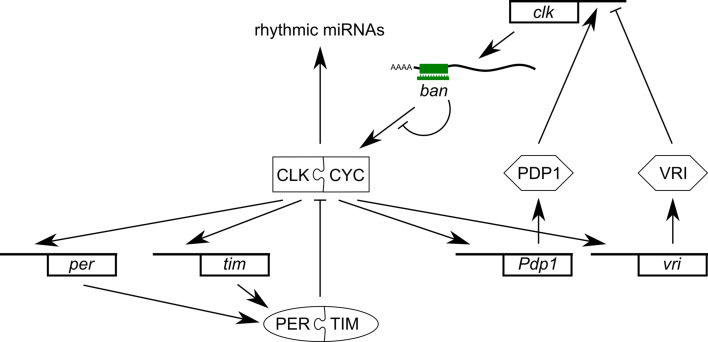
Involvement of the miRNAs in the Drosophila circadian system. The core oscillator controls rhythmic expression of a number of miRNAs [93]. The bantam miRNA targets the oscillator component CLK through interaction with its 3′UTR [94]

References

    1. Gachon F, Nagoshi E, Brown SA, Ripperger J, Schibler U. The mammalian circadian timing system: from gene expression to physiology. Chromosoma. 2004;113:103–112. - PubMed
    1. Mas P. Circadian clock function in Arabidopsis thaliana: time beyond transcription. Trends Cell Biol. 2008;18:273–281. - PubMed
    1. Schöning JC, Staiger D. At the pulse of time: protein interactions determine the pace of circadian clocks. FEBS Lett. 2005;579:3246–3252. - PubMed
    1. Gallego M, Virshup DM. Post-translational modifications regulate the ticking of the circadian clock. Nat Rev Mol Cell Biol. 2007;8:139–148. - PubMed
    1. Mehra A, Baker CL, Loros JJ, Dunlap JC. Post-translational modifications in circadian rhythms. Trends Biochem Sci. 2009;34:483–490. - PMC - PubMed

Publication types

LinkOut - more resources