


Review
doi: 10.1002/biof.117.
Epub 2010 Aug 27.
Retinoic acid: a key player in immunity
Affiliations
- PMID: 20803520
- PMCID: PMC3826167
- DOI: 10.1002/biof.117
Item in Clipboard
Review
Retinoic acid: a key player in immunity
Biofactors.
2010 Nov-Dec.
Abstract
For the past 100 years, vitamin A has been implicated as an essential dietary component in host resistance to infectious disease. However, only recently have studies begun to elucidate the cellular and molecular mechanisms of how vitamin A regulates cell-mediated and humoral-mediated immunity. In this review, we present an overview of the recent discoveries of the role that vitamin A and its metabolite, retinoic acid (RA), play in the regulation of immune cells. How RA impacts on leukocyte growth, differentiation, and homing is discussed with special attention to inflammatory responses and solid tumor microenvironment.
Copyright © 2010 International Union of Biochemistry and Molecular Biology, Inc.
Figures
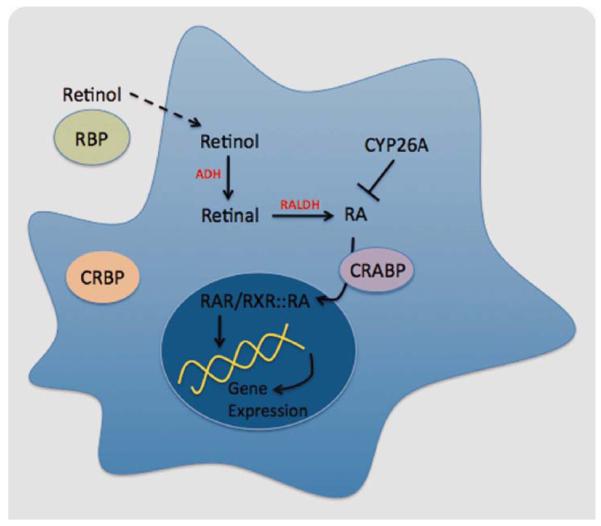
RA metabolism. Retinol gives rise to RA through the activity of different families of enzymes, including RALDH, which catalyzes the last step in an irreversible manner. Once in the cytoplasm, RA binds to CRABP and is transferred to the nucleus, where it is recognized by the nuclear receptors (RAR/RXR), and it binds to the DNA to regulate gene expression. [Color figure can be viewed in the online issue, which is available at wileyonlinelibrary.com .]

Tumor cells caused by chronic inflammation lead to systemic accumulation of MDSCs and Tregs. Both Tregs and MDSCs contribute to the immunosuppressive tumor microenvironment by inhibiting both CD4+ and CD8+ T-cell response against the tumor. Although Th17 cells have not been confirmed in all tumor models, adoptive transfer of Th17 cell can eradicate large established tumors. RA treatment can induce MDSCs differentiation to nonsuppressive DCs. These mature DC cannot inhibit the CD4+ and CD8+ T-cell response against the tumor. However, the direct effect of RA on T cells in the antitumor immunity has not elucidated yet. [Color figure can be viewed in the online issue, which is available at wileyonlinelibrary.com .]
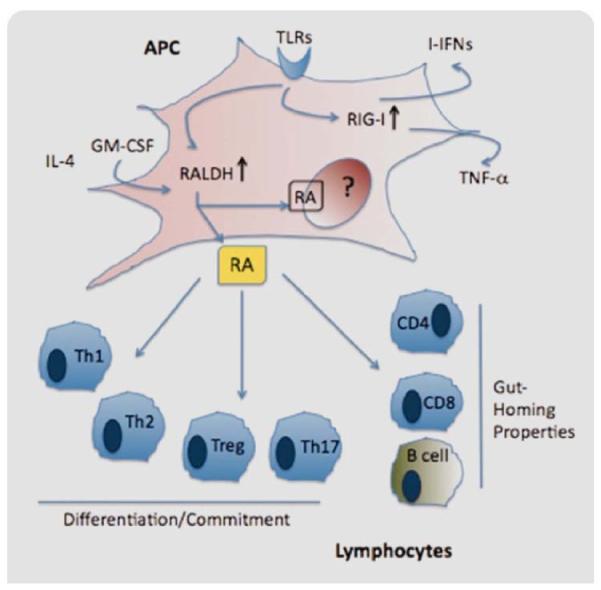
RA modulates the immune response. An inflammatory microenvironment can impact and change the phenotype of APCs as a consequence RA production. RA is known for inducing gut-homing properties on T and B lymphocytes, and for influencing the generation and differentiation of different subpopulation of T lymphocytes, which are a crucial arm of the immune response. [Color figure can be viewed in the online issue, which is available at wileyonlinelibrary.com .]
References
-
- Smith SM, Levy NS, Hayes CE. Impaired immunity in vitamin A-deficient mice. J. Nutr. 1987;117:857–865. - PubMed
-
- Duester G. Families of retinoid dehydrogenases regulating vitamin A function: production of visual pigment and retinoic acid. Eur. J. Biochem. 2000;267:4315–4324. - PubMed
-
- Baker ME. Unusual evolution of 11beta- and 17beta-hydroxysteroid and retinol dehydrogenases. Bioessays. 1996;18:63–70. - PubMed
Publication types
MeSH terms
Substances
Grants and funding
LinkOut - more resources
Full Text Sources
Miscellaneous
