Review
. 2010 Sep 3;7(3):299-313.
doi: 10.1016/j.stem.2010.08.002.

Polycomb group proteins: multi-faceted regulators of somatic stem cells and cancer

Affiliations
Review

Polycomb group proteins: multi-faceted regulators of somatic stem cells and cancer

Martin Sauvageau et al. Cell Stem Cell. .

Abstract

Polycomb Group (PcG) proteins are transcriptional repressors that epigenetically modify chromatin and participate in the establishment and maintenance of cell fates. These proteins play important roles in both stem cell self-renewal and in cancer development. Our understanding of their mechanism of action has greatly advanced over the past 10 years, but many unanswered questions remain. In this review, we present the currently available experimental data that connect PcG protein function with some of the key processes which govern somatic stem cell activity. We also highlight recent studies suggesting that a delicate balance in PcG gene dosage is crucial for proper stem cell homeostasis and prevention of cancer stem cell development.


Figures

Figure 1
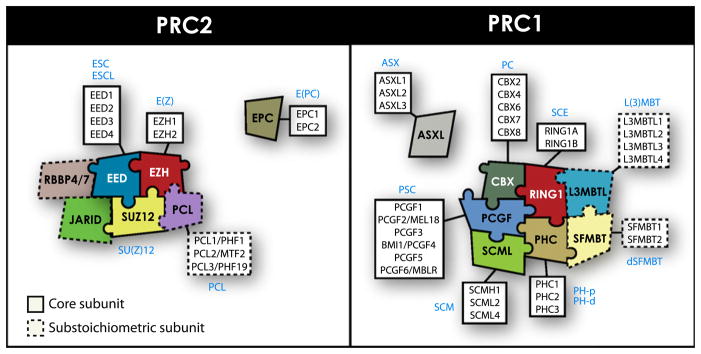
Figure 1. Diversity of PRC1 and PRC2 Complexes Formed by Vertebrate PcG Proteins
Subunits of the PRC1 (right panel) and PRC2 (left panel) complexes are indicated. The Drosophila homolog of each subunit is indicated in light blue. Multiple combinations of paralog subunits can generate a diversity of PRC1 and PRC2 complexes, which likely have specific and shared functions. Some subunits seem to be present in substoichiometric amounts and interact with the PcG complexes in a cell-context-dependent manner. The core subunits and the substoichiometric subunits are identified. The contacts illustrated in the diagrams are not intended to represent the actual interactions. Involvement of EPC and ASXL subunits with PRC2 or PRC1 complexes is still unclear and requires further investigations.
Figure 2
Figure 2. Coordinated Epigenetic Silencing Activity of PcG Complexes
Following recruitment of the PRC2 complex to chromatin, the histone methyl-transferase EZH1/2 catalyzes the trimethylation of the lysine 27 of histone H3 (H3K27me3). Subsequent recruitment of the PRC1 complex occurs in part through affinity binding of the chromodomain of the CBX subunit to the H3K27me3 covalent mark. The PRC1 RING1 E3 ligase then monoubiquitylates the lysine 119 of histone H2A (H2AK119ub1), which was proposed to consolidate transcriptional repression by preventing access to chromatin remodelers, inhibiting RNA polymerase II-dependent transcriptional elongation and facilitating chromatin compaction (Francis et al., 2004; Zhou et al., 2008). PRC1 has also been reported to be targeted to chromatin independently of PRC2 (Boyer et al., 2006; Ku et al., 2008; Schoeftner et al., 2006). The ASXL subunit has recently been found to be involved in a H2A deubiquitinase complex required for PcG-mediated repression, but its precise role remains unclear.
Figure 3
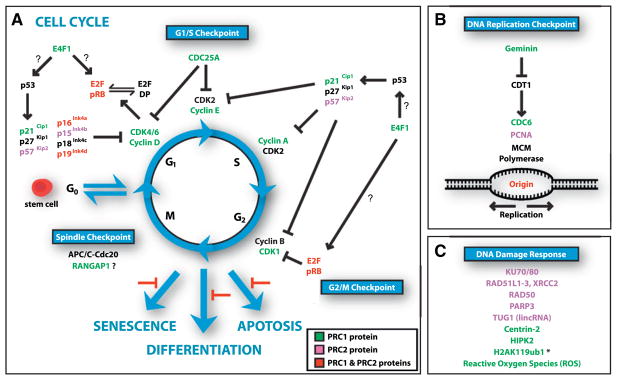
Figure 3. Regulation of Cell-Cycle Checkpoints and DNA Damage Repair Pathways by PcG
(A) The essential role of PcG proteins in somatic stem cell self-renewal is multifaceted. It involves the regulation of several cell-cycle checkpoints, DNA damage repair pathways, control of differentiation, and prevention of senescence and apoptosis programs. Cell-cycle regulators directly interacting with or repressed by PRC1 and/or PRC2 proteins are indicated in green (PRC1), purple (PRC2), and red (PRC1 and PRC2). The question mark indicates that the role of PcG proteins in the process remains to be confirmed. (B) PRC1 proteins directly interact with Geminin and mediate its degradation, thereby stabilizing the DNA replication licensing factor CDT1. PcG proteins also interact with CDC6, colocalize with PCNA, and associate with late DNA replication origins. (C) PcG proteins play an important role in maintaining genome integrity by regulating and interacting with multiple proteins and long noncoding RNAs (lincRNA) involved in DNA damage repair pathways. They also appear to participate in reactive oxygen species metabolism. The asterisk indicates that the involvement of the PRC1 complex in DNA damage-induced monoubiquitylation of lysine 119 of histone H2A (H2AK119ub1) remains unclear. The color code in (B) and (C) is the same as in (A).
Figure 4
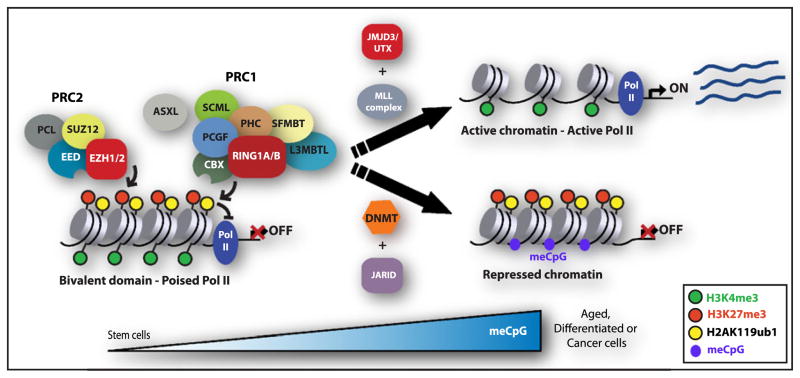
Figure 4. Resolution of Bivalent Chromatin Domains and DNA Methylation of PcG Target Genes
In stem cells, a large proportion of developmental regulators carry simultaneously both PcG-mediated H3K27me3 and H2AK119ub1 marks and the H3K4me3 modifications associated with repressive and active chromatin states, respectively. While remaining silent, these “bivalent” loci are maintained in a poised state ready for activation, given that a nonprocessive form of RNA polymerase II phosphorylated at serine 5 localizes to these loci (poised RNA Pol II). Following differentiation, these domains are resolved and retain chromatin modifications denoting either completely repressed (loss of H3K4me3) or activated (loss of H3K27me3 and H2AK119ub1) state. Resolution of the “bivalent” domains appears to require the H3K4me3 JARID demethylases (for repression) or the H3K27me3 demethylases (JMJD3/UTX) and MLL complexes (for activation). PRC1 and PRC2 proteins control DNA methylation by directly interacting with DNA methyltransferases (DNMT).
Figure 5
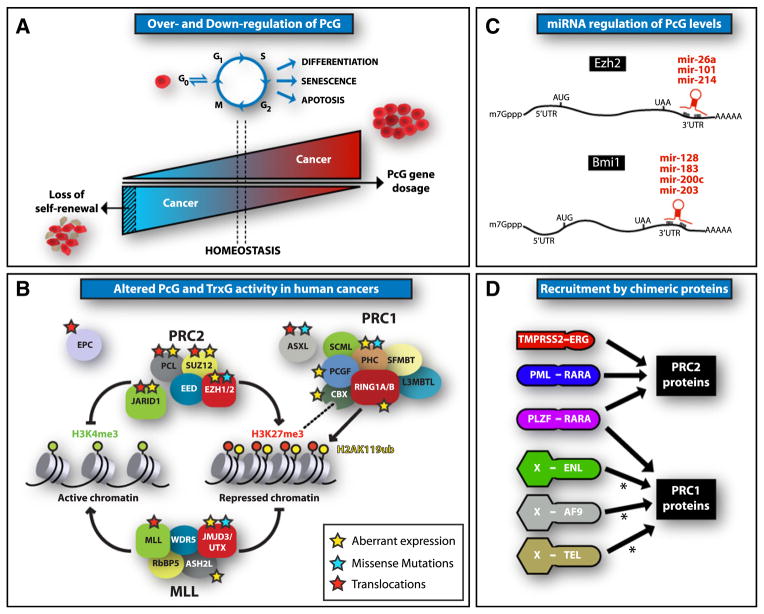
Figure 5. Deregulation of PcG Activity in Cancer
(A) Proposed model for PcG gene dosage and its effect on stem cells and cancer development. Briefly, adequate PcG gene expression levels seem to be essential to maintain homeostasis and normal stem cell function. Gain or loss of PcG functions, such as deregulated expression or mutations, lead to increased tumor development, possibly by modifying the composition or perturbing the stoichiometry of the complexes. In turn, complete ablation of PcG activity appears to be detrimental and leads to impaired self-renewal and loss of stem cells. (B) Schematic representation of the balance between PcG-mediated H3K27me3 and MLL complex-mediated H3K4me3 modifications in the maintenance of a transcriptional program. The function of many proteins from these complexes is altered by aberrant expression (yellow star), by missense mutations (blue star), or by chromosomal translocations (red star) in human cancers (Agger et al., 2009; Dalgliesh et al., 2010; Krivtsov and Armstrong, 2007; van Haaften et al., 2009; Wang et al., 2009; Xiang et al., 2007), likely leading to changes in transcriptional programs and cell states. (C) Expression of Ezh2 and Bmi1 is regulated at the post-transcriptional level by miRNAs, targeting their 3′UTR, leading to transcript degradation. (D) Multiple chimeric proteins resulting from chromosomal translocations found in human cancers interact with PRC1 and PRC2 complexes and appear to recruit them to target genes. AF9. ENL and TEL are found in multiple chromosomal translocation-derived fusion proteins in human cancers. The asterisk indicates that, although actual recruitment of PRC1 by the fusion proteins remains to be proven, the AF9, ENL, and TEL domains interacting with PRC1 proteins are present in the fusion proteins and are essential for their oncogenic activity (Boccuni et al., 2003; García-Cuéllar et al., 2001; Hemenway et al., 2001).

References

    1. Agger K, Cloos PA, Rudkjaer L, Williams K, Andersen G, Christensen J, Helin K. The H3K27me3 demethylase JMJD3 contributes to the activation of the INK4A-ARF locus in response to oncogene- and stress-induced senescence. Genes Dev. 2009;23:1171–1176. - PMC - PubMed
    1. Agherbi H, Gaussmann-Wenger A, Verthuy C, Chasson L, Serrano M, Djabali M. Polycomb mediated epigenetic silencing and replication timing at the INK4a/ARF locus during senescence. PLoS ONE. 2009;4:e5622. - PMC - PubMed
    1. Akasaka T, Takahashi N, Suzuki M, Koseki H, Bodmer R, Koga H. MBLR, a new RING finger protein resembling mammalian Polycomb gene products, is regulated by cell cycle-dependent phosphorylation. Genes Cells. 2002;7:835–850. - PubMed
    1. Al-Hajj M, Wicha MS, Benito-Hernandez A, Morrison SJ, Clarke MF. Prospective identification of tumorigenic breast cancer cells. Proc Natl Acad Sci USA. 2003;100:3983–3988. - PMC - PubMed
    1. Attwooll C, Oddi S, Cartwright P, Prosperini E, Agger K, Steensgaard P, Wagener C, Sardet C, Moroni MC, Helin K. A novel repressive E2F6 complex containing the polycomb group protein, EPC1, that interacts with EZH2 in a proliferation-specific manner. J Biol Chem. 2005;280:1199–1208. - PubMed

Publication types

Grants and funding