


Diabetes, glycemic control, and new-onset heart failure in patients with stable coronary artery disease: data from the heart and soul study
- PMID: 20805280
- PMCID: PMC2928369
- DOI: 10.2337/dc10-0286
Diabetes, glycemic control, and new-onset heart failure in patients with stable coronary artery disease: data from the heart and soul study
Abstract
Objective: Diabetes is a predictor of both coronary artery disease (CAD) and heart failure. It is unknown to what extent the association between diabetes and heart failure is influenced by other risk factors for heart failure.
Research design and methods: We evaluated the association of diabetes and A1C with incident heart failure in outpatients with stable CAD and no history of heart failure (average follow-up 4.1 years).
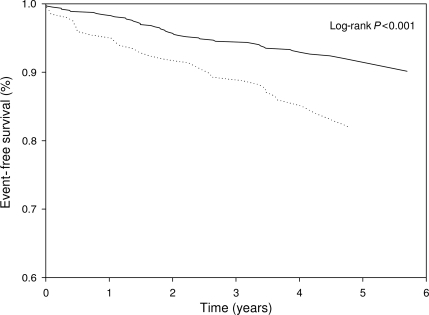
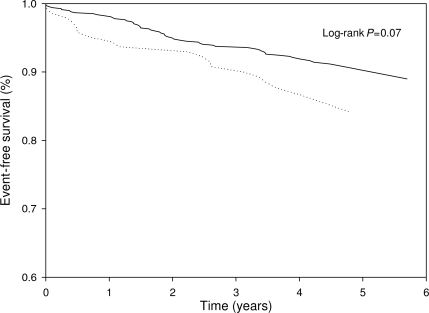
Results: Of 839 participants, 200 had diabetes (23.8%). Compared with patients who did not have diabetes, those with diabetes had an increased risk of heart failure (hazard ratio [HR] 2.17 [95% CI 1.37-3.44]). Adjustment for risk factors for CAD (age, sex, race, smoking, physical inactivity, obesity, blood pressure, and LDL cholesterol), interim myocardial infarction, and myocardial ischemia did not alter the strength of the association between diabetes and heart failure. After inclusion also of other risk factors for heart failure (left ventricular ejection fraction, diastolic dysfunction, and C-reactive protein) and medication use, diabetes remained an independent predictor of heart failure (HR 3.34 [95% CI 1.65-6.76]; P = 0.001). Each 1% increase in A1C concentration was associated with a 36% increased HR of heart failure hospitalization (HR 1.36 [95% CI 1.17-1.58]).
Conclusions: In patients with stable CAD who are free from heart failure at baseline, diabetes and glycemic control are independent risk factors for new-onset heart failure. The mechanisms by which diabetes and hyperglycemia lead to heart failure deserve further study, as the association is independent of baseline functional assessment of ischemia, systolic and diastolic function, and interim myocardial infarction.
Figures
Comment in
-
Diabetes and heart failure in patients with coronary disease: separating markers from mediators.Diabetes Care. 2010 Sep;33(9):2120-2. doi: 10.2337/dc10-1123. Diabetes Care. 2010. PMID: 20805283 Free PMC article. No abstract available.
References
-
- Hunt SA, Abraham WT, Chin MH, Feldman AM, Francis GS, Ganiats TG, Jessup M, Konstam MA, Mancini DM, Michl K, Oates JA, Rahko PS, Silver MA, Stevenson LW, Yancy CW: 2009 Focused update incorporated into the ACC/AHA 2005 Guidelines for the Diagnosis and Management of Heart Failure in Adults: A Report of the American College of Cardiology Foundation/American Heart Association Task Force on Practice Guidelines Developed in Collaboration with the International Society for Heart and Lung Transplantation. J Am Coll Cardiol 2009;53:e1–e90 - PubMed
-
- Dickstein K, Cohen-Solal A, Filippatos G, McMurray JJ, Ponikowski P, Poole-Wilson PA, Strömberg A, van Veldhuisen DJ, Atar D, Hoes AW, Keren A, Mebazaa A, Nieminen M, Priori SG, Swedberg K, Vahanian A, Camm J, De Caterina R, Dean V, Dickstein K, Filippatos G, Funck-Brentano C, Hellemans I, Kristensen SD, McGregor K, Sechtem U, Silber S, Tendera M, Widimsky P, Zamorano JL, Tendera M, Auricchio A, Bax J, Böhm M, Corrà U, della Bella P, Elliott PM, Follath F, Gheorghiade M, Hasin Y, Hernborg A, Jaarsma T, Komajda M, Kornowski R, Piepoli M, Prendergast B, Tavazzi L, Vachiery JL, Verheugt FW, Zamorano JL, Zannad F: ESC guidelines for the diagnosis and treatment of acute and chronic heart failure 2008: the Task Force for the Diagnosis and Treatment of Acute and Chronic Heart Failure 2008 of the European Society of Cardiology. Developed in collaboration with the Heart Failure Association of the ESC (HFA) and endorsed by the European Society of Intensive Care Medicine (ESICM). Eur J Heart Fail 2008;10:933–989 - PubMed
-
- He J, Ogden LG, Bazzano LA, Vupputuri S, Loria C, Whelton PK: Risk factors for congestive heart failure in US men and women: NHANES I epidemiologic follow-up study. Arch Intern Med 2001;161:996–1002 - PubMed
-
- Thrainsdottir IS, Aspelund T, Gudnason V, Malmberg K, Sigurdsson G, Thorgeirsson G, Hardarson T, Rydén L: Increasing glucose levels and BMI predict future heart failure experience from the Reykjavík Study. Eur J Heart Fail 2007;9:1051–1057 - PubMed
-
- Varela-Roman A, Grigorian Shamagian L, Barge Caballero E, Mazon Ramos P, Rigueiro Veloso P, Gonzalez-Juanatey JR: Influence of diabetes on the survival of patients hospitalized with heart failure: a 12-year study. Eur J Heart Fail 2005;7:859–864 - PubMed
MeSH terms
LinkOut - more resources
Full Text Sources
Medical
Research Materials
Miscellaneous
