. 2010 Sep;64(3):672-9.
doi: 10.1002/mrm.22448.

Prospective motion correction for single-voxel 1H MR spectroscopy

Affiliations

Prospective motion correction for single-voxel 1H MR spectroscopy

Brian Keating et al. Magn Reson Med. 2010 Sep.

Abstract

Head motion during (1)H MR spectroscopy acquisitions may compromise the quality and reliability of in vivo metabolite measurements. Therefore, a three-plane image-based motion-tracking module was integrated into a single-voxel (1)H MR spectroscopy (point-resolved spectroscopy) sequence. A series of three orthogonal spiral navigator images was acquired immediately prior to the MR spectroscopy water suppression module in order to estimate head motion. By applying the appropriate rotations and translations, the MR spectroscopy voxel position can be updated such that it remains stationary with respect to the brain. Frequency and phase corrections were applied during postprocessing to reduce line width and restore coherent averaging. Spectra acquired during intentional head motion in 11 volunteers demonstrate reduced lipid contamination and increased spectral reproducibility when motion correction is applied.


Figures

FIG. 1
FIG. 1
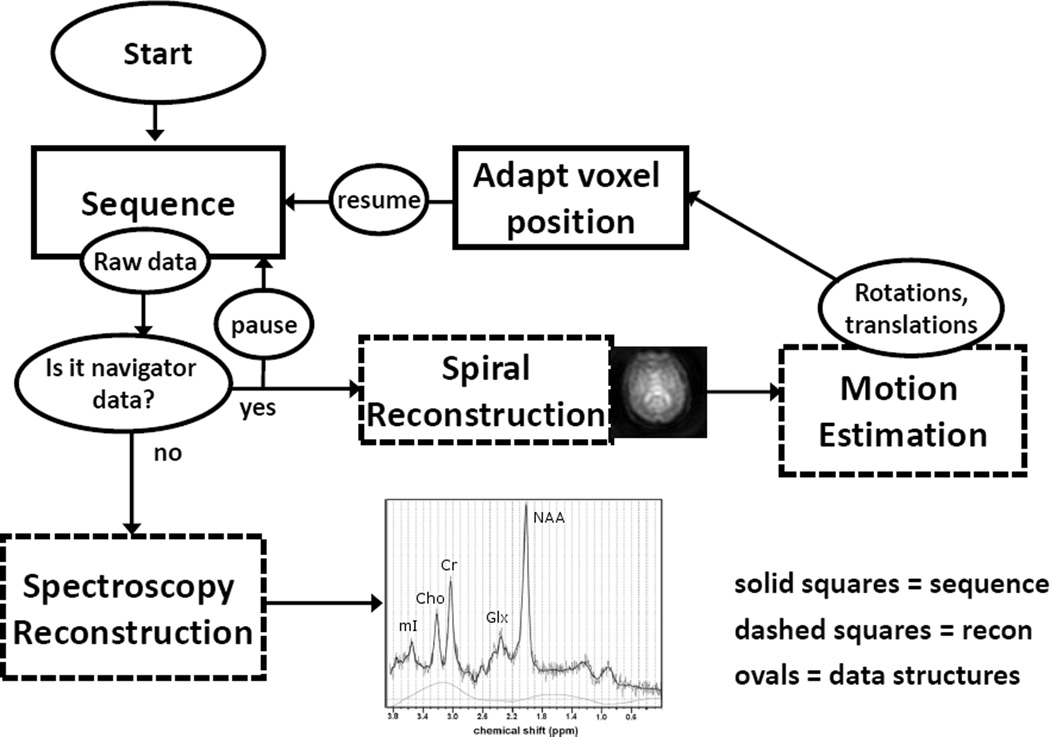
The navigated sequence pipeline. Solid squares represent sequence calculations, dashed boxes are reconstruction computations and ovals represent data structures. It is necessary to explicitly pause the sequence pre-calculation before the PRESS excitation to ensure the sequence does not calculate the gradient and RF waveforms before updated motion data are available.
FIG. 2
FIG. 2
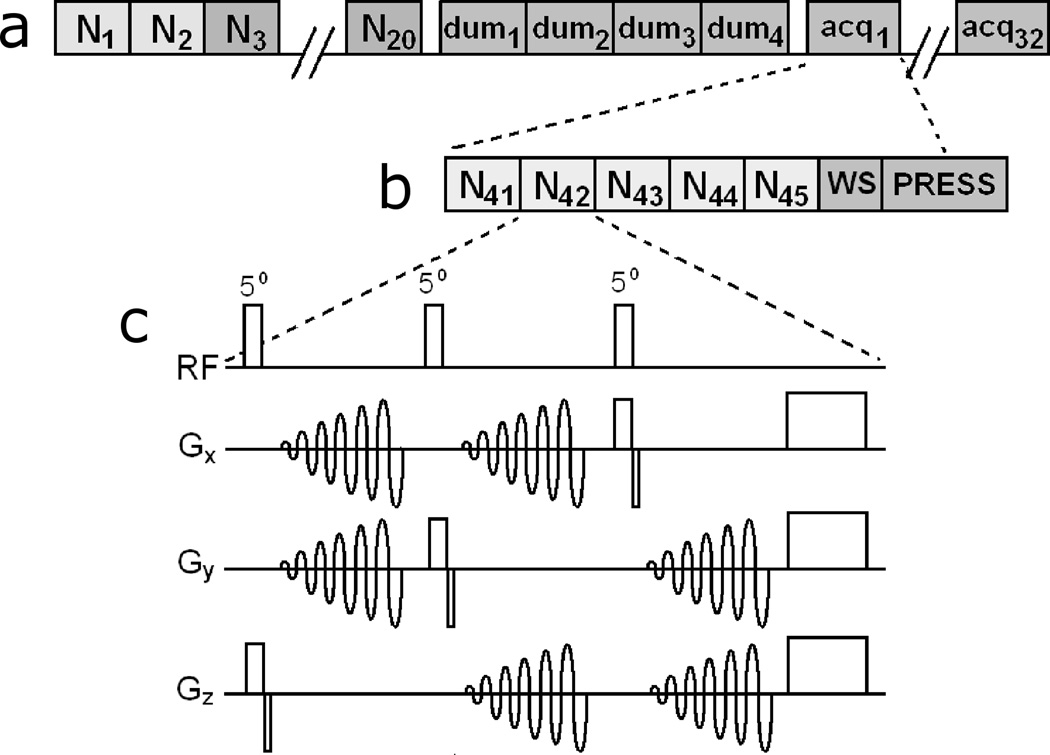
(a) Diagram of the complete navigated PRESS sequence. (b) A zoomed in view, depicting the navigators in one PRESS acquisition. Both dummy and actual acquisitions are preceded by five spiral navigators. (c) The gradient and rf waveforms for a single three-slice navigator. Each “N” here refers to the entire module depicted in (c), plus a 200ms pause for reconstruction, motion estimation and feedback. N1 and N2 are used to create field maps, N3–N20 project brain masks on the navigator planes (Fig. 2) and subsequent navigators track the head motion.
FIG. 3
FIG. 3
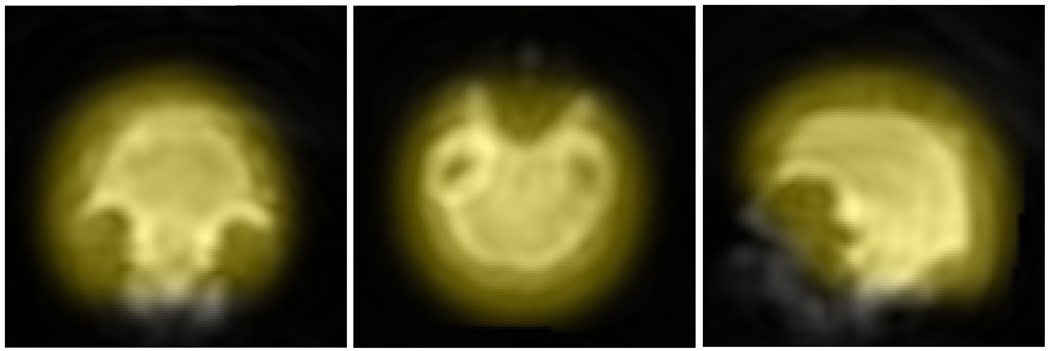
Typical navigator images with brain masks overlaid in yellow. Coronal (left) axial (center) and sagittal (right) slices.
FIG. 4
FIG. 4
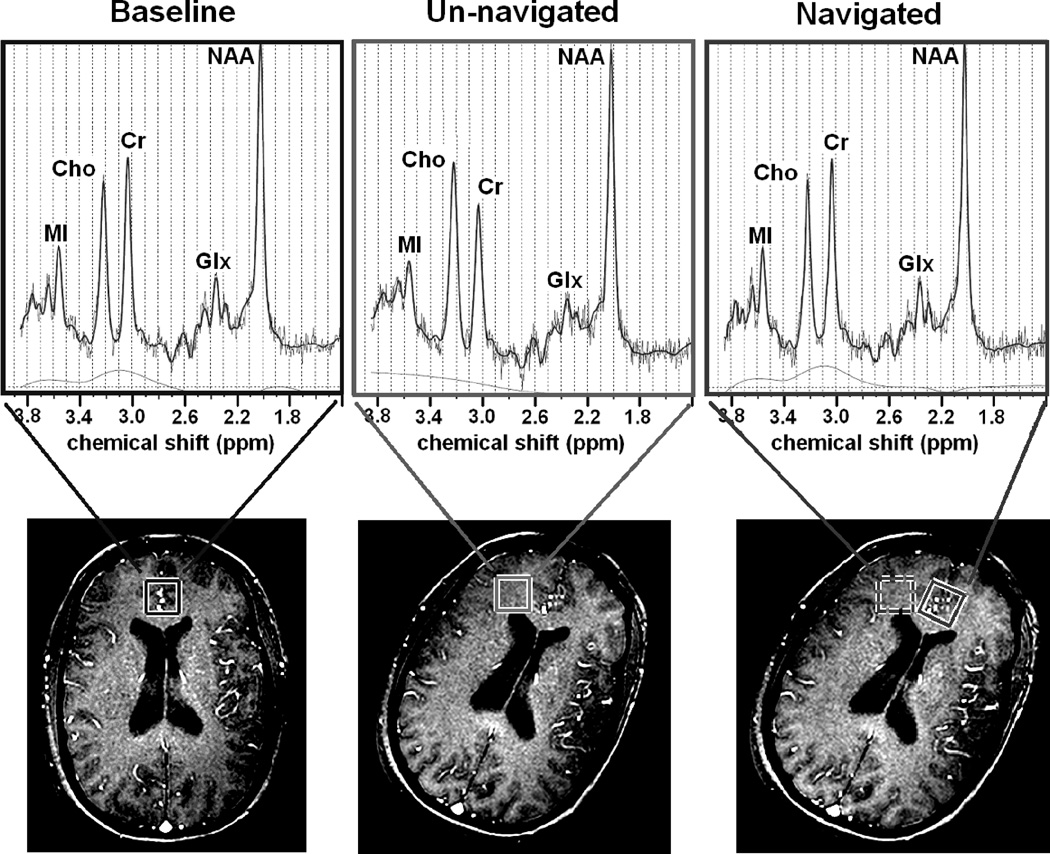
Top row: spectra acquired from baseline (left), un-navigated (center) and navigated (right) scans. Bottom row: pilot gradient echo images taken immediately after each scan. All scans started with the head in the baseline orientation (bottom left). In the baseline scan, no motion was performed. In the navigated and un-navigated cases, the motion was similar: a 21° (un-navigated) or 25° (navigated) z-rotation. Translations and other rotations were small. For all scans, the voxel was initially placed in the medial frontal grey matter and subjects were instructed perform the rotation early in the scan -- most of the acquisitions for the navigated and un-navigated spectra were acquired after the motion was performed.
FIG. 5
FIG. 5
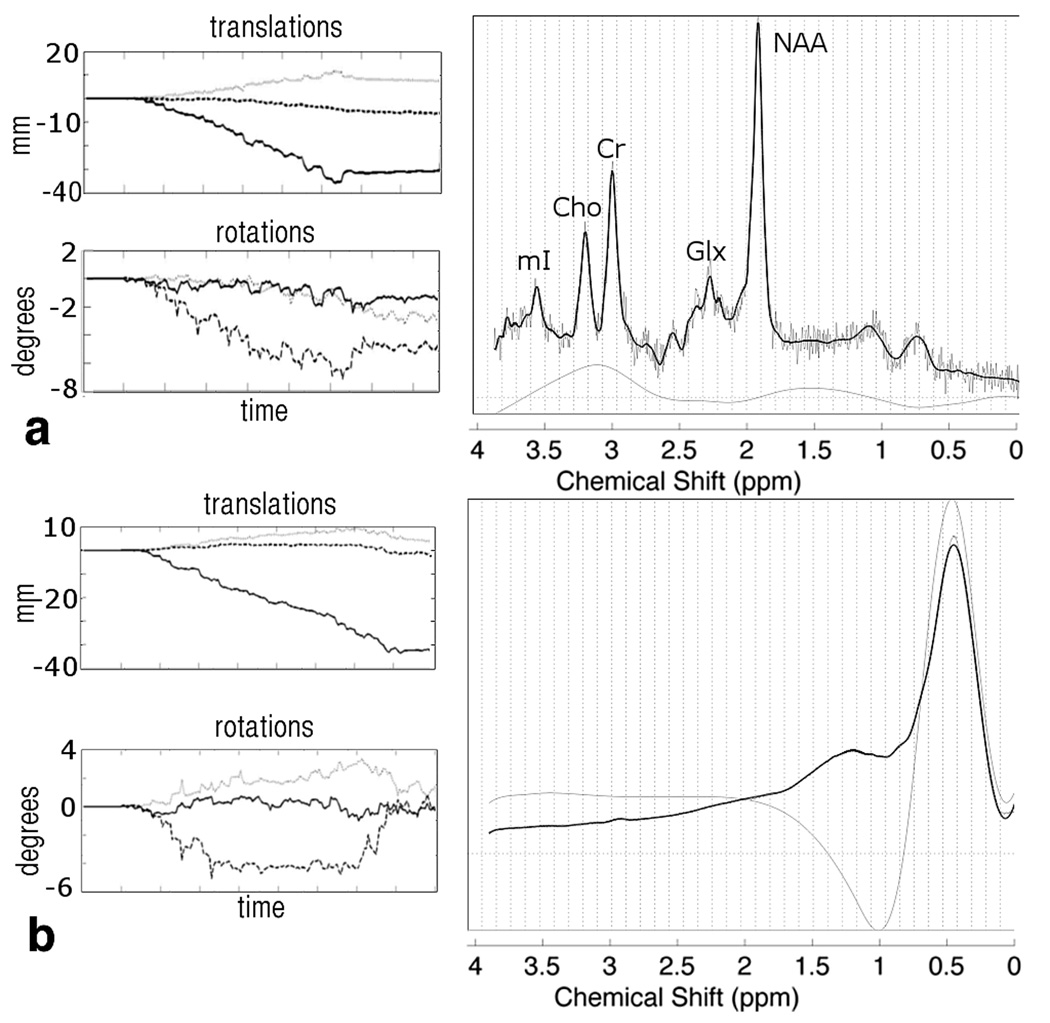
Motion plots and spectra for the navigated and un-navigated scans in one subject who performed a –z translation. In the motion plots, dashed lines refers to x-, grays lines to y- and black lines to z-rotations and translations. In the un-navigated case (a), the lipid signal dominates the spectrum, making quantification of metabolite concentrations impossible. In the navigated case (b), the voxel remains away from the skull, and a useable spectrum is obtained.

References

    1. Frahm JMH, Haenicke W. Localized high-resolution proton NMR spectroscopy using stimulated echoes: initial applications to human brain in vivo. J Magn Reson. 1987;72:502–508. - PubMed
    1. Bottomley PA. Spatial localization in NMR spectroscopy in vivo. Ann N Y Acad Sci. 1987;508:333–348. - PubMed
    1. Star-Lack JM, Adalsteinsson E, Gold GE, Spielman DM. ISMRM. Sydney, Australia: 1998. Motion correction and lipid suppression for in vivo 1H MRS — applications to the study of the human kidney and liver; p. 1472.
    1. Bhattacharyya PK, Lowe MJ, Phillips MD. Spectral quality control in motion-corrupted single-voxel J-difference editing scans: An interleaved navigator approach. Magn Reson Med. 2007;58(4):808–812. - PubMed
    1. Thiel T, Czisch M, Elbel GK, Hennig J. Phase coherent averaging in magnetic resonance spectroscopy using interleaved navigator scans: Compensation of motion artifacts and magnetic field instabilities. Magn Reson Med. 2002;47(6):1077–1082. - PubMed

Publication types