


Non-alcoholic steatohepatitis and influence of age and gender on histopathologic findings
- PMID: 20806434
- PMCID: PMC2932921
- DOI: 10.3748/wjg.v16.i33.4169
Non-alcoholic steatohepatitis and influence of age and gender on histopathologic findings
Abstract
Aim: To characterize the histopathologic specifications of non-alcoholic steatohepatitis (NASH) according to age and gender.
Methods: An analytical cross-sectional study was conducted in two private gastroenterology clinics on biopsy proven patients suffering from NASH. Biopsy histopathologic findings as well as demographic and laboratory data of the patients at the time of biopsy were gathered retrospectively from clinical records. The grading and staging of histopathologic findings were performed according to the Brunt method after reevaluation of the slides by a pathologist. Patients were divided into two groups according to age (below and above 55 years). Mean quantitative grade of all pathologic findings were also calculated according to Brunt scoring values.
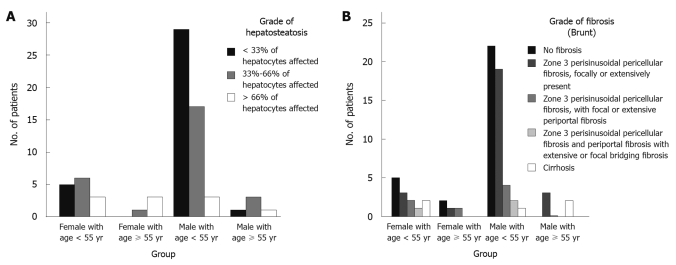
Results: A total number of 77 NASH patients, consisting of 58 males (75.3%) and 19 (24.7%) females with a mean age of 41.99 +/- 11.80 years (range, 18-70 years), were enrolled. The mean age (48.72 +/- 13.99 years vs 39.74 +/- 10.16 years, P = 0.004) and aspartate aminotransferase level (75.11 +/- 29.68 U/L vs 52.78 +/- 25.00 U/L, P = 0.002) was significantly higher in female patients. Mean quantitative grade of hepatosteatosis was significantly higher in females (2.00 +/- 0.82 vs 1.59 +/- 0.68, P = 0.031) compared to males. Fifty four percent (34/65) of young patients had mild hepatosteatosis (Grade I) while only one patient (11.2%) in the older group had grade I hepatosteatosis. Patients aged > or = 55 had significantly more severe hepatosteatosis (Grade III) (44.4% vs 9.5%, P = 0.007) and the mean quantitative grade of hepatosteatosis was significantly higher among them (2.33 +/- 0.71 vs 1.56 +/- 0.67, P = 0.002). Multivariate analysis after omitting the confounding role of age revealed a higher grade of hepatosteatosis in female patients (P = 0.010).
Conclusion: These findings point toward the possible influence of age in the severity of steatohepatitis, portal and lobar inflammation in patients suffering from NASH while gender independently might contribute to the level of steatohepatitis.
Figures
References
-
- Harrison SA, Torgerson S, Hayashi PH. The natural history of nonalcoholic fatty liver disease: a clinical histopathological study. Am J Gastroenterol. 2003;98:2042–2047. - PubMed
-
- Bacon BR, Farahvash MJ, Janney CG, Neuschwander-Tetri BA. Nonalcoholic steatohepatitis: an expanded clinical entity. Gastroenterology. 1994;107:1103–1109. - PubMed
-
- Diehl AM, Goodman Z, Ishak KG. Alcohollike liver disease in nonalcoholics. A clinical and histologic comparison with alcohol-induced liver injury. Gastroenterology. 1988;95:1056–1062. - PubMed
Publication types
MeSH terms
LinkOut - more resources
Full Text Sources
Medical
