Review
doi: 10.1126/scisignal.3137pl2.
Targeting the reversibly oxidized protein tyrosine phosphatase superfamily
Affiliations
- PMID: 20807953
- PMCID: PMC3418810
- DOI: 10.1126/scisignal.3137pl2
Item in Clipboard
Review
Targeting the reversibly oxidized protein tyrosine phosphatase superfamily
Sci Signal.
.
Abstract
Controlled production of reactive oxygen species leads to reversible oxidation of protein tyrosine phosphatases (PTPs) and has emerged as an important tier of regulation over phosphorylation-dependent signal transduction. We present a modified cysteinyl-labeling assay that detects reversible oxidation of members of each of the different PTP subclasses. Here, we describe the methods for enriching reversibly oxidized PTPs from complex protein extracts, illustrating the procedure in IMR90 fibroblasts.
Figures
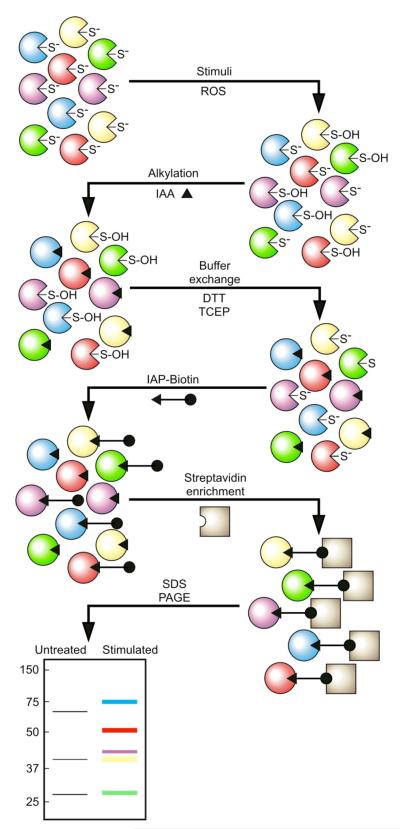
Profiling of reversible PTP oxidation. The catalytic Cys residue of members of the PTP family of enzymes is present as a thiolate under basal cellular conditions. This feature makes it a good nucleophile at neutral pH and allows it to react with phospho–amino acid residues, ROS, or certain sulhydryl-reactive compounds. After a stimulus that generates localized production of ROS, the active-site Cys residue of those specific PTPs that encounter the ROS becomes oxidized, and PTP activity is abrogated. The pool of reversibly oxidized PTPs is represented by a sulfenic acid (S-OH). In the first step of the assay, the active-site Cys residue of those PTPs that were not modified by second messenger ROS molecules in vivo is modified irreversibly by alkylation under anaerobic conditions in vitro. In the second step, the active-site Cys residues of PTPs that were reversibly oxidized and thus protected from alkylation in the first step are reduced. DTT indicates dithiothreitol and TCEP indicates tris(2-carboxyethyl)phosphine. The third step consists of a modification in which the reduced Cys residue is modified by a biotinylated sulfhydryl-reactive probe under low-pH labeling conditions. Probe-labeled PTPs are then captured on streptavidin beads, enriched, and subjected to SDS-PAGE protein fractionation, transferred onto a nitrocellulose membrane, and detected with an antibody against biotin or a PTP-specific antibody.
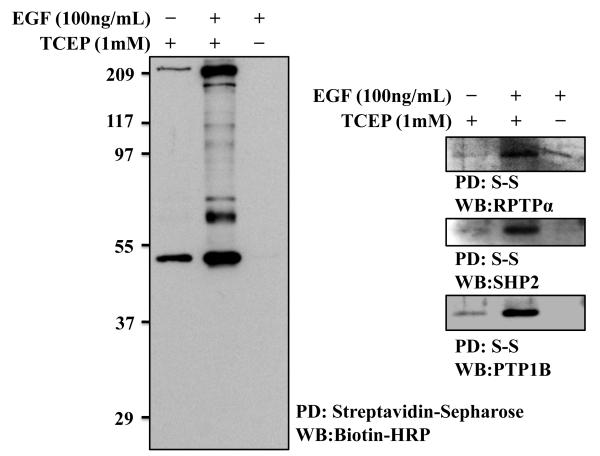
Detection of EGF–dependent reversible oxidation of PTPs in IMR90 cells. IMR90 fibroblasts were cultured to confluency in low-glucose DMEM supplemented with 10% fetal bovine serum and nonessential amino acids. On the day before the experiment, cells were serum-deprived in low-glucose DMEM without phenol red for a total of 16 hours. Healthy cells were then incubated with 100 ng/ml EGF for 2 min and transferred to an argon-equilibrated hypoxic chamber through the airlock, and the cysteinyl-labeling assay was performed. Proteins were detected with biotin-HRP, RPTPα, SHP-2, or PTP1B (FG6) antibodies. Proteins were then detected with HRP-conjugated secondary antibodies, and the immunoreactive bands were visualized by ECL. Reversible oxidation of RPTPα, SHP-2, and PTP1B was observed upon 2 min of EGF stimulation in IMR90 cells. IAP labeling detected the reversible oxidation of PTPs specifically because no immunoreactive band was visualized when TCEP was omitted from the reducing step. Probing for biotinylated PTPs with biotin-HRP revealed an increase in staining of several bands, confirming the successful enrichment of multiple reversibly oxidized proteins. PD, Pull-down; WB, Western Blot.
References
-
- Gruber J, Schaffer S, Halliwell B. The mitochondrial free radical theory of ageing—Where do we stand? Front. Biosci. 2008;13:6554–6579. - PubMed
-
- Valko M, Leibfritz D, Moncol J, Cronin MT, Mazur M, Telser J. Free radicals and antioxidants in normal physiological functions and human disease. Int. J. Biochem. Cell Biol. 2007;39:44–84. - PubMed
-
- Storz P. Reactive oxygen species in tumor progression. Front. Biosci. 2005;10:1881–1896. - PubMed
-
- Azad MB, Chen Y, Gibson SB. Regulation of autophagy by reactive oxygen species (ROS): Implications for cancer progression and treatment. Antioxid. Redox Signal. 2009;11:777–790. - PubMed
Publication types
MeSH terms
Substances
Grants and funding
LinkOut - more resources
Full Text Sources
Other Literature Sources