


Penetration of nutrition information on food labels across the EU-27 plus Turkey
- PMID: 20808336
- PMCID: PMC2996514
- DOI: 10.1038/ejcn.2010.179
Penetration of nutrition information on food labels across the EU-27 plus Turkey
Abstract
Objectives: The European Union (EU)-funded project Food Labelling to Advance Better Education for Life (FLABEL) aims to understand how nutrition information on food labels affects consumers' dietary choices and shopping behaviour. The first phase of this study consisted of assessing the penetration of nutrition labelling and related information on various food products in all 27 EU Member States and Turkey.
Methods: In each country, food products were audited in three different types of retailers to cover as many different products as possible within five food and beverage categories: sweet biscuits, breakfast cereals, pre-packed chilled ready meals, carbonated soft drinks and yoghurts.
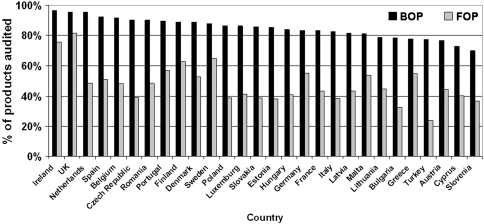
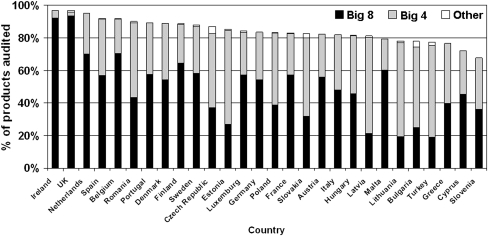
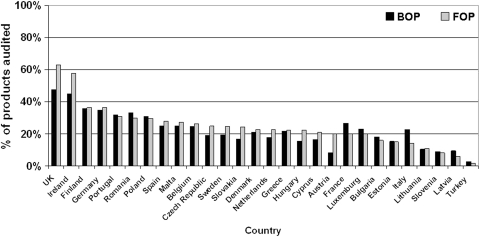
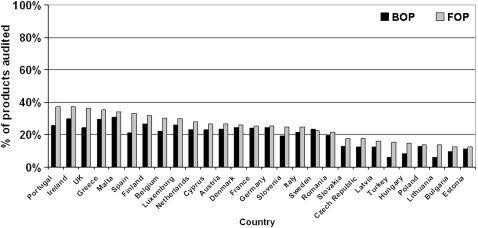
Results: More than 37 000 products were audited in a total of 84 retail stores. On average, 85% of the products contained back-of-pack (BOP) nutrition labelling or related information (from 70% in Slovenia to 97% in Ireland), versus 48% for front-of-pack (FOP) information (from 24% in Turkey to 82% in the UK). The most widespread format was the BOP tabular or linear listing of nutrition content. Guideline daily amounts labelling was the most prevalent form of FOP information, showing an average penetration of 25% across all products audited. Among categories, breakfast cereals showed the highest penetration of nutrition-related information, with 94% BOP penetration and 70% FOP penetration.
Conclusions: Nutrition labelling and related information was found on a large majority of products audited. These findings provide the basis for subsequent phases of FLABEL involving attention, reading, liking, understanding and use by consumers of different nutrition labelling formats.
Figures
References
-
- Brecher SJ, Bender MM, Wilkening VL, McCabe NM, Anderson EM. Status of nutrition labeling, health claims, and nutrient content claims for processed foods: 1997 Food Label and Package Survey. J Am Diet Assoc. 2000;100:1057–1062. - PubMed
-
- Choices International Foundation 2007 ): http://www.choicesprogramme.org/en , accessed 9 July 2009.
-
- Cinar AB, Murtomaa H. A holistic food labelling strategy for preventing obesity and dental caries. Obes Rev. 2009;10:357–361. - PubMed
-
- Cowburn G, Stockley L. Consumer understanding and use of nutrition labelling: a systematic review. Public Health Nutr. 2005;8:21–28. - PubMed
-
- EC Council Directive 90/496/EEC of 24 September 1990 on nutrition labelling for foodstuffs. OJ L. 1990;276:40–44.
Publication types
MeSH terms
LinkOut - more resources
Full Text Sources
Medical
