Review
. 2011 Jan;89(1):23-8.
doi: 10.1007/s00109-010-0677-3. Epub 2010 Aug 31.

Tailor-made inflammation: how neutrophil serine proteases modulate the inflammatory response

Affiliations
Review

Tailor-made inflammation: how neutrophil serine proteases modulate the inflammatory response

Kai Kessenbrock et al. J Mol Med (Berl). 2011 Jan.

Abstract

Neutrophil granulocytes are important mediators of innate immunity, but also participate in the pathogenesis of (auto)inflammatory diseases. Neutrophils express a specific set of proteolytic enzymes, the neutrophil serine proteases (NSPs), which are stored in cytoplasmic granules and can be secreted into the extra- and pericellular space upon cellular activation. These NSPs, namely cathepsin G (CG), neutrophil elastase (NE), and proteinase 3 (PR3), have early been implicated in bacterial defense. However, NSPs also regulate the inflammatory response by specifically altering the function of cytokines and chemokines. For instance, PR3 and NE both inactivate the anti-inflammatory mediator progranulin, which may play a role in chronic inflammation. Here, we provide a concise update on NSPs as modulators of inflammation and discuss the biological and pathological significance of this novel function of NSPs. Mounting evidence support an important proinflammatory function for PR3, which may have been underestimated in the past.


Figures
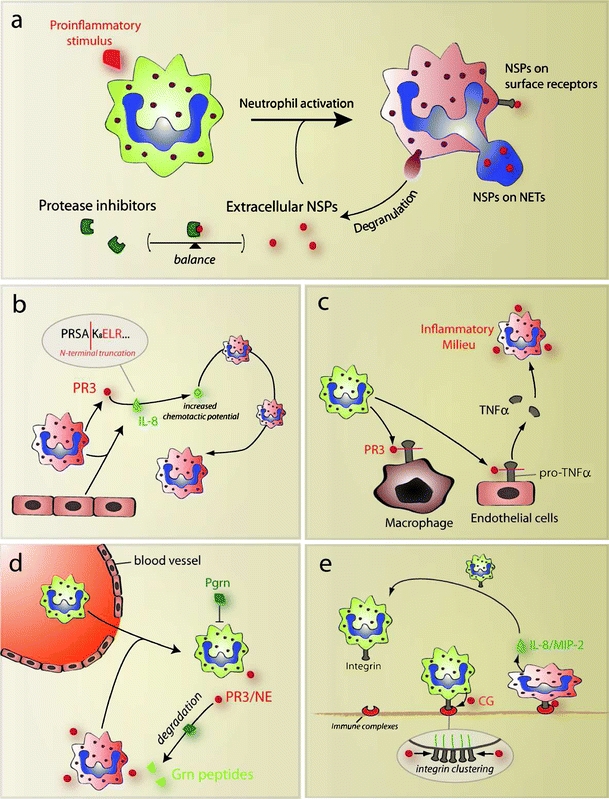
Fig. 1
Fig. 1
NSPs regulate inflammatory processes via multiple pathways. a Neutrophil activation by proinflammatory stimuli lead to increased externalization of NSPs. Activated neutrophils (red) release NSPs by degranulation, or formation of NETs. Certain fractions of NSPs are compartmentalized to cell surface receptors and stay in the pericellular environment. The function of NSPs is controlled by the balance between proteases and protease inhibitors circulating in blood and interstitial fluids. b Extracellular PR3 converts IL-8 released from neutrophils and endothelial cells by N-terminal truncation (cleavage sequence is indicated) into a more bioactive chemokine. This may potently enhance the recruitment of further neutrophils to the site of inflammation. c PR3 acts as a converting enzyme of pro-TNFα, the membrane-attached precursor of the potent proinflammatory cytokine TNFα. This may be a crucial step in the establishment of an inflammatory milieu. d Neutrophils extravasating from the vasculature are initially controlled by anti-inflammatory PGRN. PR3 and NE cooperatively enhance neutrophil activation by specifically degrading inflammation-suppressing PGRN. e CG interacts with surface integrins during the adhesion of neutrophils to immobilized immune complexes, where it promotes integrin clustering, cytoskeletal rearrangements, and subsequently the release of neutrophil attracting chemokines

References

    1. Nathan C. Neutrophils and immunity: challenges and opportunities. Nat Rev Immunol. 2006;6:173–182. doi: 10.1038/nri1785. - DOI - PubMed
    1. Brinkmann V, Reichard U, Goosmann C, Fauler B, Uhlemann Y, Weiss DS, Weinrauch Y, Zychlinsky A. Neutrophil extracellular traps kill bacteria. Science. 2004;303:1532–1535. doi: 10.1126/science.1092385. - DOI - PubMed
    1. Kessenbrock K, Krumbholz M, Schonermarck U, Back W, Gross WL, Werb Z, Grone HJ, Brinkmann V, Jenne DE. Netting neutrophils in autoimmune small-vessel vasculitis. Nat Med. 2009;15:623–625. doi: 10.1038/nm.1959. - DOI - PMC - PubMed
    1. Pham CT. Neutrophil serine proteases: specific regulators of inflammation. Nat Rev Immunol. 2006;6:541–550. doi: 10.1038/nri1841. - DOI - PubMed
    1. Segal AW. How neutrophils kill microbes. Annu Rev Immunol. 2005;23:197–223. doi: 10.1146/annurev.immunol.23.021704.115653. - DOI - PMC - PubMed

Publication types

MeSH terms
