


Liner exchange and bone grafting: rare option to treat wear & lysis of stable TKAs
- PMID: 20809171
- PMCID: PMC3008882
- DOI: 10.1007/s11999-010-1521-3
Liner exchange and bone grafting: rare option to treat wear & lysis of stable TKAs
Abstract
Background: Liner exchange and bone grafting are commonly performed for wear and osteolysis around well-fixed modular acetabular components that otherwise would require structural allografting and revision THA. However, liner exchange in the face of substantial lysis around TKA has been performed rarely with reports of failure rates of up to 25% at 3 year followup.
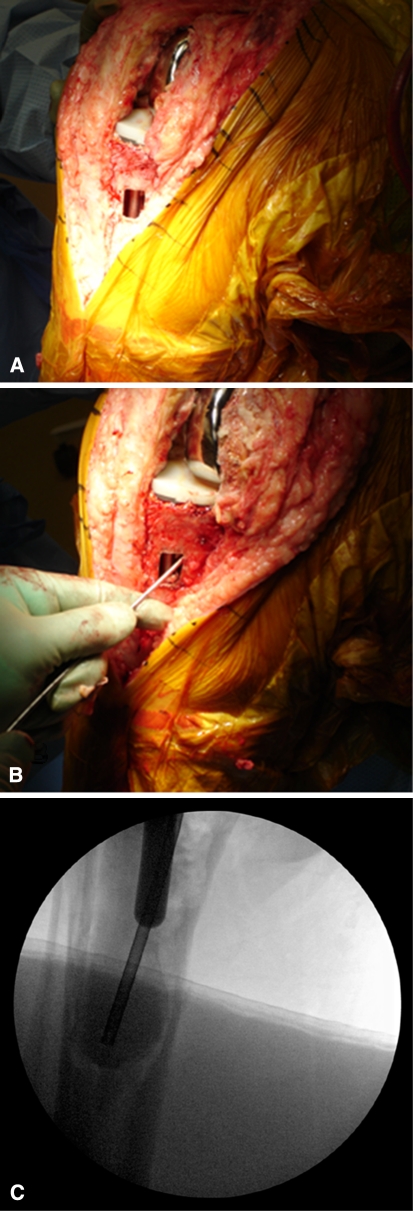
Questions/purposes: We therefore evaluated the technique of liner exchange and bone grafting for cases of wear and extensive osteolysis around TKAs in which the components were well-fixed and well-aligned to determine (1) rerevision rates; (2) fate of the bone graft; (3) radiographic loosening rates; and (4) functional scores.
Methods: We retrospectively reviewed 22 patients (25 knees) who underwent revision TKA with exchange of the modular polyethylene insert and bone grafting in cases with well-fixed components and large areas of osteolysis (up to 54 cm(2) on a single projection) at the time of revision. The average area of osteolysis was 21 cm(2) and 10 cm(2) on the AP projection of the femur and tibia, respectively. On the lateral projection, the average area of osteolysis for the femur and tibia was 22 cm(2) and 9.3 cm(2). Minimum clinical and radiographic followup was 22 and 22 months (average, 61 and 59; range, 22-142 and 22-130, respectively).
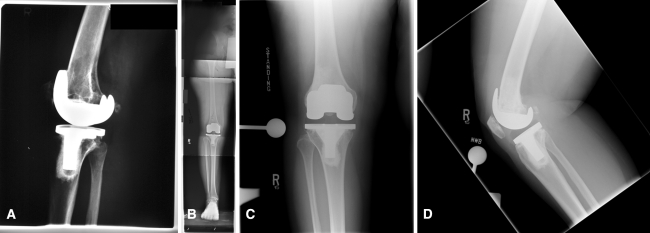
Results: One of the 25 knees was revised for aseptic loosening or recurrence of osteolysis. On radiographs, 84.6% and 70% of femoral and tibial osteolytic lesions, respectively, showed evidence of complete or near complete graft incorporation. The remaining lesions showed evidence of partial graft incorporation with the exception of one tibial lesion, which was in the revised case. All other components were well fixed with no evidence of radiographic loosening.
Conclusions: In this selected series of cases with extensive osteolysis around well-fixed and well-aligned TKAs, liner exchange and bone grafting provided durable midterm results with extensive graft incorporation.
Level of evidence: Level IV, therapeutic study. See Guidelines for Authors for a complete description of levels of evidence.
Figures
References
-
- Babis GC, Trousdale RT, Morrey BF. The effectiveness of isolated tibial insert exchange in revision total knee arthroplasty. J Bone Joint Surg Am. 2002;84:64–68. - PubMed
-
- Engh GA, Koralewicz LM, Pereles TR. Clinical results of modular polyethylene insert exchange with retention of total knee arthroplasty components. J Bone Joint Surg Am. 2000;82:516–523. - PubMed
-
- Ewald FC. The knee society total knee arthroplasty roentgenographic evaluation and scoring system. Clin Orthop Relat Res. 1989;248:9–12. - PubMed
-
- Griffin WL, Scott RD, Dalury DF, Mahoney OM, Chiavetta JB, Odum SM. Modular insert exchange in knee arthroplasty for treatment of wear and osteolysis. Clin Orthop Relat Res. 2007;464:132–137. - PubMed
MeSH terms
Substances
LinkOut - more resources
Full Text Sources
Medical
Research Materials
