


The effect of a clinical pharmacist discharge service on medication discrepancies in patients with heart failure
- PMID: 20809276
- PMCID: PMC2993887
- DOI: 10.1007/s11096-010-9433-6
The effect of a clinical pharmacist discharge service on medication discrepancies in patients with heart failure
Abstract
Objective: Heart failure patients are regularly admitted to hospital and frequently use multiple medication. Besides intentional changes in pharmacotherapy, unintentional changes may occur during hospitalisation. The aim of this study was to investigate the effect of a clinical pharmacist discharge service on medication discrepancies and prescription errors in patients with heart failure.
Setting: A general teaching hospital in Tilburg, the Netherlands.
Method: An open randomized intervention study was performed comparing an intervention group, with a control group receiving regular care by doctors and nurses. The clinical pharmacist discharge service consisted of review of discharge medication, communicating prescribing errors with the cardiologist, giving patients information, preparation of a written overview of the discharge medication and communication to both the community pharmacist and the general practitioner about this medication. Within 6 weeks after discharge all patients were routinely scheduled to visit the outpatient clinic and medication discrepancies were measured.
Main outcome measure: The primary endpoint was the frequency of prescription errors in the discharge medication and medication discrepancies after discharge combined.
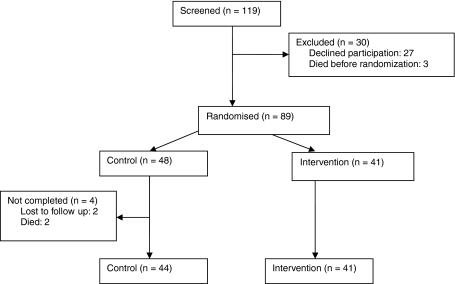
Results: Forty-four patients were included in the control group and 41 in the intervention group. Sixty-eight percent of patients in the control group had at least one discrepancy or prescription error against 39% in the intervention group (RR 0.57 (95% CI 0.37-0.88)). The percentage of medications with a discrepancy or prescription error in the control group was 14.6% and in the intervention group it was 6.1% (RR 0.42 (95% CI 0.27-0.66)).
Conclusion: This clinical pharmacist discharge service significantly reduces the risk of discrepancies and prescription errors in medication of patients with heart failure in the 1st month after discharge.
References
-
- Dickstein K, Cohen-Solal A, Filippatos G, McMurray JJ, Ponikowski P, Poole-Wilson PA et al. ESC guidelines for the diagnosis and treatment of acute and chronic heart failure 2008: the Task Force for the Diagnosis and Treatment of Acute and Chronic Heart Failure 2008 of the European Society of Cardiology. Developed in collaboration with the Heart Failure Association of the ESC (HFA) and endorsed by the European Society of Intensive Care Medicine (ESICM). Eur Heart J. 2008;29(19):2388–442. - PubMed
Publication types
MeSH terms
LinkOut - more resources
Full Text Sources
Medical
